





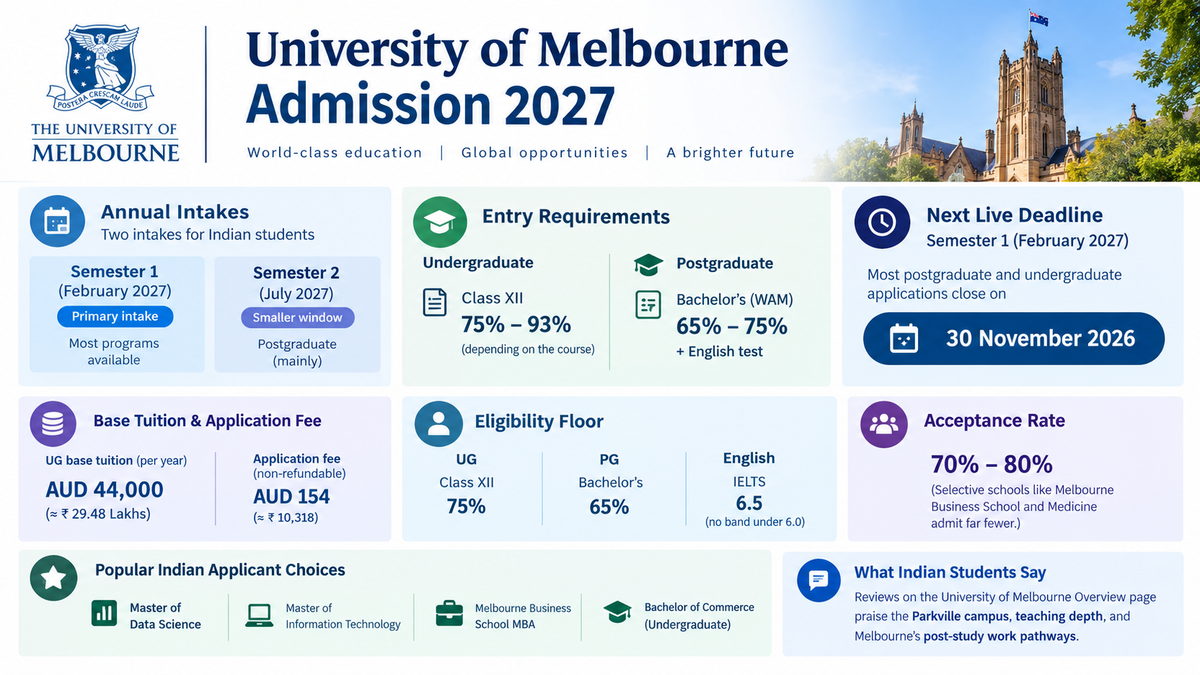
University of Melbourne admissions open two annual intakes for Indian students, with Semester 1 (February 2027) as the primary intake carrying the bulk of programs and Semester 2 (July 2027) offering a smaller postgraduate window. Undergraduate entry needs 75% to 93% in Class XII depending on the course, while postgraduate entry requires a Bachelor’s at 65 to 75% WAM an English test.
- Next live deadline: Semester 1 (February 2027), most postgraduate and undergraduate applications close on 30 November 2026.
- Base tuition and application fee: UG base tuition from AUD 44,000 (about ₹ 29.48 Lakhs) per year and the non-refundable application fee is AUD 154 (about ₹ 10,318).
- Eligibility floor: UG needs Class XII at 75%, PG needs Bachelor’s at 65%, and English needs IELTS 6.5 with no band under 6.0.
- Acceptance rate: Around 70% to 80%, though selective schools like Melbourne Business School and Medicine admit far fewer.
Popular Indian applicant choices include the Master of Data Science, Master of Information Technology, and Melbourne Business School MBA, plus the Bachelor of Commerce for undergraduate applicants. Reviews from Indian students on the University of Melbourne Overview page praise the Parkville campus, teaching depth, and Melbourne’s post-study work pathways.
Note: WAM is a numerical percentage score used by Australia universities to measure student’s overall academic achievements.
- University of Melbourne Application Deadlines for Indian Students
- UniMelb Eligibility Requirements and English Scores
- University of Melbourne Postgraduate Requirements
- University of Melbourne Undergraduate Requirements
- University of Melbourne MBA Admissions and GMAT
- University of Melbourne Application Process Step by Step
- UniMelb Documents Required for Indian Applicants
- University of Melbourne Acceptance Rate for Indians
- Australia Student Visa Process for UniMelb Admits
- Melbourne Uni Application Tips and Checklist
- FAQs
University of Melbourne Application Deadlines for Indian Students
The University of Melbourne runs two annual intakes for international students. Semester 1 opens in February and is the primary intake where nearly all undergraduate and postgraduate programs are available. Semester 2 in July admits to a smaller set of postgraduate coursework degrees. Graduate research is available year-round.
| Intake | Level | Application Deadline | App Fee |
|---|---|---|---|
| Semester 1, February 2027 (Primary intake) | Postgraduate coursework | 30 November 2026 | AUD 154 (₹ 10,318) |
| Semester 1, February 2027 (Primary intake) | Undergraduate | 30 November 2026 | AUD 154 (₹ 10,318) |
| Semester 2, July 2027 | Postgraduate coursework | 31 May 2027 | AUD 154 (₹ 10,318) |
| Semester 2, July 2027 | Undergraduate (limited programs) | 31 May 2027 | AUD 154 (₹ 10,318) |
| Graduate research (PhD) | Research (with scholarship) | 31 October 2026 (for 2027 start) | No fee |
Planning note: Application deadlines vary depending on the course. The dates in this table are eligible for most courses but always refer to the specific course page on the official university website while planning.
You can also refer to this page for course wise deadlines: Course-wise Fees and Dates
UniMelb Eligibility Requirements and English Scores
Eligibility at the University of Melbourne is set at two levels. An institution-wide floor applies to almost every applicant, and each program then adds its own subject prerequisites or higher percentage cutoffs. Indian applicants are assessed on Class XII marks for undergraduate entry and Bachelor’s percentages or GPA for postgraduate entry.
- UG general entry: Class XII at 75% to 93%, with the exact cutoff set per program.
- UG subject prerequisites: Mathematics for Commerce, Chemistry and Biology for Biomedicine, English at Class XII.
- PG coursework entry: Bachelor’s degree with 65% to 75% in a cognate discipline.
- PG research entry: Master’s degree with a research component, or a first-class Honours Bachelor’s.
The university accepts several English proficiency tests. All scores must be under two years old at the time of application.
| Test | UG Minimum | PG Minimum (Standard) | PG Minimum (Law, Medicine, Education) |
|---|---|---|---|
| IELTS Academic | 6.5 overall, no band below 6.0 | 6.5 overall, no band below 6.0 | 7.0 overall, no band below 6.5 |
| TOEFL iBT | 79 (W 21, S 18, R 13, L 13) | 79 (W 21, S 18, R 13, L 13) | 94 (W 27, S 24, R 24, L 24) |
| PTE Academic | 58 | 58 | 65 |
University of Melbourne English Language Waivers for Indian Students
Indian applicants may skip the English test in a few narrow cases. Most India-schooled candidates will still need to sit IELTS, TOEFL, or PTE because CBSE, ICSE, and state-board schooling does not qualify for the country-of-prior-study waiver.
- Completed International Baccalaureate with English A at a specified level.
- Completed at least three years of full-time tertiary study in an approved English-medium country such as Australia, UK, Canada, USA, Ireland, New Zealand, or South Africa.
- Completed the University of Melbourne Trinity College Foundation Studies program.
- Passed an approved English-language pathway program such as Hawthorn-Melbourne English.
Insider note: The University of Melbourne accepts IELTS One Skill Retake results if the retake was booked within 60 days of the original test. This helps candidates who missed the 6.0 sub-band floor in one section.
University of Melbourne Postgraduate Requirements
Postgraduate coursework at the University of Melbourne spans nine graduate schools. The programs below are the most popular choices for Indian applicants across business, technology, health, and law. Base tuition ranges from about AUD 45,000 to AUD 63,000 (about ₹ 30 to 42 Lakhs) per year for coursework Master’s degrees, and the course-wise fees breakdown carries the full year-by-year figures.
| Programme | Duration | Minimum Eligibility | English Req. Min. |
|---|---|---|---|
| Master of Data Science | 2 years | Bachelor’s in mathematics, statistics or computer science, 65% plus | IELTS 6.5 |
| Master of Information Technology | 2 years | Bachelor’s in any discipline, 65% plus | IELTS 6.5 |
| Master of Computer Science | 2 years | Bachelor’s in computer science with programming, 70% plus | IELTS 6.5 |
| Master of Engineering (Software, Mechanical, Civil) | 2 to 3 years | Bachelor’s in relevant engineering or science, 65% plus | IELTS 6.5 |
| Master of Finance | 1.5 years | Bachelor’s in finance, economics or business, 70% plus | IELTS 6.5 |
| Master of Public Health | 1.5 to 2 years | Bachelor’s in health or related field, 65% plus | IELTS 6.5 |
| Master of Laws (LLM) | 1 year | LLB or equivalent from a recognised institution | IELTS 7.0 |
| Master of Management (Marketing / HR / Finance) | 1.5 to 2 years | Bachelor’s in any discipline, 65% plus | IELTS 6.5 |
| Master of Business Analytics | 1 year | Bachelor’s with strong quantitative background, GMAT preferred | IELTS 7.0 |
University of Melbourne Undergraduate Requirements
The Melbourne Model runs six broad three-year Bachelor’s degrees followed by a specialist Master’s for career-ready outcomes. This means students take a broad-based Bachelor’s first (Arts, Commerce, Science, Design, Biomedicine, or Music) and then choose a professional Master’s such as Engineering, Teaching, or Law. Base tuition sits between about AUD 40,000 and AUD 63,000 (about ₹ 26.80 to 42.42 Lakhs) per year.
| Programme | Duration | Minimum Eligibility | English Req. Min. |
|---|---|---|---|
| Bachelor of Commerce | 3 years | Class XII at 90% plus with Mathematics | IELTS 6.5 |
| Bachelor of Arts | 3 years | Class XII at 80% plus in five subjects | IELTS 6.5 |
| Bachelor of Science | 3 years | Class XII at 85% plus with Mathematics and one science | IELTS 6.5 |
| Bachelor of Design | 3 years | Class XII at 80% plus, portfolio for some majors | IELTS 6.5 |
| Bachelor of Biomedicine | 3 years | Class XII at 90% plus with Chemistry and Biology | IELTS 6.5 |
Indian Class XII results from CBSE and CISCE boards are accepted directly. State board applicants may need a moderation review. Bachelor entry does not require SAT or ACT for Indian students, though strong Class XII marks are essential.
University of Melbourne MBA Admissions and GMAT Requirements
The full-time MBA at the University of Melbourne is delivered through Melbourne Business School (MBS) at the Carlton campus. It is a 24 month program starting in Semester 1 (January) each year. Base tuition sits at AUD 120,384 (about ₹ 80.66 Lakhs) for the full program, and the MBA course page carries the full year-wise breakdown along with funding options for Indian students.
University of Melbourne MBA Rounds and Deadlines
The MBS Full-Time MBA has only on intake in September of each year. Rounds for the September 2026 intake have all closed, with the final off-shore Round 5 shutting on 27 July 2026. Applicants targeting the September 2027 intake should watch for early Round opening around October 2026 and rst of the rounds are given below:
| Round | Applicant Type | Tentative Deadline (2028 intake) |
|---|---|---|
| Round 1 | Priority scholarship | 1st December 2026 |
| Round 2 | International | 2nd February 2027 |
| Round 3 | International | 30th March 2027 |
| Round 4 | International (final off-shore) | 25th May 2027 |
| Round 5 | Domestic and onshore only | 27th July 2027 (not applicable to Indian applicants outside Australia) |
University of Melbourne MBA Test Scores and Interview
Melbourne Business School has no strict GMAT cutoff, but the average admitted score is around 695, and Indian applicants typically score above 700 to be competitive. GRE is accepted in place of GMAT. Work experience of at least two years post-Bachelor’s is required, with the class averaging five to six years.
- GMAT or GRE: Required for most applicants, waived only for those with a distinction-level Australian or New Zealand Bachelor’s.
- Work experience: Minimum 2 years, class average 5 to 6 years.
- Interview: Panel interview by admissions committee, invited after shortlist review, held online for Indian applicants.
- Essays and references: Two essays plus two professional references.
University of Melbourne Application Process Step by Step
Indian applicants apply directly to the University of Melbourne through the Melbourne Apply online portal. There is no central platform like UCAS or Common App for international applicants. The portal handles undergraduate, postgraduate coursework, and graduate research applications.
- Create a Melbourne Apply account at study.unimelb.edu.au. Save your login securely.
- Select your program and confirm the intake (Semester 1 February or Semester 2 July).
- Upload documents: passport bio page, academic transcripts, English test score, and program-specific extras such as CV or portfolio.
- Pay the application fee of AUD 154 (about ₹ 10,318) on the Melbourne Apply portal by card at submission.
- Track your application in the portal dashboard. Standard turnaround is four to six weeks for a decision.
- Accept your offer and pay the tuition deposit of AUD 17,000 (about ₹ 11.39 Lakhs) to trigger your Confirmation of Enrolment (CoE).
UniMelb Documents Required for Indian Applicants
Documents are uploaded during the online application. Originals are not mailed. Certified copies are only required at Confirmation of Enrolment (CoE) stage for successful applicants.
- Passport bio page with at least 12 months validity from the intended start date.
- Class X and Class XII mark sheets from CBSE, CISCE, or state board.
- Bachelor’s transcripts per semester or year for PG applicants.
- Bachelor’s degree certificate or a provisional certificate.
- English test score report issued within the past two years.
- Statement of Purpose (SOP) tailored to the specific program.
- Curriculum Vitae (CV) for graduate coursework and MBA.
- Two Letters of Recommendation (LORs) for research and MBA programs.
- Work experience letters for MBA and Business Analytics applicants.
- Research proposal and supervisor endorsement for PhD applicants.
- Portfolio for Design, Architecture, and Fine Arts programs.
University of Melbourne Acceptance Rate for Indians
The University of Melbourne does not publish an official institutional acceptance rate. Independent estimates place it in the 70% to 80% range, based on competitive-intake program patterns and reported class profiles. This makes UniMelb an access-oriented university at institution level, meaning it admits most applicants who meet its stated requirements.
Insider note: Institution-wide entry percentages hide the fact that popular programs like MBS MBA and Master of Business Analytics reject strong applicants because seats are capped. Apply in Round 1 for the best odds.
Australia Student Visa Process for University of Melbourne Admits
Indian students hold the Student Visa Subclass 500 to study at the University of Melbourne. The visa is lodged online via ImmiAccount after receiving the Confirmation of Enrolment (CoE) from UniMelb. Standard processing takes four to eight weeks.
The visa application fee rose to AUD 2,500 (about ₹ 1.68 Lakhs) on 1 July 2026. Applicants must show financial capacity of at least AUD 29,710 (about ₹ 19.91 Lakhs) for 12 months of living costs, plus tuition and return airfare, per the 2026 requirement. Overseas Student Health Cover (OSHC) is mandatory for the full stay. Genuine Student (GS) statement replaced the older Genuine Temporary Entrant test in 2024 and must directly address study intent.
2026 update: The Genuine Student requirement scrutinises past visa history, course-career fit, and financial documentation. Prepare a clear GS response drawing a line from your program to your India career plans.
University of Melbourne Application Checklist
The following tips and steps are drawn from Indian-applicant patterns at the University of Melbourne over recent intakes. Combine them with your program’s own dates to build a working timeline.
- Book your IELTS or PTE 4 months before the deadline so a retake stays possible if your first attempt lands under the 6.0 sub-band floor.
- Request university transcripts 8 weeks before submission as Indian institutions can take 4 to 6 weeks to issue sealed copies.
- Draft your SOP program by program, and never reuse a template written for another Australian university.
- Apply in the first round for MBA, Business Analytics, and Data Science to compete for scholarships and to leave room for CoE and visa steps.
- Confirm program prerequisites such as Class XII Mathematics for Commerce well before applying, as these cannot be substituted later.
- Keep the AUD 17,000 tuition deposit ready for offer acceptance, since delays trigger a CoE and visa timeline slip.
- Lodge your visa within 2 weeks of receiving CoE to allow buffer for GS document requests from the Department of Home Affairs.
- Book OSHC before visa lodgement, as the policy number is a mandatory field in the ImmiAccount form.
The University of Melbourne runs a two-intake cycle with Semester 1 (February 2027) as the primary window for Indian applicants, and most UG and PG coursework applications close on 30th November 2026. Meet the Class XII or Bachelor’s floor, clear IELTS 6.5 (or 7.0 depending on the program), and file in Round 1 for the best odds on scholarships and popular programs like Data Science, MBA, and Computer Science.
FAQs
Ques. What is the primary intake for the University of Melbourne for Indian students?
Ans. Semester 1 in February is the primary intake. Nearly every undergraduate and postgraduate program opens in this intake, and PG applications for Semester 1 2027 close on 31 August 2026.
Ques. How much is the University of Melbourne application fee for international students?
Ans. The application fee is AUD 154 (about ₹ 10,318), paid at submission on the Melbourne Apply online portal. It is non-refundable and applies to each course you apply to.
Ques. What is the minimum IELTS score needed for a Master’s at UniMelb?
Ans. Most Master’s programs need IELTS 6.5 overall with no band below 6.0. Law, Medicine, and Education Master’s programs need IELTS 7.0 with no band below 6.5.
Ques. Does the University of Melbourne offer a MOI (Medium of Instruction) waiver for Indian students?
Ans. Not for standard Indian schooling. The English waiver applies only to applicants with three years of full-time tertiary study in approved English-speaking countries, IB with English A, or pathway programs like Trinity College Foundation Studies.
Ques. What Class XII percentage does UniMelb ask from CBSE and ICSE students?
Ans. The floor sits between 75% and 93%, depending on the Bachelor’s. Bachelor of Commerce and Bachelor of Biomedicine sit at the top end (90% plus), while Bachelor of Arts admits from about 80%.
Ques. What percentage in Bachelor’s is required for a Master’s at Melbourne?
Ans. Most PG coursework programs need a Bachelor’s at 65 to 75% in a cognate discipline. Selective programs like MBA and Master of Business Analytics prefer 70% plus along with GMAT.
Ques. Can I apply to the University of Melbourne without GMAT or GRE?
Ans. Most Master’s programs do not need GMAT or GRE. MBS Full-Time MBA and Master of Business Analytics require GMAT or GRE, with an average admitted GMAT of around 695.
Ques. Is there an SAT or ACT requirement for the University of Melbourne Bachelor’s?
Ans. No. Indian Class XII marks from CBSE, CISCE, or recognised state boards are assessed directly. SAT and ACT are optional and not required for entry.
Ques. What is the University of Melbourne acceptance rate for Indian students?
Ans. The estimated institution-wide rate is around 70% to 80%. UniMelb does not publish an official figure. Program-level selectivity is much tighter for Medicine, MBS MBA, and Master of Data Science.
Ques. How long does the University of Melbourne take to give an admission decision?
Ans. Standard PG coursework decisions arrive in four to six weeks. MBA rounds take six to eight weeks after interview. Graduate research applications with scholarship attached are decided in the January to March scholarship round each year.
Ques. What visa do I need to study at the University of Melbourne from India?
Ans. You need the Australian Student Visa Subclass 500. The 2026 application fee is AUD 2,500 (about ₹ 1.68 Lakhs) and financial capacity of AUD 29,710 (about ₹ 19.91 Lakhs) for 12 months must be shown.
Ques. Can I defer my University of Melbourne offer?
Ans. Yes. Coursework offers can typically be deferred by one to two semesters with faculty approval. MBA and Medicine deferrals are handled case by case and usually need a written request.
College Student Profiles

University of Melbourne Program Fees & Deadlines
| Program | Important Dates | Fees | Application Fees | Eligibility | Financial Aid |
|---|---|---|---|---|---|
MS Data Science 2 years | Application Deadline For Start- Year March 2027 Intake (31st Oct 2026) | USD 40,009 /Yr AUD 57,984 /Yr | 154 | TOEFL- 4.5 | IELTS- 6.5 |PTE- 64 | |
MBA 2 years | Round 1 Application Deadline for September 2027 Intake (1st Dec 2026) Round 2 Application Deadline for September 2027 Intake (2nd Feb 2027) Round 3 Application Deadline for September 2027 Intake (30th Mar 2027) | USD 41,532 /Yr AUD 60,192 /Yr | - | TOEFL- 5 | IELTS- 7 |PTE- 72 | |
MCS 2 years | Application Deadline For Start- Year Feburary 2027 Intake (30th Nov 2026) | USD 43,453 /Yr AUD 62,976 /Yr | 154 | TOEFL- 4.5 | IELTS- 6.5 |PTE- 64 | |
BCom 3 years | Application Deadline For Start- Year March 2027 Intake (30th Nov 2026) Application Deadline For Mid- Year July 2027 Intake (31st Mar 2027) | USD 36,128 /Yr AUD 52,360 /Yr | 154 | TOEFL- 4.5 | IELTS- 6.5 |PTE- 64 | |
Round 4 Application Deadline for 2027 Intake (19th Oct 2026) Round 5 Application Deadline for 2027 Intake (7th Dec 2026) Round 1 Application Deadline for 2027 Intake (13th Apr 2027) | USD 67,565 /Yr AUD 97,920 /Yr | - | TOEFL- 5 | IELTS- 7 |PTE- 72 | ||
MS 2 years | USD 30,360 /Yr AUD 44,000 /Yr | 154 | TOEFL- 5 | IELTS- 7 |PTE- 72 | ||
MPH 2 years | Application Deadline For Start- Year Feburary 2027 Intake (30th Nov 2026) | USD 46,213 /Yr AUD 66,976 /Yr | 154 | TOEFL- 4.5 | IELTS- 6.5 |PTE- 64 | |
LLM 1 year | Application Deadline For Start- Year March 2027 Intake (31st Oct 2026) Application Deadline For Mid- Year July 2027 Intake (30th Apr 2027) | USD 42,084 /Yr AUD 60,992 /Yr | 154 | TOEFL- 4.5 | IELTS- 6.5 |PTE- 64 | |
Master Biotechnology 2 years | Application Deadline For Start- Year March 2027 Intake (30th Nov 2026) | USD 38,640 /Yr AUD 56,000 /Yr | 154 | TOEFL- 4.5 | IELTS- 6.5 |PTE- 64 | |
| USD 43,453 /Yr AUD 62,976 /Yr | 154 | TOEFL- 5 | IELTS- 7 |PTE- 72 |
Do you think the Dates are wrong ? Report Here
Important Alerts
| Events | Dates |
|---|---|
| Data Science Application Deadline For Start- Year March 2027 Intake | Closing in 20 days |
| Health and Medical Law Application Deadline For Start- Year March 2027 Intake | Closing in 20 days |
| Banking and Finance Law Application Deadline For Start- Year March 2027 Intake | Closing in 20 days |


.png?h=32&w=32&mode=stretch)
Course Finder - Search from 50K+ courses
Popular Streams:
Reviews
Most Popular Tags
60 Reviews Found
Likes
- Being associated with the University of Melbourne is a prestigious deal
- People recognize the institution, and you as alumni are highly regarded.
Dislikes
- The one thing that the University lacks are the placement opportunities provided to its students; I believe the contemporary colleges are better at achieving this.
Likes
- The working environment is amazing
- University provides plenty of scholarships compared to others
- Faculty encourages students to explore
Dislikes
- The position of university in the city makes it hard to find accommodation
- Career assistance is on par not above par.
Likes
- Learning Environment: There was a perfect balance between academics and extracurricular activities, and this is the most important fact for all-round development.
- Mentoring by Faculty: Professors were the most engaging and helpful and were willing to stay back after classes. Tutors also provided great attention to everyone and promoted learning at a fundamental level.
- Diverse Peer Group: Engaging with classmates from different backgrounds, as with any foreign university, provided me with a fresh perspective at things. Most importantly, so many activities were always happening around the campus, which provided great networking opportunities.
Dislikes
- Abundance of Choice: There are numerous numbers of core and elective subjects that one can choose and in doing so, students keep on shuffling their subjects semester-to-semester which makes it harder for same sets of students to overlap in multiple semesters. It makes long term networking within the classrooms harder.
- Red-tapism: For various student services like changing subjects, changing scheduled classes, applying for absences etc., there was a faceless mechanisms of application which made it harder to express certain predicaments and often meant, delayed responses or ambiguity in solutions.
- Lack of career support: There weren’t many opportunities offered by the uni which helped directly in networking with industry recruiters or options available for on-campus placements post-degree completion. This made it difficult to secure a job before the degree ended.
Scholarship
- No, I didn't receive any scholarship during my course.
- It was really, really hard to get any scholarship from Unimelb, and a select few scholars could get 10-15K AUD scholarships with almost perfect grades.
- On average, 1 student per 1000 students must have gotten a scholarship, and it was really unheard of that people were getting scholarships. I met only one person who had a Chancellor's scholarship, which was approx. 20K AUD but he had perfect grades since high school so the chances are bleak.
Dislikes
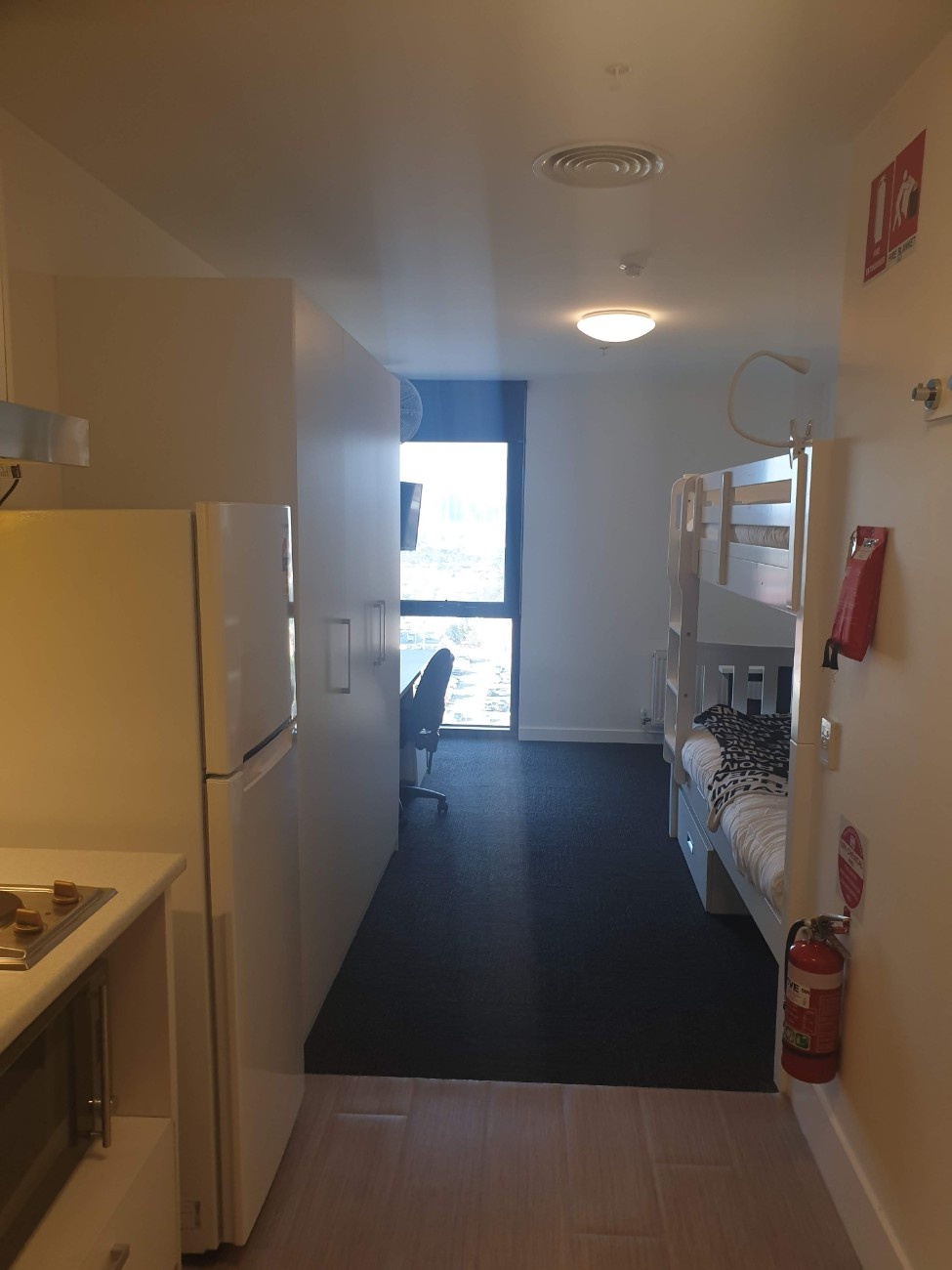
- Lack of affordable housing, too many students who won't speak English. Male sure you find a good group early on.
Likes
- Flexibility in choosing subjects
- Great campus location, very close to the city
- Great campus culture and student associations
Dislikes
- Very Asia continent dominated - especially for student
- Some subjects are entry level and not at masters standard
- Few scholarships options
Scholarship
- Yes, scholarships for masters of management are auto-granted; there are no separate applications. The Business and Economics Graduate Scholarship is offered to students enrolled in a graduate coursework degree with the Faculty of Business and Economics in recognition of their academic achievements. There are two types: 25% and 50%.
- I received a 25% merit-based scholarship and so have 5 of my friends, and I know of 2 people who have a 50% scholarship as well.
- This % is cut from the fees each semester before the semester's invoice is sent, so it is a discount, not money given back later.
- No disclosure is given for how many students, on average, receive scholarships each year, but the typical award amount is 25%.
Likes
- The courses available to choose is probably the best thing about the uni. You get to learn and work with the best talent pool and professors
- The campus facility are amazing, ranging from different clubs, the sports centre and the student support center
- Lastly, if you an extrovert, you get to make some really good friends across different cultures.
Dislikes
- The timing of the classes are little hectic, but it also depends on the subjects you choose. Sometimes they tend to overlap
- Certain subjects need prerequisites which can not be fulfilled if you don't plan it out
- Compared to other universities, the fee is considerably high, and even the scholarship amount it less.
Likes
- University of Melbourne has a research oriented academic atmosphere which fosters independent thought and critical thinking skills
- The university also provides a unique course structure where students have flexibility on which subjects/areas of expertise they want to learn and study.
- Vibrant atmosphere, beautiful campus and work-life balance
Dislikes
- The faculty to student ratio is quite low in UniMelb which makes it hard to get one-to-one time with your tutors and professors
- Academic advisors can often be quite busy as they are often juggling many different duties at once.
- The on-campus accomodations are a bit expensive
Likes
- The hands on lab session that happens for every subjeect
- A lot of opportunities to research and connect with industry
- Free food, lot of events, and activities
Dislikes
- I don't really dislike anything about the University
- The tuition fee is a bit much and it keeps increasing each year (should offer more scholarship's)
- Most the events has some kind of limited entry
Likes
- - Free food all over the campus
- - Popular professors (who teach excellently)
- - Comfortable lecture halls
Dislikes
- - Buildings are quite far from each other
- - Keep increasing the fee by 10% every year
- - Some subjects are set particularly hard
Scholarship
- I was fortunate to receive two prestigious scholarships from the University of Melbourne. The first was the Business and Economics Scholarship, a one-off grant of $10,000, awarded to recognize academic excellence and potential in the field. The second was the Graduate Scholarship, which provided a 25% reduction in my regular tuition fees, reflecting my strong academic performance and commitment to furthering my education.
- These scholarships are highly competitive, and approximately 20% of students in my cohort received either one or both of these awards. It was an honor to be among the recipients, as it validated my dedication to academics and professional growth while also easing the financial burden of pursuing a world-class education.
Likes
- Diversity: We were a class of 40, coming from 13 countries. We all came from diverse industries- consulting, banking, tech, media, healthcare, etc. The average work ex was 5 years, but the range was 2-20 years. Diversity made learning fun & engaging.
- Curriculum: Practical course structure; the course did not focus on rote learning. Each subject had multiple live projects and we worked on them in syndicates. Operations' and Data Analysis' projects were two of the toughest ones!
- Alumni: MBS alums are some of the biggest names in Australia. Since there is no concept of campus placement in Australia, these alums are the primary source of jobs for students. Networking with these alums become extremely easy when you are in MBS.
Dislikes
- Career Support: Not at par with other leading global schools. The career services do help with connecting you to the right resources but do not take the pain of ensuring you get a job. Most top global MBAs work to get you a job. NOT THIS ONE.
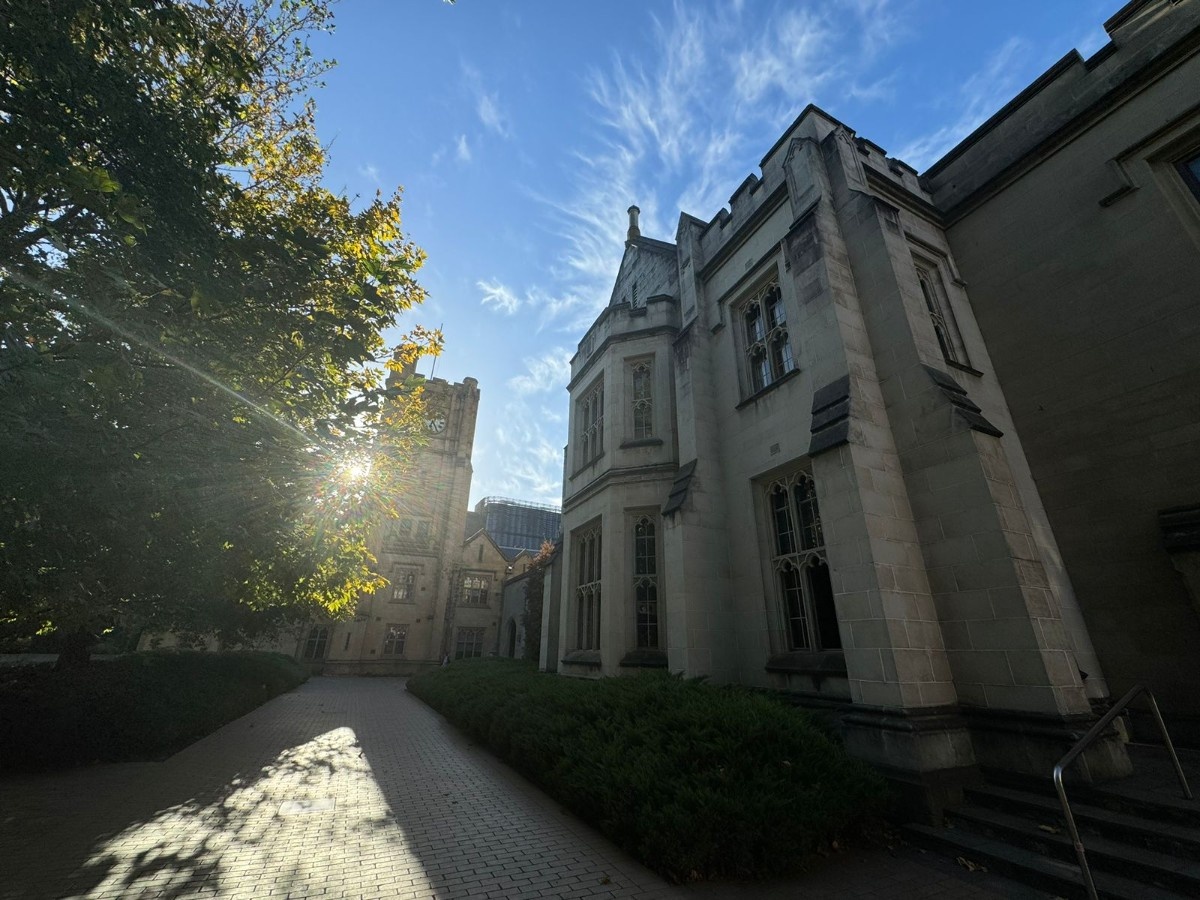
- The UniMelb campus is super pretty with victorian architecture, greenery and great infrastructure. However, the MBS building is not as impressive. Its a small building with limited facilities. However, we can always access UniMelb if required
Overview
The admission process is simple:
1. Application: There is no fee to apply, unless you are shortlisted. After shortlist, you pay AUD100. I personally liked this since most B-schools charge $100 for applying.
2. GMAT/GRE: You need to get a competitive GMAT score. For Indians, anything above 700 should be fine. The higher you go, the better scholarship you will receive. There is no specific GMAT cutoff. The admission also depends on factors like application round, academics, previous experience, etc. 3. IELTS/PTE: Need a 6.5 or above in IELTS. This is basically a hygiene check. Pro Tip: If you have a high GMAT verbal, you can ask for IELTS waiver from the university. Although, after an admit, you will need to give IELTS for the visa process.
4. Interview: A single round of interview with the career services. It was a pretty casual conversation with basic behaviourial questions. The call was focused on setting realistic expectations from the MBA.
Scholarship
In received the MBS scholarship. For this particular scholarship, I did not have to apply. Every student is considered for this scholarship if they are admitted into the program. There were other scholarships as well which required applications. However, as far as I recall, you can't combine scholarships. IMPORTANT: THE DEADLINE FOR THESE SCHOLARSHIPS IS USUALLY THE END OF ROUND 1 (November). GMAT is the biggest criteria for getting the MBS Scholarship. Higher scores ensure better scholarship. If your profile is good and if you have other offers, you can easily negotiate for a bigger scholarship.

interested in this College ?
Follow & Share this college to get information about admission.



Comments
Found 3 Comments
To get admission in the Ph.D in Science program of the University of Melbourne you must have a masters degree in a relevant discipline, including a substantial research component with a WAM of at least 75%. Students who have graduated from other universities must also have a Referee report and Endorsement from a prospective supervisor. The criteria considered in the admission selection process are mentioned below.
The University of Melbourne offers Ph.D in Science in six disciplines: Bioscience, Chemistry, Physics, Mathematics and Statistics, Ecosystem and Forest Sciences and Geography, Earth and Atmospheric Sciences. To be eligible for admission, you must have a masters degree in a relevant discipline, including a substantial research component with a WAM of at least 75%. Students who have graduated from other universities must also have a Referee report and Endorsement from a prospective supervisor.
If you are currently enrolled in an undergraduate degree at another institution or if you are willing to transfer from another institution, you need to apply directly through the university’s online application system. You may need to supply detailed subject information about subjects you have already completed at other institutions if you wish to be assessed for advanced standing.