



Content Curator
Acid rain can be defined as the precipitation of acid in the form of rain.
- It is also known as acid deposition.
- It is a form of precipitation containing acidic components such as sulfuric and nitric acids.
- These components fall to the surface of the earth from the atmosphere in both wet and dry forms.
- This includes rain, snow, fog, hail, and even acidic dust.
- Normal rainwater has a pH value of around 5.7, making it slightly acidic.
- When rainwater interacts with pollutants such as sulfur dioxide or nitrogen oxides, it becomes more acidic.
- The pH value of acid rain is around 4.0.
| Table of Content |
Key Terms: Acid rain, Sulfuric acid, Nitric acid, Precipitation, Atmosphere, pH value, Nitrogen oxides, Sulfur dioxide
What is Acid Rain?
[Click Here for Sample Questions]
“Acid rain is precipitation containing high levels of acids formed when sulfur dioxide and nitrogen oxides react with normal rainwater.”
The term precipitation refers to any form of liquid or frozen water that condenses in the atmosphere and falls back to the Earth's surface.
- The main forms of precipitation include drizzle, rain, snow, ice pellets, graupel, and hail.
- Normal rainwater reacts with pollutants like sulfur dioxide and nitrogen oxides in the atmosphere.
- This reaction between rainwater and pollutants converts them into sulfuric and nitric acids.
- The precipitation of these acids on the surface of the earth is known as acid rain.
- The word acid rain was coined first in 1852 by Scottish chemist Robert Angus Smith.
- The Royal Society of Chemistry considers him the “father of acid rain”.
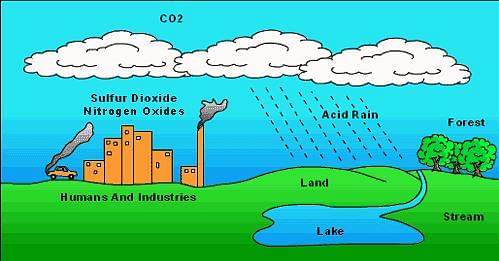
Acid Rain
Also check:
| Related Concepts | ||
|---|---|---|
| Haloalkenes and Haloarenes | Sulphurous Acid | Oxidizing Agent |
| Nitric Acid | Ozone | Periodic Classification of Elements |
Causes of Acid Rain
[Click Here for Sample Questions]
Acid rain is formed by the reaction of sulfur and nitrogen compounds with rainwater. These can be caused by two main sources:
- Human activities: Emissions from factories, power plants, and vehicles release sulfur dioxide (SO2) and nitrogen oxides (NOx) into the atmosphere.
- Natural sources: Lightning strikes can produce nitrogen oxides, while volcanic eruptions release sulfur dioxide.
Regular clear rain is also not clean but less harmful because when it reacts with carbon dioxide, it forms weak carbonic acid. The reaction involved is
H2O (l) + CO2 (g) ⇌ H2CO3 (aq)
Acid rain is more harmful because when sulfur dioxide and nitrogen dioxide react with normal rain, it results in the formation of sulphuric acid and nitric acid, respectively. The reactions involved are
2SO2 (g) + O2 (g) + 2H2O (l) → 2H2SO4 (aq)
4NO2 (g) + O2 (g) + 2H2O (l) → 4HNO3 (aq)
Effects of Acid Rain
[Click Here for Sample Questions]
The effect of acid rain can be seen on humans, plants, aquatic life, and also, on stone buildings and big metallic structures.
- Acid rain washes away all the nutrients essential for plant growth and survival.
- It also alters the soil composition.
- It causes various respiratory issues in animals and humans.
- It alters the aquatic life as if it falls into the river, and changes the pH of river water.
- It is also responsible for the water pollution of the river.
- Acid rain corrodes water pipes, leaching harmful heavy metals into drinking water.
- It is also responsible for damaging various buildings and monuments which are made up of stones and metals.
Harmful Effect of Acid Rain: Real-Life Examples
[Click Here for Sample Questions]
Some of the harmful effects of acid rain on famous buildings and monuments are given below.
Effect on the Taj Mahal
Taj Mahal is in the city of Agra where many industries are using chemicals that emit oxide of sulphur and nitrogen.
- These oxides combine with atmospheric water and fall down as acid rain.
- This acid rain is causing corrosion on the marble of the beautiful white marble of the Taj Mahal.

Effects of Acid Rain on the Taj Mahal
Effect on The Statue of Liberty
The Statue of Liberty another famous monument is also getting damaged due to the acid rain. The Statue of Liberty is made up of copper, which is turning green by the slow action of acid rain.
Prevention of Acid Rain
[Click Here for Sample Questions]
The only thing that we can do to prevent acid rain is to keep a check on the emission of nitrogen and sulphur oxide from different industries and the burning of fossil fuels.
- To prevent acid rain, reduce the amount of sulphur dioxide and nitrogen oxide in the atmosphere.
- This can simply be done by using cleaner fuel and removing oxides of sulphur and nitrogen before releasing them.
- Use coal that contains less sulphur or wash the coal to reduce sulphur content or opt for natural gas.
- Use alternate energy resources such as geothermal, wind, and solar energy, to reduce sulphur and nitrogen oxides quantity.
Also check:
| Related Articles | ||
|---|---|---|
| Effects of Environmental Pollution | Environmental Chemistry | Coordination Compounds |
| Interhalogen Compounds | Group 15 Elements | P Block Elements |
Things to Remember
- Any precipitation containing very high levels of nitric and sulfuric acid is called acid rain.
- Regular rainwater becomes more acidic when reacts with pollutants like sulfur dioxide or nitrogen oxides.
- The pH of acid rain is mainly about 4.0.
- The main reason for acid rain is mainly the combustion of fossil fuels.
- Acid rain is harmful to the fertility of the soil and contributes to the corrosion of soil surfaces.
Sample Questions
Ques. Define acid rain. (1 Mark)
Ans. Acid rain is the precipitation of acids, caused by a chemical reaction that occurs when sulfur dioxide and nitrogen oxides are released into the atmosphere.
Ques. What is acid rain made of? (2 Marks)
Ans. Acid rain is caused by highly acidic water droplets formed when air pollutants, particularly high levels of sulfur dioxide and nitrogen oxides from vehicles and factories, react with water vapor in the atmosphere. These pollutants combine with water molecules to form sulfuric and nitric acids, which contribute to the acidity of the rain.
Ques. What are the harmful effects of acid rain? (2 Marks)
Ans. Acid rain is causing damage to humans also although indirectly. The acid rain that falls from the above is mixed with the mainstream water and this water we use for drinking, for agricultural purposes. This acidic water seeps into the fruits and vegetables and we eat them and, in this way, we are ingesting the acid.
Ques. What will happen if we do not prevent acid rain? (3 Marks)
Ans. As we all know acid rain is acid precipitation or acid depositions with very low PH. This low PH is very harmful to plants, humans, as well as soil. If we will not stop acid rain the chemicals present in the acid rain will cause damage to humans in the long term. Humans being a consumer of vegetation and using groundwater for drinking purposes will be badly affected if we do not stop the acid rain.
Ques. Is it dangerous to walk in acid rain? (2 Marks)
Ans. Walking in acid rain can not harm one immediately but causes damage in the long term. The acid rain also seems like a normal rain in feeling but contains some amount of acid in it which is harmful to skin, and hair.
Ques. How is acid rain related to soil acidification? (2 Marks)
Ans. Acid rain contains two harmful acids; sulfuric and nitric hence it is directly responsible for soil acidification. Soil acidification is the process of building hydrogen cations in soil and acid rain adds up in this.
Ques. How acid rain can be prevented? (2 Marks)
Ans. Acid rain can be stopped by reducing pollution, reducing sulfur dioxide in the environment. People can use other sources of energy instead of using fossil fuels, and use cleaner and sulfur-free fuels.
Ques. What is the primary source of acid rain? (2 Marks)
Ans. Fossil fuel burning at power plants is a major source of acid rain. These plants release sulfur dioxide (SO2) and nitrogen oxides (NOx) into the atmosphere. When these pollutants react with water vapor, they form sulfuric and nitric acids, which fall to the ground as acid rain.
Ques. Can acid rain burn your skin? (1 Mark)
Ans. No, acid rain cannot burn your skin. While acid rain is acidic compared to normal rain, it's not strong enough to cause burns on human skin.
Ques. Can acid rain damage buildings? (1 Mark)
Ans. Yes, acid rain damages buildings. It damages the materials and corrodes the metals of the buildings. For example, the Tarnishing of the Taj Mahal.
For Latest Updates on Upcoming Board Exams, Click Here: https://t.me/class_10_12_board_updates
Also Read:
| Class 11 Chemistry Study Guides | ||
|---|---|---|
| NCERT Solutions for Class 11 Chemistry | NCERT Class 11 Chemistry Books | Some Basic Concepts of Chemistry |



Comments