



Content Curator
An oxidising agent (also known as an oxidizer or oxidant) is a chemical species that tends to oxidise other substances, causing them to lose electrons and raises their oxidation state. Halogens (such as chlorine and fluorine), oxygen, and hydrogen peroxide are all examples of oxidizing agents. An oxidising agent is a part of redox reaction and the oxidant is a chemical component that transports oxygen atoms in order to obtain electrons.
| Table of Content |
Keyterms: Oxidizer, Oxidant, Halogens, Chlorine, Fluorine, Oxygen, Hydrogen, Atom, Electron
Read More: Rate of a Chemical Reaction
Oxidizing Agent Definition
[Click Here for Sample Questions]
Oxidizing agents can be interpreted in two categories:
Electron Acceptor
They are chemical substances whose atoms in a chemical reaction remove at least one electron from another atom. According to this definition, Oxidizing agents are those reactions that undergo the process of reduction in redox reactions.

Electron Acceptor
Atom-Transfer Substance
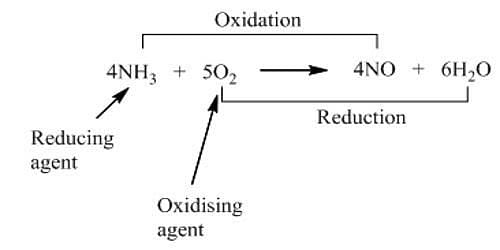
In a chemical reaction, an oxidising agent is a substance that transfers at least one electronegative atom to any of the chemical species. Typically, oxygen atom is the transferred atom. The transfer of an electronegative atom between two reactants is involved in a number of combustion reactions and organic redox reactions.
Atom-Transfer Substance
Also Read:
| Related Articles | ||
|---|---|---|
| Oxidation and Reduction | Balanced Chemical Equation | Decomposition Reaction |
| Displacement Reaction | Oxidation Reaction | Corrosion |
Factors Affecting the Oxidizing Power of Oxidizing Agent
[Click Here for Previous Year Questions]
Oxidizing agents are usually found in their highest oxidised states, which means they have a significant ability to gain electrons and undergo reduction. Ions, atoms, and molecules with a high affinity for electrons are considered to be good oxidizers. The greater the oxidising power, the stronger the electron affinity.
Elemental Fluorine is considered to be the most powerful elemental oxidising agent. This could be because fluorine is the most electronegative element in the modern periodic table, and hence has the greatest attractive force on electrons of all the elements. In fact, diatomic fluorine (F2) has such a powerful oxidising power that it can cause metals like asbestos and quartz (as well as molecules like water) to explode into flames when exposed to it.
Few more examples of elemental oxidising agents are Diatomic oxygen (O2), diatomic chlorine (Cl2), and ozone (O3). The elemental forms of the second and third most electronegative elements that are oxygen and chlorine, respectively make up these oxidizers good electron acceptors.
In a redox process, the standard electrode potential of a half-reaction gives information on the chemical substance's oxidising power.

Factors Affecting the Oxidizing Power of Oxidizing Agent
Some compounds with substantial oxidation states can also be used as oxidizers. The permanganate ion, chromate ion, and dichromate ion are all ionic examples. Nitric acid, perchloric acid, and sulphuric acid are some of the acidic examples of excellent oxidizers. As the oxidation states of the atoms increase, the electronegativity of the molecules increases, enhancing their ability to oxidise other substances.
Read More: Chemical Kinetics
Examples of Oxidizing Agent
[Click Here for Sample Questions]
Halogens
The group 17 elements of the modern periodic table are generally referred to as Halogens. They are considered to have a significant ability to gain electrons, owing to their high electronegativities in comparison to other groups of elements. This indicates directly that they have the ability to easily attract the electrons to their nuclei. Iodine, bromine, chlorine, and fluorine are examples of halogens that are good oxidising agents. Fluorine is considered to be the most powerful elemental oxidising agent because of its high electronegativity.
Oxygen
Oxygen is the element with the atomic number of 8 and is represented by the letter 'O.' It is a highly reactive non-metal with good oxidising properties that belongs to the chalcogen group of the modern periodic table. Metals, in general, tend to form metal oxides when they react with ambient oxygen, owing to oxygen's high oxidising power. The majority of combustion processes are found to include oxygen.
Hydrogen Peroxide
The chemical compound hydrogen peroxide has the formula H?O?. It appears physically as a colourless liquid with a viscosity that is greater than water. The most simple chemical with a peroxide functional group and a single oxygen-oxygen bond is hydrogen peroxide. It's being used as a disinfectant, bleaching agent, and a weak oxidising agent. Various oxidising agents are routinely employed in industries as well as in people's daily lives. Household bleach (NaClO), potassium nitrate (KNO3), and sulphuric acid(H2SO4) are some examples.
Applications of Oxidizing Agent
[Click Here for Previous Year Questions]
Some of the applications are:
- Bleaching of clothing material.
- Water purification.
- An oxidising agent helps in the fuel combustion.
- Storing energy in batteries.
- Rubber vulcanization (increase in the strength and elasticity of the rubber).
- Many biological functions, such as metabolism and photosynthesis, require oxidising agents.
Also Read:
| Related Articles | ||
|---|---|---|
| Precipitation Reaction | Redox Reactions | Types of Redox Reactions |
| Difference Between Oxidation and Reduction | Oxidizing Agent | Redox Titration |
Things to Remember
- An oxidising agent (also known as an oxidizer or oxidant) is a chemical species that tends to oxidise other substances, causing them to lose electrons and hence raise their oxidation state. Halogens (such as chlorine and fluorine), oxygen, and hydrogen peroxide are all examples of oxidizing agents.
- Oxidizing agents are usually found in their highest oxidised states, which means they have a significant ability to gain electrons and undergo reduction.
- Elemental Fluorine is considered to be the most powerful elemental oxidising agent. This could be because fluorine is the most electronegative element in the modern periodic table, and hence has the greatest attractive force on electrons of all the elements.
- In a redox process, the standard electrode potential of a half-reaction gives information on the chemical substance's oxidising power.
- Halogens are considered to have a significant ability to gain electrons, owing to their high electronegativities in comparison to other groups of elements.
Previous Year Questions
- Hot concentrated sulphuric acid is a moderately strong oxidizing… (NEET 2016)
- Alkali metals have negative reduction potential and… (KCET 2013)
- The average oxidation state of sulphur in… (KEAM)
- Which of the following is not an example of a redox reaction…
- Copper becomes green when exposed to moist air for a long… (JEE Main 2014)
- Which metal displace hydrogen from acids… (JIPMER 2000)
- Which of the following reactions is the metal displacement reaction… (NEET 2001)
- In the following decomposition reaction…
- Which of the following is a redox reaction… (NEET 1995)
- The oxide, which cannot act as a reducing agent, is… (NEET 1995)
Sample Questions
Ques 1. Define oxidizing agent. (1 marks)
Ans. An oxidising agent (also known as an oxidizer or oxidant) is a chemical species that tends to oxidise other substances, causing them to lose electrons and hence raise their oxidation state.
Ques 2. Which reactant acts as the oxidizing agent in this reaction? (1 marks)
H2S(g)+Br2(l)→2HBr(l)+S(g)
Ans. Br2
Ques 3. Identify the oxidizing agent. (1 marks)
CuO(s)+H2(g) → Cu(s)+H2O(g)
Ans. CuO
Ques 4. Identify the oxidizing agent. (1 marks)
Cl2(g) + 2NaBr(aq) → 2NaCl(aq) + Br2(l)
Ans. Cl2
Ques 5. Which is the most powerful elemental oxidising agent? And why? (3 marks)
Ans. Elemental Fluorine is considered to be the most powerful elemental oxidising agent. This could be because fluorine is the most electronegative element in the modern periodic table, and hence has the greatest attractive force on electrons of all the elements. In fact, diatomic fluorine (F2) has such a powerful oxidising power that it can cause metals like asbestos and quartz (as well as molecules like water) to explode into flames when exposed to it.
Ques 6. Describe Hydrogen peroxide as an oxidizing agent. (3 marks)
Ans. The chemical compound hydrogen peroxide has the formula H2O2. It appears physically as a colourless liquid with viscosity that is greater than water. The simplest chemical with a peroxide functional group and an oxygen-oxygen single bond is hydrogen peroxide. It's being used as a disinfectant, bleaching agent, and a weak oxidising agent. Many different oxidising agents are routinely employed in industrial organizations as well as in people's daily lives. Household bleach (NaClO), potassium nitrate (KNO3), and sulphuric acid(H2SO4) are some examples.
Ques 7. Which component is the oxidising agent in aqua regia? (3 marks)
Ans. Nitric acid and hydrochloric acid are mixed in a 1:3 ratio to make aqua regia.
When two strong acids react, the most reactive components are formed:
3HCl + HNO3 → NOCl + Cl2 + 2H2O
Chlorine and nitrosyl chloride are strong oxidising agents that allow aqua regia to dissolve a variety of metals, including noble metals that HNO3 and HCl alone cannot dissolve.
Ques 8. What are some of the applications of oxidizing agents? (5 marks)
Ans. Some of the applications are:
- Bleaching of clothing materials
- Water purification.
- An oxidising agent is used in the combustion of fuel.
- Storing energy in batteries.
- Rubber vulcanization (increasing the strength and the elasticity of rubber).
- Many biological functions, such as metabolism and photosynthesis, require oxidising agents.
Check Out:



Comments