



Content Curator
Adrenal glands are triangular-shaped endocrine glands. These glands produce hormones which help in regulating metabolism and blood pressure, functioning of the immune system and adrenaline rush. Adrenal glands secrete important hormones like Epinephrine, Nor-epinephrine, Hydrocortisone, Corticosterone. Adrenal glands are also considered as “Glands of Emergency” as these produce most of the vital hormones needed in the emergency conditions. These glands are located extra-peritoneally at the upper pole of each of the kidneys. Hence, these are also called “Suprarenal Glands.”
| Table of Content |
Key Terms: Adrenal glands, glands, hormone, endocrine system, metabolism, blood pressure, immune system, adrenaline.
What are Adrenal Glands?
[Click Here for Sample Questions]
Adrenal Glands are small, triangular-shaped endocrine glands. There are two adrenal glands located above each of the kidneys. Other names of the adrenal glands are “Suprarenal Glands” & “ Glands of Emergency.” These glands indirectly regulate metabolism, immune system, blood pressure, response to stress & other important functions by secreting certain hormones.
Location of Adrenal Glands
Human body has two adrenal glands, above each of the kidneys. Even the name “adrenal” suggests its location ( ad- near & renes- kidneys). On the front of the left adrenal gland lies stomach, pancreas and spleen and on the back lies left crus of the diaphragm. The right adrenal gland is surrounded by inferior vena cava and the right lobe of the liver is situated in the front and right crus of the diaphragm lies in the back. The below diagram shows the location of the adrenal glands:
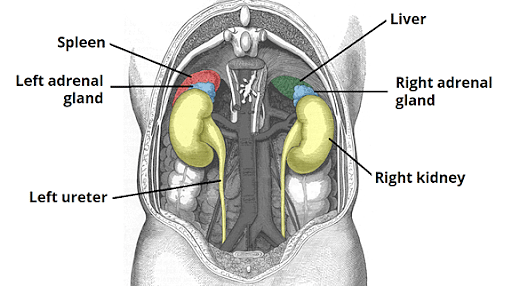
Location of Adrenal glands
Anatomy of Adrenal Glands
[Click Here for Sample Questions]
The two adrenal glands have different shapes. The right gland is in the shape of a pyramid while the left gland is semilunar. The left adrenal gland is also larger than the right one. Adrenal glands are approximately 10 centimeter cube in volume with a height of 5 centimeter and breadth of 3 cm. It is proven that healthy glands are yellowish. Adrenal glands are ductless glands which release the hormones directly into the blood or lymph system. Thus, it gets circulated to the whole body.

Anatomy of Adrenal gland
-
Adrenal Capsule
The capsule is made of fat and is the outermost layer of the adrenal glands. Capsule acts as a protective layer. It’s function is to enclose the adrenal glands and protect the glands.
-
Adrenal Cortex
The adrenal cortex is a three-layered outermost part of the adrenal glands. Its main purpose is to produce hormones such as aldosterone, cortisol, and androgens. Each of the three layers of the cortex are called zones. It is easy to differentiate the layers by studying them under a microscope.
- Zona Glomerulosa – It secretes mainly aldosterone which helps in absorption of sodium by the kidneys. This further maintains the balance of water and salt in the body.
- Zona Fasciculata – It produces cortisol which is a very important hormone for maintaining blood sugar levels and generating certain substances which help in repairing damaged tissues. It also secretes small quantities of androgens (hormones which plays a vital role in development of sexual traits and reproduction) like testosterone & aldosterone.
- Zona Reticularis – It produces DHEA or dehydroepiandrosterone which is a hormone that helps in producing other hormones such as testosterone and estrogen, and etc. DHEA is maximum at adulthood which starts from 21 or 22 years of age.
-
Adrenal Medulla
It is the innermost part of the adrenal glands. It has the Chromaffin cells in it, which are the main source of catecholamines and endorphins. Catecholamines help in managing stress and endorphins are such hormones which are produced when we exercise and help in relieving pain and tension and boosts our happiness.
Functions of Adrenal Glands
[Click Here for Sample Questions]
Adrenal Glands are responsible for the secretion of important hormones like Glucocorticoids, Mineralocorticoids, Adrenal sex steroids, Catecholamines. These glands play crucial bodily functions through the regulation of certain hormones. The major roles of adrenal glands are mentioned below-
- The most well-known job done by adrenal glands is triggering a “fight or flight” response. It releases the stress hormone which triggers this response.
- Some crucial hormones like cortisol are known for its anti-inflammatory actions and immune response are also released by the adrenal glands
- Adrenal glands also balance the salt and water in the body by releasing hormones like aldosterone.
Types of Hormones produced by Adrenal Glands
The different parts of adrenal glands secrete different kinds of hormones. For example- Hormones secreted by adrenal cortex are called Corticosteroids & adrenal medulla secretes Catecholamines. Corticosteroids include Glucocorticoids, Mineralocorticoids & Adrenal sex steroids. Catecholamines include Epinephrine, Norepinephrine & Dopamine. The important hormones are briefly discussed below-
- Glucocorticoids: It includes cortisol & corticosterone. These hormones have effects on glucose & protein metabolism.
- Mineralocorticoids: The main mineralocorticoid is Aldosterone. It helps in regulating the balance of sodium & Extracellular Fluid volume in the body.
- Epinephrine: It is also known as adrenaline. This is the hormone we refer to when we talk about the excitement we get on a roller coaster ride or watching a horror movie. This hormone immediately responds to any kind of stress. As it releases, the heart rate goes up and the glucose level increases in the body.
- Nor-epinephrine: These are also called noradrenaline. It helps us in dangerous situations as it makes the brain and body take immediate action. It is the highest when we are fully awake and the lowest when we are sleeping. When you can’t sleep at night due to some worry, you can blame it on this hormone.
- Dopamine: It is a naturally occurring precursor of norepinephrine. Dopamine is the hormone that is responsible for the feelings of pleasure, satisfaction, & motivation.
Adrenal Glands Disorder
[Click Here for Sample Questions]
Adrenal Gland disorders happen when not the right amount of hormones are produced by the adrenal glands. This can also be due to some abnormal growths or a tumour.
-
Conditions related to uneven hormone production
- Cushing’s Syndrome is when the adrenal glands produce a large amount of cortisol. This term is also referred to when a medical patient is given high steroids for the treatment purposes.
- Congenital Adrenal Hyperplasia (CAH) happens when the body produces very low levels of cortisol genetically. Depending on the intensity of this disorder, high levels of male hormone is produced.
- Addison’s Disease may happen when not enough cortisol or aldosterone is made. It may raise symptoms like weakness, fatigue, low blood pressure, nausea, etc.
-
Conditions related to abnormal growth and tumour
- Adrenocortical carcinoma is a rare condition that refers to cancer forming in the outer layer of the adrenal gland.
- Pheochromocytoma is a condition when a non-cancerous (benign) tumor develops in an adrenal gland. Too much epinephrine and norepinephrine is produced during this condition which in turn raises the blood pressure.
Things to Remember
- The main role of adrenal cortex is to carry on processes like fight or flight response, various anti-inflammatory functions, regulating blood pressure & metabolism by releasing certain hormones.
- Adrenal glands are located at the top of each of the kidneys.
- Each of the adrenal glands is made up of three parts- adrenal capsule, adrenal cortex & adrenal medulla.
- Adrenal glands release hormones like epinephrine, norepinephrine, hydrocortisone & corticosterone.
- Imbalance of the hormones released by the adrenal glands may trigger disorders like Cushing's syndrome, Congenital adrenal hyperplasia & Addison’s disease.
- Conditions like Adrenocortical carcinoma & Pheochromocytoma may also be triggered in the adrenal glands.
Sample Questions
Ques: What is the role of cortisol in the body? (2 marks)
Ans: Cortisol is a very important hormone for maintaining blood sugar levels and generating substances which help in repairing damaged tissues. It plays a vital role in anti-inflammatory actions and for the regulation of the immune system. It also helps in metabolic activities.
Ques: What is adrenal cortex? (2 marks)
Ans: The adrenal cortex is a three layered & outermost part in each of the adrenal glands. Its main purpose is to produce hormones such as aldosterone, cortisol, and androgens. The three layers are Zona glomerulosa, Zona fasciculata, Zona reticularis.
Ques: What is endorphin?(2 marks)
Ans: Endorphin is a hormone produced in adrenal glands. They are produced when we exercise and play an important role in relieving pain and tension and boosts our happiness.
Question: Explain the role of adrenal glands in managing stress? (2 marks)
Ans: In the innermost part of the adrenal glands (adrenal medulla) there are Chromaffin cells. These are the main sources of catecholamines and endorphins. Catecholamines help in managing stress and endorphins are the hormones which are produced when we exercise and help in relieving pain and tension and boosts our happiness.
Ques: What is an endocrine system? (3 marks)
Ans: Endocrine system is a messenger system comprising organs and glands located all around the body. It regulates and controls important functions of the body. This is mainly concerned with different kinds of metabolic activities of the body. The endocrine system comprised various endocrine glands & neurosecretory cells located in the hypothalamus. Major endocrine glands present in our body are- Pituitary gland, Thyroid gland, Parathyroid gland, Adrenal glands, Pancreatic islets, Kidneys etc.
Ques: Define hormones? (2 marks)
Ans: Hormones are chemical messengers that are released directly into the bloodstream, where they are carried to organs and tissues throughout the body to perform their tasks. The word hormone is derived from a Greek word “hormaein” which means to execute or to arouse. Hormones can be classified as- 1. Endocrine hormones, 2. Neurocrine hormones, 3. Paracrine hormones & 4. Autocrine hormones.
Ques: Diagrammatically indicate the location of the adrenal glands in our body. (5 marks)
Ans:

Figure: Location of Adrenal glands
Ques: List the hormones secreted by Adrenal glands. (2 marks)
Ans: Aldosterone, cortisol, androgens, DHEA or dehydroepiandrosterone, catecholamines, endorphins, noradrenaline and adrenaline are the hormones directly produced by adrenal glands. Some other hormones like testosterone and estrogen are sub-product of DHEA hormone.
Ques: Write a short note on adrenal medulla. (2 marks)
Ans: Adrenal Medulla is the innermost part of the adrenal glands. It has the Chromaffin cells in it, which are the main source of catecholamines and endorphins. Catecholamines help in managing stress and endorphins are the hormones which are produced when we exercise and help in relieving pain and tension and boosts our happiness.
Ques: How does Addison's disease take place? (2 marks)
Ans: When not enough cortisol or aldosterone is produced, this disease takes place. It causes weakness, fatigue, low blood pressure, nausea, etc.
It may occurs in both men and women of all age groups, but is most common in the 30-50-year-old age range.



Comments