



Education Journalist | Study Abroad Lead
Aluminium Iodide is a chemical compound formed by the reaction of aluminium and iodine. It is an ionic compound that acts as a catalyst in certain organic reactions and as a strong Lewis acid. Furthermore, we obtain a hexahydrate by reacting metallic aluminium and/or aluminium hydroxide with hydrogen iodine or hydroiodic acid. Besides that, we use it as a reagent for the scission of certain types of C-O and N-O bonds. It also deoxygenated epoxides and cleaves aryl ethers.
| Table of Content |
Key Terms: Aluminium Iodide, Electrons, Octet, Ions, Ionic Bond, reaction, Lewis Acid
Aluminium Iodide
[Click Here for Sample Questions]
Aluminium Iodide is dimeric in nature as it is made up of two identical simpler molecules. The monomeric and dimeric forms of its structure are defined by the gas phase. Furthermore, AlI3 is a trigonal planar monomer whereas Al2I6 is a bridged dimer similar to Al2Cl6 and Al2Br6.
- Because aluminium is a metal, it loses electrons. In its electron cloud, aluminium loses three electrons from its outer shell to complete its octet. The ion so formed, i.e, Al+3, makes it more stable.
- Iodine is a non-metal and since nonmetals gain electrons, Iodine gains an electron from aluminium to complete its outer shell.
- Ions with opposite charges are similar to two magnets with opposing poles. They will stick together if we bring the "north" end of one magnet close to the "south" end of another magnet.
- Ions with different charges bind together in a similar way, and this is known as an electrostatic attraction.
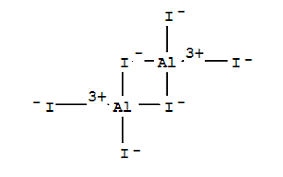
Structure of Aluminium Iodide
Formula of Aluminium Iodide
[Click Here for Sample Questions]
The chemical formula of Aluminium Iodide is AlI3. It is an ionic compound as aluminium and iodine ions form ionic bonds with each other.

Reaction of Aluminium and Iodine
Occurrence of Aluminium Iodide
[Click Here for Sample Questions]
Aluminium iodide, with the chemical formula AlI3, is formed by the reaction of aluminium and iodine, which is the reaction of aluminium hydroxide with hydroiodic acid. It is an inorganic Lewis acid, a type of chemical capable of accepting an electron pair, from the binary compound group. Both elements exist separately in nature, and aluminium iodide forms under special conditions in laboratories and industries. Iodine exists as a molecule I2 and aluminium exists freely in atomic form.

Aluminium Iodide
Preparation of Aluminium Iodide
[Click Here for Sample Questions]
Iodine is a member of the halogen family of non-metals, which are highly reactive. It's also a diatomic element, meaning it's highly reactive and much more stable in molecular form. Besides that, because aluminium exists in its atomic form, the reaction between aluminium and iodine is as follows:
Al + I2 → AlI3
Two atoms of iodine start the reaction, and three atoms of iodine finish it. This occurs because the outer shell electrons of an aluminium atom must be completed by losing or gaining one electron. Similarly, in order to complete its outer shell, iodine must either gain or lose one electron. To complete its outer shell, aluminium requires three iodine atoms.
Properties of Aluminium Iodide
[Click Here for Sample Questions]
Mentioned below are the important properties of Aluminium Iodide:
- Physical Properties: Aluminium iodide has a colour of white with a yellowish hue. It exists in powder form and has a density of 3.98 g/cm3. It also has a melting point of 189.4oC and a boiling point of 360oC. The molar mass of this compound is 407.69 g/mol. It can dissolve in water, ethanol, diethyl ether, carbon disulfide, pyridine and sulphur dioxide.
- Chemical Properties: In organic chemistry, it is sometimes necessary to use a catalyst to speed up a reaction. Aluminium iodide is a chemical compound that breaks the bonds between carbon and oxygen, as well as nitrogen and oxygen. It can also be used to remove oxygen atoms from epoxides, a cyclic ether, and as a stall treatment spray. It also produces a lot of heat, making it exothermic, which is why scientists and industries use a special heat-resistant container and a fume hood to conduct it. When iodine reacts with aluminium in the presence of water, purple vapour forms.
Uses of Aluminium Iodide
[Click Here for Sample Questions]
Some of the industrial applications of Aluminium Iodide are:
- Veterinary medicine and pigs are examples of the applications for aluminium iodide. When pigs get pneumonia, they are sprayed with an aerosol form of aluminium iodide.
- It's also used to kill germs and disinfect enclosures in horse and cattle barns. It can protect calves and pigs from respiratory diseases if sprayed in areas where they are exposed to them.
- It can act as a catalyst in organic chemistry, speeding up the reaction between elements or compounds.
- It also demolishes the carbon-oxygen and nitrogen-oxygen bonds.
- It is used to eliminate the oxygen atom from epoxides.
- The antibacterial properties of aluminium iodide are high, but it has little effect on mucus membranes.
- To increase pathogenic and therapeutic effects, new applications are being researched.
Safety Hazards
[Click Here for Sample Questions]
Some of the safety hazards if Aluminium Iodide are:
- Aluminium Iodide causes severe allergic reactions in people who are allergic to aluminium compounds.
- Aluminium iodide, like several other aluminium compounds, must be handled with extreme caution in a well-sealed fume cupboard.
- To get rid of a mixture of aluminium iodide, pour it into sodium hydroxide and let it sit until it dissolves.
- If inhaled or ingested, its primary target organs are the central nervous system and bone.
- Aluminium binds to dietary phosphorus and impairs phosphorous absorption in the gastrointestinal tract, resulting in bone softening due to defective bone mineralization and rickets.
- Furthermore, high levels of aluminium in the body have been linked to Alzheimer's disease.
- Aluminium allergies can cause vomiting, digestive problems, dermatitis, and other symptoms.
- Aluminium inhalation results in coughing and abnormal chest X-rays.
Things to Remember
[Click Here for Sample Questions]
- Aluminium Iodide is simply prepared by the reaction of aluminium atom and iodine atom.
- Iodine is a highly reactive non-metal that belongs to the halogen family. It's also a diatomic element, which means it's highly reactive in molecular form and much more stable.
- Aluminium exists freely in atomic form.
- It also exists in powder form and has a density of 3.98 g/cm3.
- It is widely used as a disinfectant in animal stalls and even in houses.
- Aluminium iodide can cause burns to the skin and eyes, as well as damage to the digestive system's mucosae.
Solved Questions
Ques. How much aluminium iodide can be produced by the reaction of 5.00 g of aluminium with 20.0 g of iodine? Which of the following is the limiting reactant? (4 marks)
Ans. In order to find the amount of aluminium iodide produced, first of all we need to write the balanced equation as,
2Al + 3I2 = 2AlI3
We can see that 2 moles of aluminium react with 3 moles of iodine giving 2 moles of aluminium iodide.
Now, convert moles to masses,
Molar mass of Al = 27.0 g/mol;
Molar mass of I2 = 126.9 x 2 = 253.8 g/mol
Molar mass of AlI3 = 27.0 + 126.9 x 3 = 407.7 g/mol
So (2 x 27) = 54.0 g of aluminium reacts with (3 x 253.8) = 761.4 g of iodine giving (2 x 407.7) = 815.4 g of aluminium iodide.
Ques. In the reaction above, what exactly is the excess reactant? How much of the excess reactant do you anticipate remaining? (4 marks)
Ans. If 54.0 g of aluminium requires 761.4 g of iodine, then 5.00 g of aluminium would require 5.00 x 761.4 / 54.0 = 70.5 g of iodine. Since, we have 20.0 g of iodine, so iodine is the limiting reactant and aluminium is the excess reactant. Also, the amount of the final product is determined by the amount of limiting reactant.
761.4 g of iodine produces 815.4 g of aluminium iodide. So 20.0 g of iodine would produce 20.0 x 815.4 / 761.4 = 21.4 g of aluminium iodide.
761.4 g of iodine requires 54.0 g of aluminium for the reaction, so 20.0 g of iodine would require 20.0 x 54.0 / 761.4 = 1.4 g of aluminium. And if we have 5.00 g of aluminium then we would have (5.00 – 1.4) = 3.6 g leftover.
Ques. Determine the reaction of aluminium iodide with chlorine gas to form aluminium chloride and iodine gas. (5 marks)
Ans. Iodine has a common oxidation state of 1 and aluminium has a common oxidation state of +3. As a result, three iodides can bond to one aluminium. Aluminium chloride is AlCI3 for similar reasons. Chlorine and iodine are both diatomic elements that exist naturally (in their elemental states), so their formulas are Cl2 and I2, respectively. Despite the fact that we would expect iodine to be solid. In total, we get
2AlI3 (aq) + 3Cl2 (g) → 2AlCI3 (aq) + 3I2 (g)
Knowing there were two chlorines on the left, we simply multiplied the common multiple of 2 and 3 by 6 and doubled the AlCI3 on the right. Because we now have two Al on the right, I doubled the AlI3 on the left. As a result, we have six I on the left, and I have to triple I2 on right.
Ques. Consider the reaction between solid aluminium iodide and potassium metal, which results in solid potassium iodide and aluminium metal.
AlI3(s) + 3 K(s) + AlI3(s) + AlI3(s) + AlI3(s) + AlI3(s) + AlI3(s) + AlI3(s) + AlI3(s).
Based on the balanced chemical equation, how many moles of aluminium are produced when 3.05 moles of aluminium iodide react with 7.31 moles of potassium? (3 marks)
Ans. The following is the reaction equation:
AlI3 + 3 K implies 3KI + Al
The reaction ratio is: 1:3:3:1, Respectively
Because there are 3.05 moles of AlI3 in excess, the limiting mole is 7.31. As a result, the moles equal 7.313.
Hence, 2.437moles of aluminium is the answer.
Ques. Write down some important characteristics of Aluminium iodide. (3 marks)
Ans. Some important characteristics of Aluminium iodide are:
- It combines with sulfuric acid.
- When exposed to moisture in the air, it decomposes slightly into a subsalt.
- Aluminium hydroxide precipitates from heated aluminium iodide solution.
- The hydrolysis of a cation in water results in the formation of an acid medium.
- It reacts with dilute alkalis to form aluminium hydroxide.
- It is decomposable through the formation of tetrahydroxoaluminate.
Ques. Draw the lewis structure of Aluminium iodide. How is Aluminium iodide industrially made? (3 marks)
Ans. The lewis structure of Aluminium iodide is:
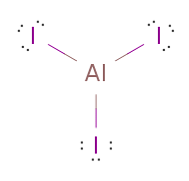
AlI3 is formed by the reaction of aluminium and iodine, which is produced by the reaction between aluminium hydroxide with hydroiodic acid. It is an inorganic Lewis acid, a type of chemical capable of accepting an electron pair, from the binary compound group.
Ques. State some health and safety hazards which are used while handling Aluminium iodide. (3 marks)
Ans. Aluminium iodide, like several other aluminium compounds, should be handled with extreme caution in a fume cupboard that is well-sealed.
- Pour a mixture of aluminium iodide into sodium hydroxide and let it sit until it dissolves to get rid of it. It's primary target organs if inhaled or ingested are the central nervous system and bone.
- Aluminium binds to dietary phosphorus and inhibits phosphorous absorption in the gastrointestinal tract, resulting in bone softening and rickets due to faulty bone mineralization.
- A high level of aluminium in the body has also been linked to Alzheimer's disease.
Ques. How to combine iodine and aluminium? (2 marks)
Ans. In a mortar, finely grind 0.4 g of iodine. Carefully combine the iodine and 0.1 g of aluminium powder in a small mound on the tin lid. The mixture then catches fire, emitting white smoke along with iodine vapour and leaving a glowing, white residue of aluminium iodide.
Ques. Is aluminium iodide poisonous? (2 marks)
Ans. Yes, aluminium iodide is poisonous for health. Some of the hazards of aluminium iodide are:
- Skin: Irritating and potentially severe skin irritation, especially if the skin is wet or moist.
- Ingestion: May cause digestive tract irritation and possible burns.
- Inhalation can cause severe respiratory tract irritation as well as burns.
Ques. Is aluminium iodide a gas or a liquid? (2 marks)
Ans. Powdered aluminium is mixed with iodine in a heat-resistant container to start the reaction. The purple vapours are produced when a few drops of water are added. The heat generated by the reaction causes the iodine to sublime, or change from a solid to a gas.
Ques. What happens when aluminium iodide and mercury(II) chloride solutions are combined? (2 marks)
Ans. Aluminium chloride remains dissolved in solution and is composed of one aluminium and three chlorides to balance the aluminium's 3+ charge. Mercury chloride is a solid that precipitates from solution and is composed of one mercury ion and two iodide ions to balance the mercury's 2+ charge.
Read More:



Comments