



Education Journalist | Study Abroad Lead
Pyridine is a colorless liquid and a heterocyclic molecule with the chemical formula C5H5N. It is an organic compound. Its structure resembles that of a benzene molecule. Unrefined coal tar is used to produce pyridine. Pyridine’s simple derivatives are mostly stable in nature. It is also known as Azine. It has a sour smell and is a weak base that mixes with water. In this article, we will learn more about pyridine, its characteristics, structure, and uses of pyridine.
| Table of Contents |
Keyterms: Heterocyclic molecule, Organic compound, Pyridine, Azine, Methine groups, Crude coal tar, Ammonia, formaldehyde, Acetaldehyde
What is Pyridine?
[Click Here for Sample Questions]
Pyridine is a heterocyclic organic molecule with a basic structure. The structure is similar to that of benzene, except one of the methine groups in it has been replaced by a nitrogen atom. It's also known as Azine. The smell is nasty, rotten, and fish-like. Pyridine can be manufactured from crude coal tar, ammonia, formaldehyde, and acetaldehyde, or it can be made from ammonia, formaldehyde, and acetaldehyde.
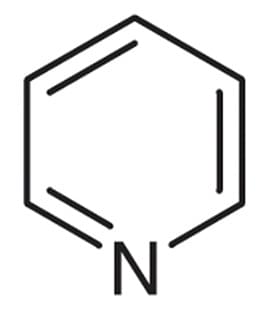
Pyridine
It has poor basicity and is water-miscible. It is extremely combustible and poisonous when inhaled or swallowed. Nausea, asthmatic breathing, vomiting, headache, laryngitis, and coughing are some of the symptoms of pyridine exposure. It's a common ingredient in agrochemicals and pharmaceuticals as a precursor. It is also employed as a reagent and an organic solvent. Pyridine is a weak base that dissolves in water.
Also Read:
| Related Articles | ||
|---|---|---|
| Uses of Methanol and Ethanol | Isopropyl Alcohol | Preparation of Alcohols |
| Nomenclature of Alcohols Phenols and Ethers | Esterification | IUPAC Nomenclature of Organic Compounds |
Characteristics of Pyridine
[Click Here for Sample Questions]
Pyridine and its simple derivatives are odorless, stable, and largely unreactive liquids with a powerful penetrating odor. Pyridine is the hydrogen derivative of this ring; it is benzene with a nitrogen atom replacing one of the CH- or methine groups. The structure of o-pyridine is identical to that of benzene, with the exception that CH is replaced by N.
| C5H5N | Pyridine |
| Molecular weight/Molar mass | 79.1 °/mol |
| Density | 982 kg/m3 |
| Boiling point | 115°C |
| Melting point | -41.6°C |
1. Physical characteristics
- Pyridine's simple derivatives are largely stable, non-reactive fluids with awful permeating scents.
- The atomic electric dipole second is equal to 2.2 debyes.
- Pyridine has a diamagnetic defenselessness of -48.7 106 cm3mol-1.
- The standard enthalpy of development in the fluid phase is 100.2 kJ/mol and 140.4 kJ/mol in the gas phase.
- Pyridine has a thickness of 0.88 mPa/s and thermal conductivity of 0.166 Wm-1K-1 at 25 degrees Celsius.
- At normal pressure and the breaking point, the enthalpy of vaporization is 35.09 kJ/mol.
- At the dissolving point, the enthalpy of the combination is 8.28 kJ/mol.

Physical characteristics
Pyridine has the following fundamental properties:
- Pressure - 6.70 MPa,
- Temperature - 620 K, and
- Volume - 229 cm3mol-1.
- With a temperature range of 340-426°C, the Antoine equation can be used to calculate the vapor pressure p.
A-[B/(C+T)] = Log10p
Where, A = 4.16272,
B = 1371.358K,
C = -58.496 K are the temperature values.
2. Chemical characteristics
- The pyridine ring contains electronegative nitrogen, hence the atom is often electron deficient.
- As a result, it takes longer than benzene derivatives to engage electrophilic aromatic substitution reactions.
- Pyridine is gradually susceptible to nucleophilic substitution, as evidenced by the ease with which solid organometallic bases can metalize it.
- Three compound groupings can be used to identify the reactivity of the pyridine structure.
- Electrophilic substitution occurs when pyridine conveys aromatic characteristics to electrophiles.
- Pyridine reacts with nucleophiles at positions 2 and 4 and continues along these lines like imines and carbonyls.
- The entanglement of the nitrogen particle of pyridine is caused by the reaction with numerous Lewis acids, which is similar to the reactivity of tertiary amines.
- Pyridine and its derivatives can oxidize, forming amine oxides (N-oxides), which is a component of tertiary amines.
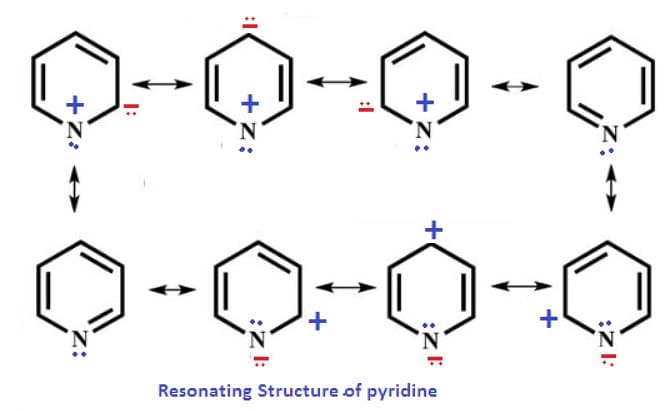
Resonating Structure of Pyridine
A solitary pair of electrons is required at the nitrogen focus point of the pyridine structure. The sweet-smelling framework rings are not covered by a single pair. Pyridine has chemical characteristics similar to tertiary amines. Pyridium, C5H5NH+, is formed through protonation. The conjugate corrosive (Pyridium cation) has a pKa of 5.25. Pyridine and pyridinium have virtually identical structures.
Structure of Pyridine
[Click Here for Sample Questions]
Pyridine has a C5N hexagonal structure, similar to benzene. Pyridine structures have a shorter C-N ring bond (137 pm in Pyridine versus 139 pm in benzene), which reflects the electron constraint. The carbon-carbon interactions in the pyridine ring are comparable to those in benzene, with a length of 139 pm. These bond lengths fall between the qualities for single and twofold interactions.
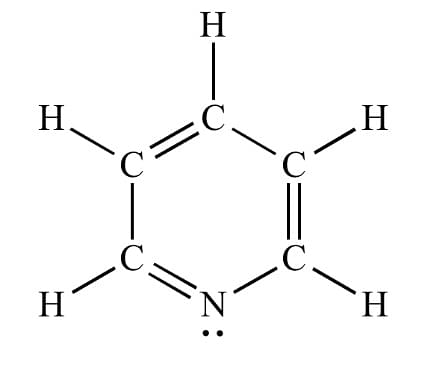
Pyridine Structure
In pyridine, there are three Pyridine structural resonances. Pyridine structures have positively charged carbons in all three resonances. Electrophilic substitution reaction rates are generally lower in pyridine structures than in benzene for electrophilic substitutes.
Uses of C5H5N (Pyridine)
[Click Here for Sample Questions]
The uses of pyridine are as follows:
- Pyridine is a very essential raw ingredient in the chemical industry.
- It's utilized in dental care products as an antiseptic.
- Pyridine is used as a solvent for dehalogenation.
- It's used in the pharmaceutical industry.
- It is employed as a denaturant in antifreeze formulations.
- As a sulfonating agent, pyridine is often employed.
- It functions as a reducing agent.
- It is utilized in paints and dyes.
- Pyridine is used to keep things clean.
- It is utilized as a ligand in coordination chemistry.
Things to Remember
- Pyridine, having the chemical formula C5H5N, is a heterocyclic compound that is colorless.
- The carbon-carbon interactions in the pyridine ring are comparable to those in benzene, with a length of 139 pm.
- The atomic electric dipole second is equal to 2.2 debyes.
- It is a natural heterocyclic molecule that's also known as Azine or Pyridine.
- It is used in the pharmaceutical industry.
- There are three pyridine structural resonances.
Also Read:
Sample Questions
Ques. Why is pyridine a basic compound? (3 marks)
Ans. Pyridine is more fundamental than pyrrole because the lone pairs of electrons on N in pyridine and pyrrole are distinct. As a result, the lone pair of electrons on the N atom in pyridine can easily be transferred to an H+ ion or a Lewis acid. In addition, pyridine is a superior base to pyrrole.
Ques. What is the process for making Pyridine? (2 marks)
Ans. Pyridine is a chemical product made up of acetaldehyde, ammonia, and formaldehyde, which are mixed with a catalyst and heated to 250-500 degrees Celsius at atmospheric pressure. Pharmaceuticals, solvents, and colors all include pyridine.
Ques. Is pyridine an effective nucleophile? (2 marks)
Ans. Pyridine is a natural nucleophile of carbonyl groups and is frequently employed as a catalyst in acylation processes. Because it is difficult to delocate the lone pair of electrons on the nitrogen across the ring, the nitrogen atom in pyridine is nucleophilic.
Ques. Is it true that pyridine is an aromatic compound? (3 marks)
Ans. Pyridine is an odorless, colorless chemical. This is an aromatic chemical that is linked to benzene. Because the nitrogen atom forms a dipole in the molecule, an electrophilic reaction is unlikely to occur. Nucleophilic reactions take place at the meta location to prevent a positive change from being deposited on the nitrogen.
Ques. Which plant is thought to be a natural source of pyridine? (1 mark)
Ans. Pyridine is found in abundance in Atropa belladonna's leaves and roots.
Ques. What are the uses of pyridine? (3 marks)
Ans. Pyridine is often used as:
- Pyridine is used as a solvent for dehalogenation.
- It functions as a reducing agent.
- It is utilized in paints and dyes.
- Pyridine is used to keep things clean.
- It is utilized as a ligand in coordination chemistry.
For Latest Updates on Upcoming Board Exams, Click Here: https://t.me/class_10_12_board_updates
Check-Out:



Comments