



Content Writer
Aluminum Chloride formula, also called the Trichloroaluminum formula or the Aluminum trichloride formula, is widely used in the chemical industry as Lewis acid.
- The chemical formula of the compound is AlCl3, which forms a hexahydrate with the formula [Al(H2O)6]Cl3.
- It is an inorganic compound that undergoes reversible changes from a polymer to a monomer at a mild temperature.
- You can use aluminium chloride for the polymerization and isomerization of lightweight hydrocarbons.
Key Terms: Aluminum Chloride Formula, Aluminum Chloride, Aluminum, Chlorine, Electrons, Lewis acid, Aluminum Trichloride, Aluminum Chloride Formula Structure
Key Highlights
- Aluminium chloride is a well-known organic catalyst that has a low boiling and melting point.
- It can explode if in contact with water as it is very deliquescent.
- The compound dissolves in carbon tetrachloride, water, benzene, and chloroform, but it happens to be a poor conductor of electricity.
- Aluminium Chloride is an ionic compound due to the presence of a strong electrostatic attraction.
- It is a poisonous chemical where one atom of aluminium can lose three electrons to attract three chlorine atoms.
Aluminium Chloride Formula
[Click Here for Sample Questions]
Aluminium chloride has the chemical formula AlCl3, which implies that three chloride ions are required for one aluminium ion. The swap-and-drop method, also known as the criss-cross method, is used to determine the chemical formula of compounds like aluminium chloride.
- Aluminum contains three electrons in the outermost shell.
- In contrast, chlorine contains seven electrons in its outer shell.
- Aluminium needs to get rid of three valence electrons.
- As a result, the inner electron shell would become the outer shell, which already has eight electrons.
- We know chlorine has seven electrons in its outer shell, which means it has one space available.
- Therefore, three chlorine ions replace every aluminium ion in the compound.
- It is neutral like all ionic compounds, and is devoid of any net charge.
- We can write the aluminium chloride formula as:
Al+3 + 3Cl−1 → AlCl3
Aluminium Chloride Formula Structure
[Click Here for Sample Questions]
The structure of the aluminium chloride formula depends upon the state of the compound, whether it is solid, liquid, or gaseous. When the compound is in the solid state, it will form a cubic, close-packed layered structure.
- The coordination geometry of aluminium chloride in a solid state is octahedral.
- In the case of a liquid state, it will exist as a dimer with coordination geometry being tetrahedral.
- The compound is formed by an exothermic reaction between aluminium and chlorine.
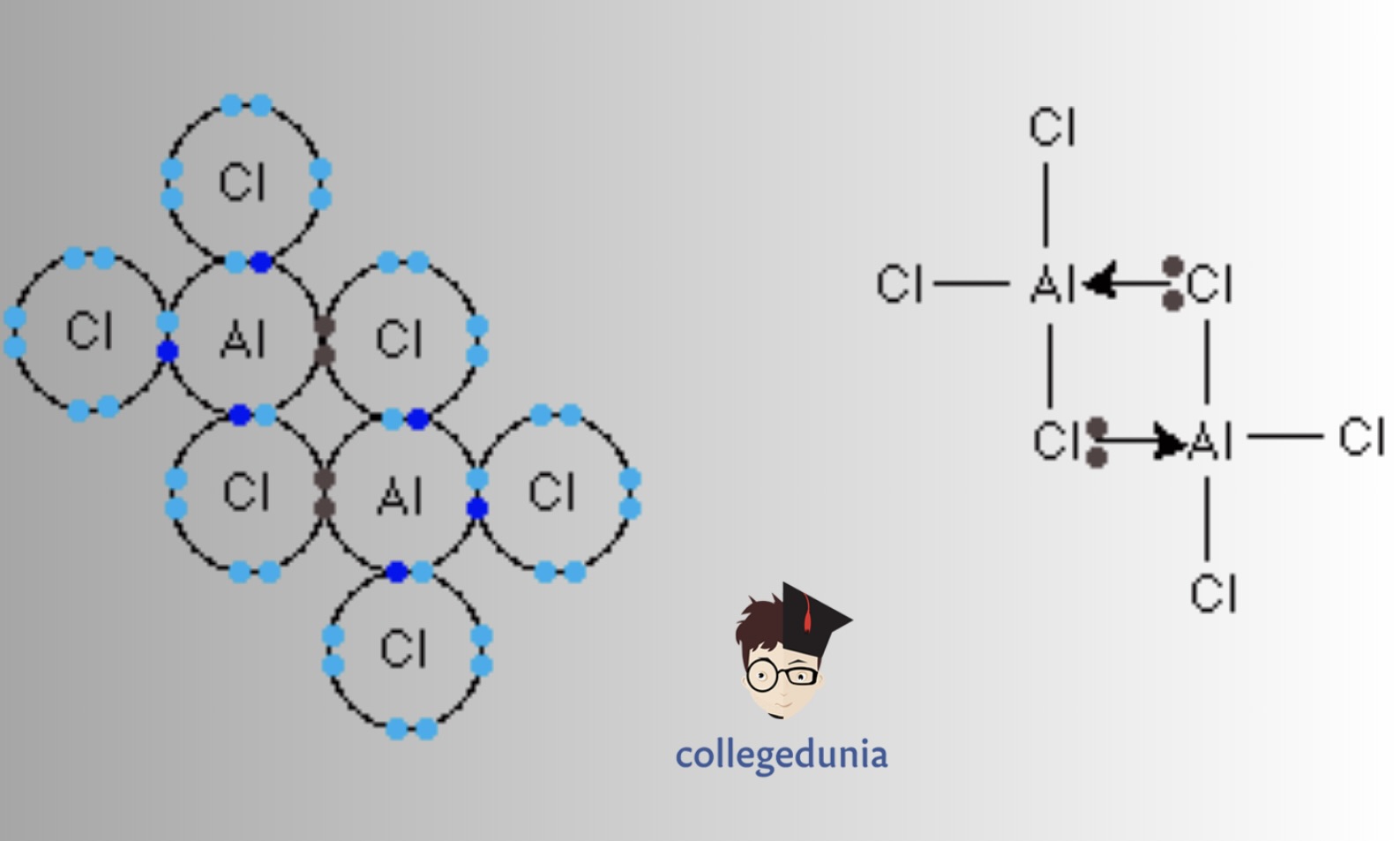
Aluminium Chloride Formula Structure
Properties of Aluminium Chloride Formula
[Click Here for Sample Questions]
The properties of aluminium chloride formula is divided into physical and chemical properties which are as follows:
Physical Properties of Aluminium Chloride Formula
The physical properties of the Aluminium Chloride Formula are as follows:
- AlCl3 has low boiling points and reaches its highest point at 180°C.
- The melting point of the compound is 192.6°C (anhydrous) and 100°C (hexahydrate, dec.)
- In its molten state, AlCl3 is a poor conductor of electricity.
- AlCl3 is white in colour, but it is frequently contaminated by iron trichloride, which turns it yellow.
- Aluminium chloride can become liquid only at pressures more than 2.5 atm and temperatures more than 190°C.
The physical properties are tabulated below:
| Compound | Data |
|---|---|
| Chemical formula | AlCl3 |
| Other Names | Aluminium(III) Chloride and Aluminum Trichloride |
| Molecular weight | 133.341 g/mol (anhydrous) and 241.432 g/mol (hexahydrate) |
| Density | 2.48 g/cm3 (anhydrous) and 2.398 g/cm3 (hexahydrate) |
| Melting point | 192.6°C (anhydrous) and 100°C (hexahydrate, dec.) |
| Vapour Pressure | 133.3 Pa (99 °C) and 13.3 kPa (151 Viscosity |
| Viscosity | 0.35 cP (197 °C) and 0.26 cP (237 °C) |
Chemical Properties of Aluminium Chloride Formula
The chemical properties of Aluminium Chloride Formula are as follows:
- AlCl3 is an extremely potent Lewis acid which is used as a significant industrial catalyst.
- Aluminium chloride is a corrosive solid that is anhydrous, non-explosive, and non-flammable.
- It reacts strongly when it comes into contact with water.
Preparation of Aluminium Chloride Formula
[Click Here for Sample Questions]
Various ways for preparation of Aluminium Chloride Formula are as follows:
Exothermic Reaction
In exothermic reaction, aluminium metal react with chlorine to form alunimium chloride.
2Al + 3Cl2 —> 2AlCl3
Reaction with Hydrogen Chloride
Aluminium metal reacts with hydrogen chloride to prepare aluminium chloride.
2Al + 6HCl → 2AlCl3 + H2
Displacement Reaction
In displacement reaction, aluminium metal reacts with copper chloride to form aluminium chloride.
2Al + 3CuCl2 → 2AlCl3 + 3Cu
Sample Questions
Ques. What is Aluminum Chloride? State its chemical formula? (2 marks)
Ans. Aluminum Chloride is an inorganic compound of Aluminum and Chlorine that is white in color. The chemical formula for Aluminum Chloride happens to be AlCl3.
Ques. What is the medical purpose of Aluminum Chloride? (2 marks)
Ans. AlCl3 topical is an over-the-counter (OTC) medication for the treatment of severe, persistent excessive perspiration (hyperhidrosis). Some of the numerous brand names for aluminum chloride topical are Drysol, Xerac AC, and Hyper care Solution.
Ques. Explain the structure of Aluminum Chloride? (2 marks)
Ans. Aluminum Chloride has a cubic close-packed layered structure when it is in a solid-state. AlCl3 has a coordination geometry that will be octahedral in this situation.
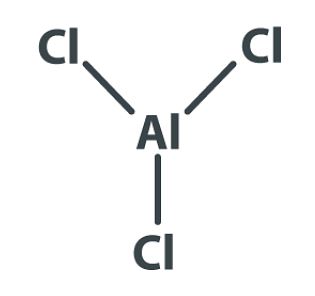
Aluminum chloride occurs as a dimer in its liquid or molten form. And the coordination geometry of AlCl3 will be tetrahedral in this case as the dimers disintegrate into trigonal planar at higher temperatures.
Ques. Is Aluminum Chloride a safe substance to use? (2 marks)
Ans. Aluminum Chloride seldom causes a severe allergic reaction. Despite this, if we detect any symptoms of a major allergic response, such as a rash, itching/swelling (particularly of the face/tongue/throat), extreme dizziness, or problems breathing, we should seek medical help right away.
Ques. State few uses of Aluminum Chloride? (3 marks)
Ans. Uses of Aluminum Chloride:
- Aluminum Chloride is used as a catalyst in a variety of chemical processes. It is also used during the process of making anthraquinone from phosgene and benzene.
- It can help aldehyde groups to attach to aromatic series or rings and it is a type of antiperspirant.
- When we study the Gatterman-Koch reaction, there, a Lewis acid (aluminum chloride) is employed to extract a chloride ion from a solution.
- Aluminum Chloride is also employed in light molecular weight hydrocarbon polymerization and isomerization procedures.
- Common examples include ethylbenzene manufacturing and dodecylbenzene production for detergents.
- Aluminum Chloride is used in the making of medications, rubber, lubricants, pesticides, wood preservatives, and paints.
Ques. State few chemical and physical properties of Aluminum Chloride? (4 marks)
Ans. Important chemical and physical properties of Aluminum Chloride formula are as follows:
Chemical Properties:
- AlCl3 is an extremely potent Lewis acid.
- Aluminum chloride is a significant industrial catalyst.
- It is a corrosive solid that is anhydrous, non-explosive, and non-flammable.
- Aluminum chloride reacts strongly when it comes into contact with water.
Physical Properties:
- The Molar Mass of AlCl3 is 133.341 g/mol for anhydrous and 241.432 g/mol for hexahydrate.
- The density of AlCl3 is 2.48 g/cm3 (anhydrous) and 2.398 g/cm3 (hexahydrate)
- The melting point of AlCl3 is 192.6°C (anhydrous),100°C (hexahydrate, dec.)
- The boiling point of AlCl3 is 180°C
Ques. What precautions must be maintained while working with Aluminum Chloride? (2 marks)
Ans. In the anhydrous form, aluminum chloride should be kept away from water and bases with extreme caution. This is due to the intense heat of hydration; aluminum chloride can explode when it comes into contact with water. AlCl3 also emits fumes into the atmosphere. Protective equipment such as glasses, gloves, and a faceguard should be worn during chemical reactions. Aluminum chloride should be kept in a firmly sealed container that is kept dry.
Ques. How is Aluminum Chloride prepared? (3 marks)
Ans. AlCl3 is generally prepared by an exothermic reaction between two elements: aluminum and chlorine. The compound aluminum chloride can also be obtained in a variety of other methods. Two popular methods are reacting the aluminum metal with hydrogen chloride or performing a single displacement reaction between copper chloride and aluminum metal.
- 2Al + 3Cl2→ 2AlCl3
- 2Al + 6HCl → 2AlCl3 + H2
- 2Al + 3CuCl2 → 2AlCl3 + 3Cu
Ques. How does aluminium chloride react with water? (2 marks)
Ans. A vigorous reaction occurs when a small amount of water is added to aluminium chloride. The anhydrous aluminium chloride reacts with water molecules to form a hydrated aluminium chloride complex and hydrogen chloride gas. The equation for this reaction can be represented as:
AlCl₃ + H₂O → Al(H₂O)₆³⁺ + 3 Cl⁻ + HCl
Ques. What is the molecular weight of aluminium chloride formula? (2 marks)
Ans. The weight of Aluminium is given as: 26.982
Similarly, weight of chlorine is given as 35.453
Weight of three chlorine atoms = 3 × 35.453 = 106.359
So molecular weight of Aluminium chloride= 26.982 + 106.359 = 133.341
Ques. What are the industrial uses of aluminium chloride? (2 marks)
Ans. The industrial uses of aluminium chloride are as follows:
- Aluminium chloride is used in the manufacturing of rubber, wood preservatives and paints.
- The compound is used in the preparation of pesticides and pharmaceuticals.
- The compound is used as an antiperspirant.
- It is used in the manufacturing of petrochemicals like ethylbenzene and alkylbenzene.
Read Also:



Comments