



Content Curator
Why is it important to know whether a compound is aromatic or not? Because we come into contact with aromatics daily. We would be without many material necessities if aromatic chemicals were not there, and our bodies would be unable to operate.
- Aromatic compounds are critical in the industry; around 35 million tonnes of aromatic compounds are manufactured annually around the world to make vital chemicals and polymers like polyester and nylon.
- Aromatic molecules are also necessary for all living creatures' metabolism.
- All five nucleotides that makeup DNA and RNA sequences are aromatic molecules, as are three of the twenty amino acids that make up proteins ("the building blocks of life").
- Aromatic molecules are, without a doubt, essential to our survival in a variety of ways.
| Table of Content |
Key Takeaways- Polymers, Nucleotides, Proteins, DNA, RNA
What is Aromaticity?
[Click Here for Sample Questions]
Aromaticity is a quality of a cyclic, planar molecule with a ring of resonance bonds that demonstrates greater stability than alternative geometric or connective configurations with the same set of atoms in organic chemistry. Aromatic substances can smell good. Aromatic molecules are stable and do not react easily with other chemicals. The aryl group is an aromatic functional group. The features of aromatic compounds are as follows:
- The resonance energy of aromatic compounds is exceptionally high.
- Aromatic compounds usually undergo substitution rather than addition reactions.
- Pi-electrons have delocalized in these.
- It has to be a cyclic compound.
- The molecule is planar because each element within the ring must have a p-orbital that is perpendicular to the ring.
- Hückel's Rule must be followed (the ring must have 4n+2 p-orbital electrons).
Read More:
Aromaticity Examples
[Click Here for Sample Questions]
The majority of aromatic chemicals are thought to be benzene derivatives. The term "aromatic" refers to benzene derivatives in their true sense, as it was defined first. There are also a variety of aromatic chemicals that aren't benzene. Take, for example, the DNA and RNA bases with double chains, which are a fairly prevalent sort of aromatic ring in living beings. The aryl group refers to the functional group or substituent of an aromatic chemical. Below are some examples of aromatic compounds.
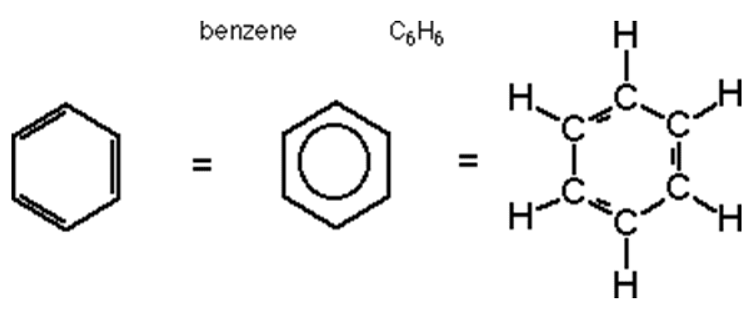
Benzene

Naphthalene

Non-Benzene Aromatic Compound – Furan
Read More:
Aromaticity Rules
[Click Here for Sample Questions]
There are four characteristics that a molecule must satisfy to be aromatic. It's a case of all or nothing. Aromaticity cannot be achieved if any of these requirements are not satisfied.
- The aromatic compounds are always cyclic structures.
- Being cyclic is not a necessary criterion for aromaticity. Cyclohexene is a non-aromatic compound. Aromaticity requires the presence of a continuous ring of p-orbitals surrounding the ring, which builds up into a larger cyclic "pi system." To put it another way, every atom in the ring must be capable of conjugation with one another. Remember that the "available p orbital" criteria apply to atoms with a lone pair, a radical, or an empty p orbital as well that are part of a pi bond(e.g., carbocations).
- The cyclic, conjugated molecule must have the correct number of pi electrons as the third criterion. Although both benzene and cyclooctatetraene are cyclic and conjugated, benzene is aromatic while cyclooctatetraene is not. The distinction between benzene and cyclooctatetraene is that benzene has six pi electrons while cyclooctatetraene has eight. All of the compounds follow Huckel's Rule, which states that all aromatic compounds should contain (4n+2) Pi number of electrons.
- It's best if the molecule is planar or flat. Those compounds that fulfil the above four characteristics of aromaticity are often flat because they have a large enough potential energy in that state.
Aromaticity Importance
[Click Here for Sample Questions]
Aromaticity is extremely important in the biochemistry of all living things. Histidine, tryptophan, phenylalanine, and tyrosine are the four types of aromatic amino acids that make up the 20 basic types of protein building blocks. Also known as aromatic purines and pyrimidines, the five types of nucleotides adenine, cytosine, thymine, guanine, and uracil make up the primary sequence inside the genetic code present in DNA and RNA.
Chlorophyll, a green pigment found in plants, contains an aromatic system. In the field of industry, these chemicals are also important. Benzene, ortho-xylene, toluene, and para-xylene are the most important aromatic hydrocarbons for commercial purposes. Hydrocarbons are created from complicated combinations collected through the refining or distillation process and are then used to make a variety of chemicals such as styrene, aniline, phenol, polyester, and nylon.
Huckel's Rule of Aromaticity
[Click Here for Sample Questions]
Only planar, fully conjugated monocyclic polyenes with 4n + 2 pi electrons, where n is an integer, such as 0, 1, 2, 3, 4, etc., should have aromatic stability, according to Huckel's rule. An aromatic compound must be planar, with a cyclic cloud of pi electrons below and above the molecule's plane. It must follow the Huckel rule because it contains SP2 hybridised carbon atoms.
The ring system must have (4n+2) electrons according to this criterion, where n is any whole integer (0, 1, 2, 3, etc). On this approach, aromatic ring systems with 2(n=0), 6(n=1), 10(n=2), 14(n=3), and so on have pi electrons. Benzene, naphthalene, and anthracene are examples of aromatic compounds.
Read More:
Points to Remember
Following are some important points:
- The term aromatic was first used by August Wilhelm Hofmann in 1855.
- Many non-benzene aromatic compounds that have no odour have been discovered recently.
- Aromatic Hydrocarbons are organic compounds structured circularly that contain sigma bonds in addition to delocalized pi electrons.
- When aromatic hydrocarbons are burned, they produce a bright, sooty flame that turns yellow.
Sample Questions
Ques: Are all aromatic compounds cyclic? (2 Marks)
Ans: There are four characteristics that a molecule must satisfy to be aromatic. It's a case of all or nothing. Aromaticity cannot be achieved if any of these requirements are not met. It must first be cyclic. Cyclic compounds can be aromatic or non-aromatic; for example, benzene is an aromatic cyclic compound, whereas cyclohexane is not. Aliphatic chemicals are organic compounds that are not aromatic, but only aromatic rings are particularly stable.
Ques: What is the difference between aliphatic and aromatic? (2 Marks)
Ans: Aliphatic chemicals are hydrocarbons that have both open and closed chains. Aromatic compounds have only a single closed-chain structure. The carbon molecules in aromatic compounds are linked together by conjugated pi electrons in a ring structure. Methane, propane, butane, and other aliphatic compounds are examples. Benzene, toluene, and other aromatic compounds are examples.
Ques: What are heterocyclic aromatic compounds? (2 Marks)
Ans: A heterocyclic compound is an organic compound in which one or more carbon atoms in the molecule's backbone have been replaced by an element other than carbon. The most frequent heterocycles are those with five or six members with nitrogen (N), oxygen (O), or sulphur (S) heteroatoms (S). Pyridine, pyrrole, furan, and thiophene are the most well-known simple heterocyclic compounds.
Ques: What is an aromatic organic compound? (2 Marks)
Ans: Aromaticity is a feature of cyclic (chain-shaped), planar (flat) structures with a ring of resonance bonds that gives them higher stability than alternative geometric or connective arrangements with the same number of atoms in organic chemistry. In place of individual alternating double and single bonds, the compounds have conjugated planar ring systems with delocalized pi-electron clouds. Aromatics and arenes are other names for them. Toluene and benzene are the greatest examples.
Ques: What is Huckel's rule of aromaticity? (2 Marks)
Ans: Erich Hückel, a German chemist and physicist, devised a theory in 1931 to assist assess whether a planar ring molecule has aromatic properties. To be aromatic, a molecule must have a particular number of lone pairs of electrons within p orbitals or pi bonds within a closed loop of adjacent, parallel p orbitals. Hückel's Rule was the name given to this rule.
Ques: What do you mean by the term aromaticity? (2 Marks)
Ans: When compared to alternative connective or geometric configurations consisting of the same set of atoms, this term is used to characterise a planar, cyclic molecule with a ring of resonance bonds that is more stable. It is also defined as a feature of conjugated cycloalkenes that increases a molecule's stability by causing electrons in the - orbitals to delocalize. Aromatic molecules are regarded to be extremely stable, as they do not easily break and react with a variety of different compounds.
Ques: What are Polycyclic Aromatic Hydrocarbons? (2 Marks)
Ans: Polycyclic Aromatic Hydrocarbons (PAHs) are hydrocarbons that are made up of numerous aromatic rings and can be found in tar oil, coal, and some prepared meals like smoked salmon and burnt toast. The two-ring aromatic compound naphthalene, as well as the three-ring compounds phenanthrene and anthracene, are examples of the simplest aromatic compound members. Under incomplete combustion conditions or when organic material is present, these chemicals occur (For example, forest fires, chimney soot, and so on). Biologically, these chemicals have a proclivity for cancer. Smaller members with 2-3 rings, such as anthracene or naphthalene, aren't too awful. Benzo A Pyrene (BAP), on the other hand, has five rings and is known to be carcinogenic. Furthermore, BAP is the first pure compound to be proved to cause cancer, and it is credited with pioneering the field of chemical carcinogenesis research.
Ques: What makes an unsaturated cyclic hydrocarbon aromatic? (2 Marks)
Ans: Aromaticity does not exist in all unsaturated cyclic hydrocarbons. Unsaturation and cyclic nature are required for a substance to be aromatic, yet these two characteristics alone cannot make a compound aromatic.
Any compound is aromatic if it meets the conditions listed below.
- Cyclic and SP2 hybridised compounds are required.
- A compound must have an empty 'P' orbital.
- Delocalized pi orbitals must be present in a compound.
- The Huckel rule must be followed while creating compounds.
- The Huckel rule is a criterion for any compound's aromaticity.
Also Read:



Comments