



Education Journalist | Study Abroad Lead
Benzene is one of the organic, aromatic hydrocarbons with the chemical formula C6H6 which signifies the number of atoms of carbon and hydrogen forming the benzene compound. Benzene is a type of organic compound that is considered a parent compound of various aromatic compounds. In this article, we will learn about Benzene, its properties, and its chemical formula along with the structure of benzene. Benzene is a highly toxic colorless liquid that is used to produce polystyrene. It is produced in nature naturally through forest fires, volcanic eruptions, and many animals and plants. In this article, we will understand what benzene is, its characteristics, structure, applications, aromatic properties, and preparation techniques.
| Table of Content |
Read Also: Cis-Trans Isomerism
What is Benzene?
[Click Here for Sample Questions]
Benzene is an aromatic hydrocarbon that is represented by the chemical formula C6H6. Benzene is the simplest organic compound that was first discovered by an English scientist, Michael Faraday. It is an essential and natural component of crude oil. Physically, it looks like a colorless liquid with an odor that resembles gasoline. Chemically, scientists have found that benzene is a highly toxic and carcinogenic compound.
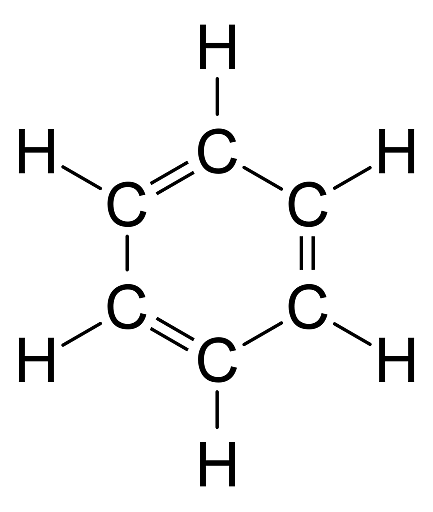
Benzene exists naturally in our environment in many animals and plants and is also produced as a result of volcanic activity and forest fires. It is used in the production of pesticides, detergents, plastic, and various other chemicals also. An important feature of benzene is that it’s used as the raw material for the production of polystyrene.
Characteristics of Benzene
[Click Here for Previous Year Questions]
Benzene has a lot of significant characteristics and features that make it distinct from other types of organic compounds. Some of them are:
- First of all, in terms of appearance, benzene has a crystal-like texture. It does not have any specific color which makes it less attractive but simultaneously it carries a pleasant smell.
- The chemical formula of benzene is C6H6 which is the combination of carbon and hydrogen. This also means that benzene is an aromatic hydrocarbon.
- The structure of benzene is like a ring that has six interconnected carbon atoms joined by single and double bonds.
- Benzene is also a major petrochemical substance, therefore, a large amount of benzene is also found in crude oil.
- The melting point of benzene is about 5.5 degrees Celsius while the boiling point for the same is 80.1 degrees Celsius.
- The oxidation of benzene is an extremely slow process because of its property of resisting hydrogenation as compared to other organic compounds.
- Most of the chemical reactions involving benzene belong to a class called electrophilic aromatic substitution. Such chemical reactions are often used for the production of the derivatives of benzene.
Also Read:
| Related Articles | ||
|---|---|---|
| Carbocation Stability | Aldol Condensation | |
| Catalysis | Classification of Organic Compounds | |
Structure of Benzene
[Click Here for Sample Questions]
Every organic compound has its unique structure which makes it different from other compounds. This structure of the organic compounds also reflects their formation and the components involved in their formation. Thus, to a major extent, the structure of the organic compounds defines their properties as well. Let us see the structure of benzene along with the diagram to have a better understanding.
- Benzene (C6H6) has a ring-like structure that has six interconnected carbon atoms joined together by single and double bonds.
- It looks like a cyclic hydrocarbon, which means that each of the atoms of the carbon is arranged in a ring-like structure with six vertices. All of these carbon atoms then make the bond with only one hydrogen atom each.
- The Benzene ring involves the formation of three separated π-orbitals spanning through all the six carbon atoms at the vertices. This type of formation of an organic compound has also been described in the molecular orbital theory.
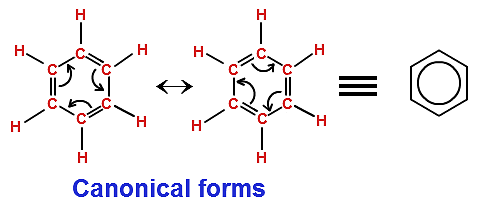
- On the other hand, it is the valence bond theory that describes the two stable resonance structures for the ring making an organic and aromatic hydrocarbon. Follow the diagram for a better understanding.

Properties of Benzene
[Click Here for Previous Year Questions]
The properties of benzene could be classified into two types, that is, the chemical properties and the physical properties.
- Physical properties of benzene
- Benzene has a colorless appearance and a sweet and pleasant smell similar to gasoline.
- It is known to be a highly flammable and volatile liquid.
- Benzene is more easily soluble in organic solvents as compared to water.
- Benzene has multiple properties which manifest its structure of resonance and simultaneously it has elements of aromaticity as well.
- Benzene is an organic compound and an essential hydrocarbon and has an extremely lighter density which is even lower than that of water at 0. 87gm cm3.
- Chemical Properties of Benzene
- Nitration: Nitration involves the reaction when benzene is reacted with nitric acid in the presence of sulphuric acid. The temperature then remains at 55°C and it results in the formation of nitrobenzene.

- Sulphonation: Benzene reacts with fuming sulphuric acid and results in the formation of benzene sulfonic acid in sulphonation reactions.

- Halogenation: Benzene reacts with halogen in the presence of the Lewis acid resulting in the formation of aryl halide. This reaction is known as halogenation.

- Friedel Crafts Acylation reaction: During the reaction of the benzene with an acyl halide, in presence of Lewis acid, it results in the formation of acyl benzene. This is called Friedel craft’s acylation reaction.

- Friedel Crafts Alkylation reaction: During the reaction of the benzene with an alkyl halide, in presence of Lewis acid like anhydrous Aluminium Chloride, alkyl benzene is formed. This is called Friedel craft’s alkylation reaction.

Read Also: Carboxylic Acid
Resonance of Benzene
[Click Here for Sample Questions]
- Benzene is a hydrocarbon that has a resonance structure and this has been accompanied by the presence of the double bonds which oscillate in the ring-like structure of benzene. All this has been proven through the valence bond theory.
- In the benzene ring, it is seen that all the carbon atoms which are present, are sp2 hybridized. Albeit, there is one sp2 hybridized orbital atom that undergoes overlapping with the sp2 orbital of the adjacent carbon atom. Thus, all of this easily leads to the formation of six C-C sigma bonds.
- This makes a way for the leftover sp2 hybridized orbitals to combine with s orbital of hydrogen and it ultimately results in the formation of the six C-H sigma bonds.
- While the remaining carbon atoms which have unhybridized p orbitals form pie bonds along with the adjacent carbon atoms by the phenomenon of lateral overlap.
- This kind of formation lately represents the hybrid structure, followed by inserting a circle in the ring. Therefore, this manifests the formation of the two resonance structures as proposed by Kekule.
Also Read:
| Related Articles | ||
|---|---|---|
| Lindlar Catalyst | Saturated Hydrocarbon | |
| Alkane and Alkene | Huckel Rule | |
Aromaticity of Benzene
[Click Here for Previous Year Questions]
The bonds of carbon with carbon that are present in benzene are of medium length due to which the benzene is an aromatic compound. Along with that, the benzene structure has the components of planarity, delocalization of the π electrons in the ring of benzene, and the presence of (4n + 2) π electrons in the ring where n symbolizes an integer. And therefore, the presence of such components in the benzene ring is majorly responsible for the aromaticity of benzene.
Preparation of Benzene
[Click Here for Sample Questions]
There are majorly three main types of methods that are responsible for the preparation of benzene. Let us see all of them.
- The very first method of preparing the benzene is through alkynes. The process involves the polymerization of ethyne through the hot iron tube, where 873K temperature works as the catalyst.

- Another method involves the use of aromatic acids which undergo a decarboxylation process. Here, the sodium benzoate and sodium hydroxide are heated to produce benzene, and calcium oxide acts as a catalyst in this reaction.

- The last method consists of the reduction of phenol which is heated along with zinc to reduce into benzene and zinc oxide.

Uses of Benzene
[Click Here for Previous Year Questions]
Benzene has all the required properties which makes it an aromatic hydrocarbon. Such hydrocarbons already have multiple usages and so does the benzene. It is used in various manufacturing and industrial sectors, for instance benzene is used for the production of lubricants, plastics, rubbers, dyes, synthetic fibers, etc. Apart from this, the organic compound of benzene also has multiple non-industrial usage. Let us see some of the important uses/applications of benzene.
- Benzene acts as the raw material for the preparation of phenol. Simultaneously, it is also used for the production of aniline.
- Benzene serves as an important element that is used for the degreasing of the metal.
- The manufacturing of nylon fibers is also done through benzene.
- Most importantly, benzene can also be used as an important element or substance for the production of numerous types of chemicals like ethylbenzene, cyclohexane, cumene, nitrobenzene, alkylbenzene, etc.
Health Effects of Benzene
[Click Here for Sample Questions]
Benzene is an organic compound and has multiple applications in the industry and outside as well. But nonetheless, it could not be ignored that benzene is tahazardous compound, it is a toxic and a carcinogen element. Therefore, its accidental consumption might lead to severe diseases such as leukemia or it might also damage the central nervous system and affect the chromosomes in the human body.
Things to Remember
- Benzene is the simplest organic compound that was first discovered by an English scientist, Michael Faraday. Although, the compound received its name from the German Chemist Eilhard Mitscherlich in 1833.
- Benzene is an organic compound that is also found in nature, that is, we can extract benzene from volcanoes, plants, animals, and forest fires.
- Benzene also acts as a major petrochemical product as it is found in crude oil and is also extracted from the coal as its by–product, thus, benzene is also one of the major industrial chemicals.
- Benzene has a clear, crystal–like appearance with a pleasant smell.
- Benzene is also a raw material for a variety of products, like it is used for the production of medicines, plastics, oil, synthetic rubber, and dyes.
- It is used for making plastics, detergents, and pesticides. Benzene is also considered one of the most important components of gasoline.
Previous Year Questions
- Identify Z in the sequence of reactions, CH3CH2CH…..[NEET 2014]
- Which of the following alkane cannot be made in good yield by Wurtz reaction ? [NEET 2020]
- Which of the following compounds has the lowest boiling point? [NEET 1994]
- Which of the following has zero dipole moment? [NEET 1996]
- An alkyl bromide (X)(X) reacts with Sodium in ether to form 4, 54,5 -diethyl octane, the compound X is [KCET 2013]
- Conversion of benzene to acetophenone can be brought by [KCET 2013]
- Cycloalkane formed when 1, 41,4 -dibromopehtane is heated with Sodium is [KCET 2013]
- Ethyl benzene cannot be prepared by [KCET 2011]
- In electrophillic aromatic substitution reaction, the nitro group is meta directing because it [KCET 2009]
- Which one of the following is NOT formed when a mixture of methyl….… [KCET 2012]
- Which one of the following reactions proceeds through free radical chain mechanism? [KEAM]
- In the eclipsed conformation of ethane, the dihedral angle between the hydrogen atoms….. [KEAM]
- Sulfonation of benzene with excess sulfuric acid provides [KEAM]
- (CH3)3CMgCl on reaction with D2O produces [KEAM]
- Chlorination of benzene in the presence of halogen….[KEAM]
- The compounds formed at anode in the electrolysis of an aqueous solution of potassium….[JIPMER 2009]
Sample Questions
Ques. What is Benzene? (2 marks)
Ans. Benzene is the simplest organic compound that was first discovered by an English scientist, Michael Faraday. Although, the compound received its name from the German Chemist Eilhard Mitscherlich in 1833. Benzene is understood as an aromatic hydrocarbon which is represented by the chemical formula C6H6.Benzene is an organic compound that is also an essential and natural component of crude oil. Physically, it looks like a colorless liquid with a pleasant odor that resembles the odor of gasoline. Chemically, scientists have found that benzene is a highly toxic and carcinogenic compound. Its usage as the raw material for the production of polystyrene is one of its important feature.
Ques. Define benzene. Mention a few important characteristics of Benzene. (5 marks)
Ans. Benzene is an organic compound that is also an essential and natural component of crude oil. Physically, it looks like a colorless liquid. Its characteristics are as mentioned below.
- First of all, in terms of appearance, Benzene has a crystal-like texture. It does not have any specific color which makes it less attractive but simultaneously carries a pleasant smell.
- The chemical formula of benzene is C6H6 which is the combination of carbon and hydrogen. This also means that benzene is an aromatic hydrocarbon.
- The structure of benzene is like a ring with six inter–connected carbon atoms joined by single and double bonds.
- Benzene is also a major petrochemical substance, therefore, a large amount of benzene is also found in crude oil.
- The melting point of benzene is about 5.5 degrees Celsius while the boiling point for the same is 80.1 degree Celsius.
Ques. Illustrate the chemical properties of benzene in terms of chemical reactions. (5 marks)
Ans. Some of the chemical reactions associated with benzene are as follows.
- Nitration: Benzene reacts with nitric acid, that too, in the presence of the sulphuric acid. The temperature at which the reaction takes place is 55°C and it results in the formation of nitrobenzene.
- Sulphonation: Benzene reacts with the fuming sulphuric acid and results in the formation of benzene sulfonic acid.
- Halogenation: Benzene reacts with halogen, that too, in the presence of the Lewis acid and it results in the formation of aryl halide.
- Friedel craft’s acylation reaction: During the reaction of the benzene with an acyl halide, in presence of Lewis acid, an acyl benzene is formed. This is called Friedel craft’s acylation reaction.
- Friedel Crafts Alkylation reaction: During the reaction of the benzene with an alkyl halide, in presence of Lewis acid like anhydrous Aluminium Chloride, alkyl benzene is formed. This is called Friedel craft’s alkylation reaction.
Ques. What are the physical properties of benzene? Enumerate the list of the food items containing benzene. (5 marks)
Ans. The physical properties of benzene are as follows.
- Benzene has a colorless appearance and a sweet and pleasant smell.
- It is known to be a highly flammable and volatile liquid.
- Benzene is more easily soluble in organic solvents as compared to water.
- Benzene has multiple properties of showing resonance and aromaticity.
- Benzene is an organic compound with an extremely lighter density, even lower than that of water at 0.87gm cm3.
The food items which contain benzene are mentioned below.
- Pineapple Crush
- Giant Light Cranberry Juice Cocktail
- Aqua Cal Strawberry Flavoured Water Beverage
Ques. Mention in detail the health effect of benzene. (2 marks)
Ans. Benzene is an organic compound and has multiple applications in the industry and outside as well. But nonetheless, it could not be ignored that benzene is the most hazardous compound, it is a toxic and a carcinogen element. Therefore, its accidental consumption might lead to severe diseases such as leukemia or it might also damage the central nervous system and affect the chromosomes in the human body.
Ques. Illustrate the structure of the benzene. (4 marks)
Ans. Just like every other compound, benzene also has a unique structure that reflects its formation. Such as,
- Benzene (C6H6) has a ring–like structure that has six inter–connected carbon atoms joined by single and double bonds.
- It looks like a cyclic hydrocarbon, which means that each of the atoms of the carbon is arranged in a ring–like structure with six vertices. All of these carbon atoms then make the bond with only one hydrogen atom each.
- The Benzene ring involves the formation of three separated π – orbitals spanning through all the six carbon atoms at the vertices. This type of formation of an organic compound has also been described in the molecular orbital theory.
- On the other hand, it is the valence bond theory that describes the two stable resonance structures for the ring making an organic and aromatic hydrocarbon.
Ques. Explain the three important methods for the preparation of benzene. (3 marks)
Ans. There are majorly three main types of methods that are responsible for the preparation of benzene.
- The very first method involves the polymerization of ethyne through the hot iron tube, where 873K temperature works as the catalyst.
- Another method involves the decarboxylation process. Here, the sodium benzoate and sodium hydroxide are heated to produce benzene, and calcium oxide acts as a catalyst.
- The last method consists of the usage of phenol which is heated along with zinc to reduce it into benzene and zinc oxide.
Ques. Explain the properties of benzene which are responsible for aromaticity. (3 marks)
Ans. The bonds of the carbon with carbon that are present in benzene are of medium length due to which the benzene is an aromatic compound. Along with that, the benzene structure has the components like planarity, delocalization of the π electrons in the ring of benzene, and the presence of (4n + 2) π electrons in the ring where n symbolizes an integer. And therefore, the presence of such components in the benzene ring is majorly responsible for the aromaticity of benzene.
Ques. What is Benzene? Mention its applications. (4 marks)
Ans. Benzene is an organic compound that is also an essential and natural component of crude oil. Some of the most common applications of benzene as a hydrocarbon are mentioned below:
- Benzene acts as the raw material for the preparation of phenol. Simultaneously, it is also used for the production of aniline.
- Benzene serves as an important element that is used for the degreasing of the metal.
- The manufacturing of nylon fibers is also done through benzene.
- Most importantly, benzene can also be used as an important element or substance for the production of numerous types of chemicals like ethylbenzene, cyclohexane, cumene, nitrobenzene, alkylbenzene, etc.
Ques. Explain the resonance structure of the benzene. (5 marks)
Ans. Benzene is a hydrocarbon for which it is possible to have a resonance structure and this has been accompanied by the presence of the double bonds which oscillate in the ring–like structure of benzene. All this has been proven through the theory of the valence bond.
- In the benzene ring, it is seen that all the carbon atoms which are present, are sp2 hybridized. Albeit, there is one sp2 hybridized orbital atom that undergoes overlapping with the sp2 orbital of the adjacent carbon atom. Thus, all of this easily leads to the formation of six C - C sigma bonds.
- And this makes a way for the leftover sp2 hybridized orbitals to combine with s orbital of hydrogen and it ultimately results in the formation of the six C - H sigma bonds.
- While the remaining carbon atoms which are unhybridized p orbitals lead to the formation of pie bonds along with the adjacent carbon atoms by the phenomenon of lateral overlap.
- This kind of formation represents the hybrid structure, followed by inserting a circle in the ring Therefore, this manifests the formation of the two resonance structures as proposed by Kekule.
Do Check Out:



Comments