



Content Curator
Carbocation is an organic species with a positive charge and a carbon atom with only six electrons in its outermost shell. With a flat structure, the carbocation has all the three covalent bonds in plane with the bond angle of 120 between them.
| Table of Contents |
Read More: Etard reaction
Carbocation Stability Definition
Carbocations have a planar structure and their trivalent carbon can be referred to as the sp² hybridizes. The three constituents are placed in the corners of an equilateral triangle. Since there are only six valence electrons on carbon and all of them can be said to be in sigma bonds, the p orbital exceeding the plane either up or down, remains empty. 2 methyl propene can be reactive in the presence of H? in order to give rise to carbocation consisting of three alkyl substituents or tertiary ion of 3º and it can react in order to produce the carbonation consisting of one alkyl substituent having a base ion of 1º. Tertiary cation is more favoured than the primary one since the tertiary alkyl chloride can be said to be the only product that is visible.
Carbocation stabilities can be determined by measuring the amount of energy to create the carbocation by dissociating the corresponding alkyl halide, whereas the tertiary alkyl halide separates to produce carbocation much more easily than primary or secondary that leads to tri-substituted carbocations which can be found to be more easily stable than the di-substituted or mono-substituted ones. The polar solvents can easily stabilise the ions which result in a low dissociation enthalpy, however there is no change in the carbonation stability.
Read More: Collision Theory
Reactivity and Stability of Carbocations
The relationship between reactivity and stability of carbocation is an important aspect to understand especially in cases of nucleophilic substituents. Carbocations can be formed through the organic reactions in order to produce organic compounds. Through this reaction tri-coordinated carbonation intermediate is produced which is entirely different from the nucleophilic or electrophilic substitution.
- Carbocation is very unstable and brought as intermediate since stability is reciprocally proportional to the charge.
- When in the gaseous phase the ionization of 2-chloro-3-methyl propane is known as endothermic having a 153 Kcal per mol the rate of reaction will be slow at the room temp.
- The activation energy of carbocation increases with solvents, hence the results of the gas phase are often disregarded.
- The thermodynamic stability of carbocation is known by the measurement of hydride affinity.
- Hydride affinity is defined as enthalpy of reaction for the dissociation of RH- to yield R+ H-.
- The thermodynamic basis for comparing the relative stability of non isomeric carbocations is hydride affinity.
- If the hybride affinity price is a smaller amount, stability of carbocations can increase.
- Resonance/mesomeric impact > Hyperconjugative impact > Inductive impact
Read Also:
Allylic Carbocation Stability
Similar to allylic radicals, allylic carbocation contains a double bond beside the carbon having a carbon-deficient. The allyl cation can be referred to as the simplest form of allylic carbocation. Since the allyl cation consists of only a single substituent on the positive charged carbon it can be said to be a primarily allylic carbocation. Allylic carbocation is more stable than the substituted alkyl carbocation due to the delocalization relation of the resonance interaction between the carbon bearing the positive charge and the pie bond present next to it.
A molecule having its charge distributed can be considered as more stable than a molecule having a localized charge. It has also been determined through experiments that a double bond of a vinyl group present adjacently imparts stability which is approximately equal to two alkyl groups. Therefore it can be said that the cation 2º isopropyl cations are more stable in comparison. 1º, 2º, 3º alkyl cation can be decided through the placement of the positive charge present in the more important contributing structure.
CH2 = CH-CH2+
CH3-CH+-CH3
Reaction Intermediate
Reaction intermediate can be found in Elimination Reaction, Electrophilic Addition Reaction and Substitution Nucleophilic Unimolecular reaction. The tertiary carbocations are more stable than secondary because we have three electron donating groups and in secondary it'll be two and for primary it is one. Methyl Carbocation is a very weak electron donating group. It can donate electron density to the carbocation by the means of the inductive effects i.e., through the sigma bond that is the way it can stabilize and also by hyperconjugation and resonance effects.
Carbocation Stability Order
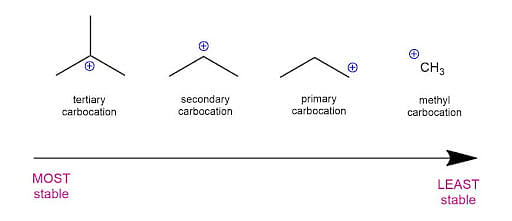
Carbocation Stability
While comparing the carbocations it must be kept in mind that the standards for every cation is the substrate from which it is produced. Through experiments we know that as the carbocation decreases in order, its stability decreases. It has been observed that the primary and methyl carbocations are so unstable that they can hardly be seen in any solutions. We can say that the more the stability of the carbocation intermediate, the faster is its formation. When the charge of a system is delocalized it is considered to be more stable irrespective of its positive or negative charge.
The carbocation stability order can also be explained by considering that when the alkyl groups bond to a carbon which is positively charged and exerts electron density in the direction of the carbon and helps in delocalizing the cation having the positive charge. Therefore the electrons that release the ability of alkyl groups that bonds to a cationic carbon can have either of the two results: Inductive effect or hyperconjugation.
Methyl cationEthyl cationIsopropyl cationTert-butyl cation
Carbocations have more difference in stability than that of free radicals. The tert butyl radical is 12 Kcal more in stability than the methyl free radical. Therefore it depends on the substrate which has 66-72 Kcal more stability than the methyl cation.
- Forms between the reaction takes place
- Short life span approximately of (10− 6 sec)
- Which decides final product
- Examples: Carbocation, Carbanion, Free Radical, Carbenes, Nitrenes, Benzyne etc. Carbocation Characteristics:
- 6 electrons in valence shell/ Electron deficient- It is an electrophile
- SP2 Hybridized with trigonal planar shape.
Inductive Effect of Carbocation Stability
- The inductive effect is caused by the shifting of sigma electrons as a result of the popularity of the bond.
- The polarity is the electronegativity difference.
- There are two types of inductive effects. Positive inductive effect and negative inductive effect
- Positive inductive effect occurs due to the relocation of sigma electron towards carbon atom as a result of the presence of electron releasing group
- Negative inductive effect is due to shifting of sigma electrons away from carbon atoms due to presence of electron withdrawing group.
Hyper-Conjugation Effect on Carbocation Stability
- This is a stabilising impact caused by the letter bond within the C-H bond once there's associate degree empty or partly crammed or pi bond adjacent to the C-H bond.
- Hyperconjugation primarily involves delocalisation of letter electrons through overlapping p-orbitals of a covalent bond with letter orbital of the adjacent single bond.
- Since one H+ is free and conjointly the actual fact that it will happen in a very resonant manner, provides it a reputation of no bond resonance.
- The number of hyperconjugative structures and its stability is proportional to each other.
- Tertiary carbocation is additional stable than secondary carbocations
- Secondary carbocation is area unit additional stable than primary carbocations
- Primary carbocation may be a rue stable than alkyl group carbocations
- Stability order-“ Tertiary C> Secondary C> Primary C”
- In carbocation, it's the immediate Carbon connected to the carbocation that undergoes this hyperconjugation
Resonance Effect
- It is outlined as ‘the polarity created within the molecule by the interaction of 2 pi-bonds or between a pi-bond and lone combine of electrons gift on the adjacent atom’
- The impact is transmitted to chain
- There area unit 2 kinds of resonance or mesomeric impact selected as R or M impact
- Positive Resonance impact
- Negative Resonance impact
- Positive Resonance Effect( +R Effect): Electrons area unit transferred faraway from the conjugated system's atom or substituent cluster.
- Negative Resonance Effect( -R Effect): Electrons area unit transferred towards the conjugated system's atom or substituent cluster.
- More resonant Structure will increase stability
Also Read:
Things to Remember
- Carbocation stability is a part of CBSE class 11 first term chemistry syllabus.
- It comes under unit 7 Organic Chemistry: Some basic Principles and Techniques carrying a total of 10 periods and 9 marks.
- Carbocation has a greater influence on the final product because it forms as an intermediate product between reactions
- Precautions must be taken ahead of time because these are extremely unstable.
- 6 electrons in valence shell/ electron deficient is known as an electrophile.
- SP2 Hybridization and its shape is trigonal planar in carbocation.
- Carbocation can be found in elimination reaction, electrophilic addition reaction and substitution nucleophilic unimolecular reaction.
Sample Questions
Ques 1. Why does stability of carbocations increase with substitution? (2 marks)
Ans. Carbocation for a positively charged species is electron deficit, hence something that contributes the density of the electron to the electron deficit center helps in stabilizing it. It is incorrect to determine that mostly the carbocations with higher substitution are more stable than the lower ones.
Ques 2. Are allylic carbocations more stable than tertiary? (1 marks)
Ans. When it comes to stabilized resonance carbocations, the primary ones are less stable than the tertiary but the secondary ones are more stable in comparison to tertiary ones.
Ques 3. How does conjugation affect stability? (2 marks)
Ans. A conjugated structure can be referred to as a system of bound p orbitals present in a molecule consisting of delocalized electrons which helps in attaining stability by lowering the total energy of the molecule. It is traditionally referred to as one containing one and several alternating bonds.
Ques 4. What is the stability of carbanion? (2 marks)
Ans. A carbonion can be said to be a nucleophile that regulates the reactivity and stability with the help of various factors known as the inductive effect. The voltage helps in stabilizing the electronegative atoms present beside the charge. The stability of the anion increases with the increase in the charge bearing atom, the degree of anion’s conjugation.
Ques 5. Rank the carbocations in order of decreasing stability. (2 marks)

Ans. The carbocation becomes more stable with increasing substitution as a result of the inductive effect. In the inductive effect the side by side carbon atoms contribute some of their electron density to the nearby carbocations in order to make them neutral and more stable. Hence the 3º carbocation can be referred to as the most stable.

Ques 6. Let's go over how carbocation can form from alcohol. Write in the curved arrows to show the formation of the protonated alcohol, and water acting as a leaving group to form a carbocation. (2 marks)
Ans.


Ques 7. Let's go over how a carbocation can form from an alkene. Use curved arrows to show the two carbocations that can form from 1-methylcyclohexene. (3 marks)

Ans. Only 3º carbocations are formed since they are more stable than that of the 2º ones.

Ques 8. Carbocations aren't very stable and so don't last very long after they are formed. (5 marks)
Use curved arrows to show:
- how a carbocation reacts with halide ions to form an alkyl halide.
- how a carbocation reacts with water to form an alcohol.
- how a carbocation reacts with a base to form an alkene.

Ans.

Ques 9. Which carbocation is the most stable? (2 marks)

Ans. b.
This carbocation is most stable due to extended conjugation because with an increase in the adjacent methyl groups the hyperconjugation stabilization increases due to an increased number of adjacent C-H.
Ques 10. Which one among the following carbocations has the longest half-life? (2 marks)

Ans. a.
The half-life of the cation increases with its increasing stability. In carbocation, the p orbitals overlap the compound and become a more stabilizing factor than the aromaticity.
Ques 11. The order of decreasing stability of the following cations is: (4 marks)
(I) CH3C+ HCH3 (II) CH3C+ HOCH3 (III) CH3C+ HCOCH3
- III > II > I
- I > II > III
- II > I > III
- I > III > II
Ans. a.

Ques 12. Which of the following is the most stable intermediate? (2 marks)


Ans. c has the most stable intermediate since it is stabilized by +M effect of OH and hyperconjugation effect (5????H).
Ques 13. Which intermediate is involved in the reaction given below? (1 mark)

- free radical
- carbocation
- carbanion
- carbene
Ans. d
Ques 14. Arrange the following intermediate into decreasing order of stability. (1 mark)

- I > II > III > IV
- II > IV > III > I
- II > I > IV > III
- II > I > III > IV
Ans. d
Also Read:



Comments