



Content Curator
Atomic Mass is the sum of the masses of an atom's protons, neutrons, and electrons. Besides, atomic mass can too be referred to as the average mass in a group composed of atoms. Also, electrons have a much lesser weight than both protons and neutrons. Thus, electrons don't make any difference in the calculations. In this way, the atomic mass of an element effectively is the total sum of masses of neutrons and protons.
The basic formula to calculate the atomic mass of an element/molecule is given below:
Atomic mass = mass of Protons + mass of Neutrons + mass of Electrons
| Table of Content |
Read More: Acid Test
Atomic Mass
Atomic mass of an element is equal to the weighted average of the isotopes that belongs to that element. The isotopes are those atoms that have the same atomic number but a different number of neutrons. The measurement of an atomic mass takes place in the atomic mass units i.e. amu and 1 amu is roughly equal to the mass of a single proton or neutron.
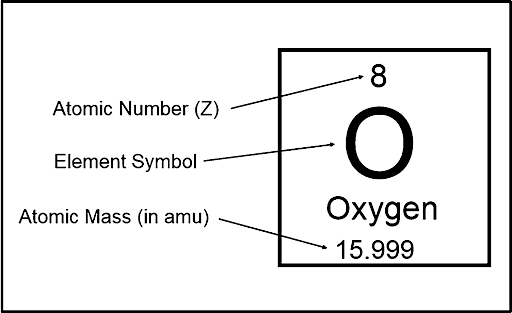
The atomic mass of an element can be calculated by multiplying the element’s isotope mass with its relative abundance. After multiplication, the individual masses are added together to the result.
Read More: Synthetic Rubber
Atomic Mass Calculation
There are a total number of 3 ways depending upon circumstances for calculating the atomic mass of an element.
Referring to the Periodic Table
Inside a periodic table, the digit of an atomic mass is generally marked beneath the description of an element.
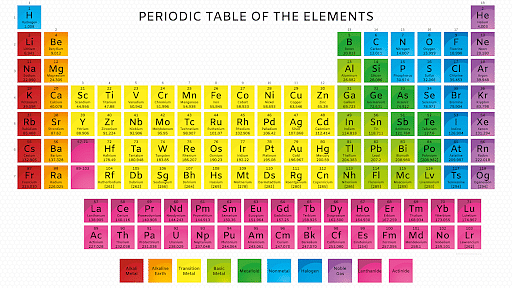
For instance,
Hydrogen (H) atomic mass -1
Lithium (Li) atomic mass -3
Also Read:
Addition of Mass of Protons & Neutrons
For an element, its atomic mass can be determined by adding the mass of protons and neutrons.

Weighted Average of Elements
The weighted average of an isotope of each element grounded by their abundance is the atomic weight of an element. The list of isotopes having natural abundance and mass is provided either as a percentage value or a decimal value. Every isotope’s abundance is multiplied by its mass. If the abundance of an isotope is present, then their solution has to be divided by 100 and add these values.
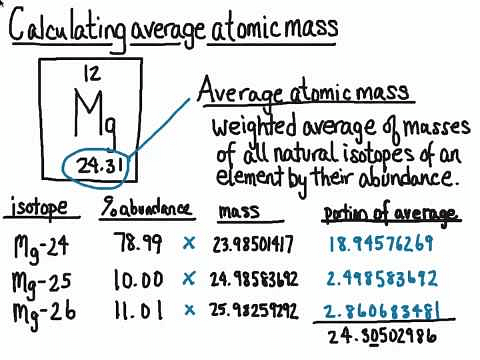
The solution will contain the atomic mass of the specific element where the unit of atomic mass can be related with the other mass unit by the use of the conversion factor.
1u = 1.66054 x 10⁻²⁴g.
Read More: Zero Order Reaction
Atomic Mass of Elements
Atomic mass of elements is measured through unique atomic mass units for each atom. In other words, the total of the masses of Neutrons, Protons & electrons of an atom is the atomic mass. Since Protons or neutrons have more mass than in comparison with electrons, that is why the mass of electrons is not included in the calculation.
Atomic mass= Mass of Protons + Mass of Electrons + Mass of electrons
Atomic mass is known as unified atomic mass and hence is denoted by ‘u’.
Atomic Mass of First 10 Elements
| Atomic no. | Element | Atomic Mass |
|---|---|---|
| 1 | Hydrogen | 1.008 |
| 2 | Helium | 4.0026 |
| 3 | Lithium | 6.94 |
| 4 | Beryllium | 9.0122 |
| 5 | Boron | 10.81 |
| 6 | Carbon | 12.011 |
| 7 | Nitrogen | 14.007 |
| 8 | Oxygen | 15.999 |
| 9 | Fluorine | 18.998 |
| 10 | Neon | 20.180 |
Relative Atomic Mass
The relation between the mass of an element and the number of atoms it carries is the element's relative atomic mass of an atom. It’s used to compare masses of different atoms.

The lightest atom of all was initially assigned a relative atomic mass of 1 and the relative atomic mass of the rest elements as compared with this.
Read More: Tollens' Test
Things to remember
- Matter is composed of very tiny parts which are known as atoms
- The electrons have a lesser weight than protons and neutrons.
- Atomic mass is the sum of the total mass of protons, neutrons, and electrons.
- An atomic mass of an element is not reported with units.
- An atomic number is equivalent to the fraction of protons existing in the nucleus of an atom.
Read More: Williamson Synthesis
Sample questions
Ques: What is the element mass number when the atomic number is 18 and the neutron number is 20? (3 marks)
Ans: No. of Neutrons = 20
No. of Protons = 18
Atomic mass number= No. of protons + No. of neutrons
A= 20+18
Mass no. = 38
Ques: What are the different ways to calculate atomic mass? (3 marks)
Ans: There are commonly three methods with the help of which you can determine the atomic mass of a given element based upon the circumstances, which is as follows:
- By referring to the periodic table
- By additions of no. of mass & no. of protons
- Weighted average of elements.
Ques: Which is the heaviest element? (2 marks)
Ans: The heaviest element or stable element is Uranium. The atomic number of uranium is 92 hence, it is the heaviest element. In the nucleus of an atom, the atomic number corresponds to the number of protons. All the elements which have atomic numbers greater than equal to 92 are considered to be heavy elements.
Ques: What will be the mass number of an element having 15 as atomic number and the total number of protons present is 15? (2 marks)
Ans: We can calculate the mass number using the formula,
Atomic number = Number of Protons present
Mass number = No. of Protons + No. of Electrons
=> 15+15
=> 30
Ques: Explain how the atomic weight can be measured? (2 marks)
Ans: For any isotope, the sum of total numbers of its protons & neutrons are identified as mass numbers. The mass of an atom can be calculated/ measured by adding both the number of protons and neutrons and then multiplying the result by 1 am.
Also Read:



Comments