



Content Curator
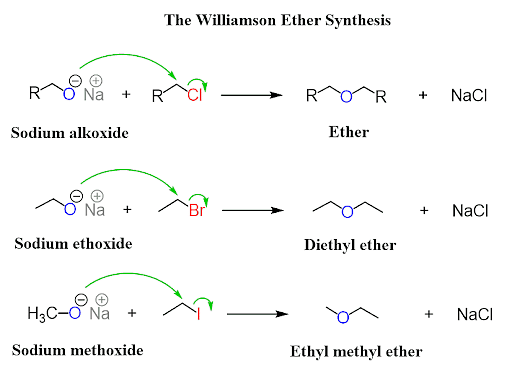
Williamson synthesis is a reaction that is organic in nature. It is a general method where ether is created by combining deprotonated alcohol (alkoxide) and organohalide. The structure of ether formation is studied in this reaction which makes it a very important reaction in organic chemistry.
| Table of Content |
Key Terms: Williamson synthesis, alcohol, alkoxide, organohalide, C- alkylation, alkali phenoxide, organic chemistry, ether
Williamson Ether Synthesis Importance
[Click Here for Sample Questions]
The reaction is important in organic chemistry because:
- Primary alkyl halide reacts with alkoxide ion which gives rise to SN2 reaction which leads to the formation of the structure of the ethers.
- It is essential for the alkyl halide to be primary or secondary as the reaction can happen only in an SN2 pathway.
- Their ethers have a more complex structure because they have a high amount of carbon atoms.
The reaction is:

Williamson Ether Synthesis
The reaction of chloroethane and sodium ethoxide results in the formation of sodium chloride and diethyl ether. The reaction is:
Na + C2H6O- + C2H6ClC2H6OC2H6 + Na+Cl-
Also Read:
| Related Articles | ||
|---|---|---|
| Acetylation | Carboxylic Acid | Wittig Reaction |
| Gattermann – Koch Reaction | Kolbe’s Reaction | Fehling Test |
Mechanism of Williamson Ether Synthesis
[Click Here for Previous Year Questions]
- Williamson ether reaction used the SN2 bimolecular nucleophilic substitution reaction.
- In the SN2 reaction mechanism, the nucleophile creates a backside attack on an electrophile.
- The whole process takes place all at once in a concentrated mechanism.
- Halide is strongly electronegative which is necessary for an SN2 reaction to take place.
- An alkoxide ion (RO) acts as The nucleophile in Williamson ether reaction which attacks the electrophilic carbon with an alkyl halide or an alkyl tosylate.
- The withdrawing group must be a primary carbon as the tertiary and secondary withdrawing groups lead to an elimination reaction.
- The reaction supports the formation of alkenes instead of the formation of substantial ethers such as di-tert butyl ether because of its spatial hindrance.
Uses of Ether
[Click Here for Sample Questions]
- Alkoxide can be primary, secondary, or tertiary but a primary alkylating agent is preferred. A sulfonate ester is specially made for the reaction if the withdrawing group is not a halide.
- The reaction is highly used in laboratories and industries in the preparation of both symmetrical and asymmetrical ethers. It is considered the most simple and easy method of preparing ethers. The intramolecular reaction of the halohydrins produces epoxides.
- In the Williamson reaction, two alcohols are used for the production of ethers. The two respond together (slylate) after one of them is converted to a leaving group (tosylate)
- The selection of the preferred reactant in unsymmetrical ether depends on the reactivity or the availability.
Disadvantages of the Reaction
[Click Here for Previous Year Questions]
Disadvantages of the reaction are as follows:
- Synthetic organic chemists find this process for preparing ethers to be very much limited to be used practically.
- In the presence of alkoxide where the nucleophile acts as a base, the primary, secondary, and tertiary halides undergo E2 elimination.
Conditions Required
[Click Here for Sample Questions]
Conditions required for the reaction are as follows:
- In extreme cases, silver oxide which is a silver salt assists the leaving halide group to make its withdrawal more simple
- A catalyst is not required in a lab synthesis process but iodine salt is added if the alkylating agent is unreactive.
- Laboratory preparation uses a carbonate base or a potassium hydroxide. Industrial preparation uses the phrase transfer catalysis.
- The reaction requires a temperature of 50-100 degrees Celcius in a duration of 1-8 hours for the completion of the reaction
- Due to side reactions, it is impossible to completely use the raw materials which result in 50-95% yield.
Things to Remember
- Williamson ether synthesis is a part of CBSE class 12 unit 5 Alcohols, Phenols and Ethers.
- It carries a total of 9 periods and 4 to 5 marks.
- Better quantitative result can be expected from the industrial procedure
- C- alkylation along with O- alkylation takes place in the case of alkali phenoxide
- Solvents such as N- dimethylformamide, acetonitrile, and N are used
- The carbon configuration is altered as Williamson ether synthesis is an SN2 reaction and it undergoes attack from the back.
Also Read:
Previous year Questions
- Indicate which set of reagents amongst the following is ideal to affect the above conversion?...[NEET 1989]
- Ethyl chloride is converted into diethyl ether by...[NEET 1999]
- When phenol is treated with excess of bromine water, it gives...[NEET 1992]
- HBr reacts fastest with...[NEET 1992]
- Methanol is industrially prepared by...[NEET 1992]
- How many isomers of C5H11OH will be primary alcohols?...[NEET 1992]
- Which of the following will not be soluble in sodium hydrogen carbonate?...[NEET 2014]
- Among the following sets of reactants which one produces anisole?...[NEET 2014]
- When phenol is treated with CHCl3 and NaOH, the product formed is :-...[NEET 1980]
- Reaction of phenol with chloroform in presence of dilute sodium hydroxide finally introduces which one of the following functional group ?...[NEET 2015]
- In the following sequence of reactions,….[NEET 2012]
- The reaction can be classified as:...[NEET 2016]
- n− propyl alcohol and isopropyl alcohol can be chemically distinguished by which reagent :-….[NEET 2002]
- The boiling point of ethanol is higher than that of dimethyl ether due to the presence of...[NEET 1993]
- In the reaction given below, ...[DUET 2009]
Sample Questions
Ques 1. What are the reactants used to make ether? (1 mark)
Ans: ether is made with alcohol or related bases. It involves an SN2 reaction between an alkyl halide and an alkoxide nucleophile.
Ques 2. Are ethers nucleophiles? Describe. (1 mark)
Ans: ethers in a nucleophilic substitution reaction, involve heavy acids such as HBr or HI which splits alkyl ethers. A good withdrawal group is created by the protonation of the ethereal oxygen. Halide ions, bromide, and iodide are regarded as nucleophiles.
Ques 3. Explain ion alkoxide. (2 marks)
Ans: Alkoxide ion is an assembled base of alcohols. It is an ion that is bonded with a negative formal charge on an oxygen atom to an sp3 carbon atom. They are denoted as RO- where R is the organic substituent.

Ion alkoxide
Ques 4. What is the name of the reaction? (1 mark)
C2H5ONa+IC2H5 → C2H5OC2H5 + Nal
Ans: Williamson ether reaction. It consists of alkoxide which reacts with sulfonate ester or primary haloalkane. Alkoxides have an R group bonded to an oxygen group. They involve a conjugate base of alcohol.
Ques 5. Which reactant is used to prepare tert-butyl ethyl ether? (2 marks)
Ans: Potassium tert- butoxide and ethyl bromide are used to prepare tert-butyl ethyl ether. Ethyl tert butyl ether ((CH3)3-O- CH2CH3) is formed when potassium tert butoxide ((CH3)3 O- + K is mixed with ethyl bromide (CH3CH2Br)
Ques 6. Mention the reaction condition and the reactant used in the following reaction.CH2CH2OH → C2H5OC2H5 (2 marks)
Ans: The reactant is H2SO4 and the reaction condition is 413K. Alkenes and ethers are produced by dehydration of the alcohols in the presence of sulphuric or protic acid. Ethane is produced by the dehydration of ethanol at 443k in the presence of sulphuric acid whereas ethoxyethane is produced at 413k under similar conditions.

Ques 7. Write the equation for the preparation of ethoxybenzene by Williamson ether synthesis. (1 mark)
Ans: The equation for the preparation of ethoxybenzene by Williamson ether synthesis:

Ques 8. Write the equation for the preparation of 1- propoxyphene by Williamson ether synthesis. (2 marks)
Ans: 
Ques 9. How is diethyl ether produced? (2 marks)
Ans: Diethyl ether is produced by the method of Williamson ether synthesis which is an industrial method for making ethers. Diethyl ether is made by heating sodium ethoxide and ethyl iodide.
C2H5ONa + C2H5I → C2H5 – O – C2H5 – O – C2H5 + NaI
Ques 10. What are the agents used in the synthesis of n- alkyl tert-alkyl ether? (1 mark)
Ans: 1º RX and 3º RONa are the reactants used.
n- alkyl tert-alkyl ether will go through dehydrohalogenation to form an alkene if 3ºRX is used.
Ques 11. Which method is used to prepare Me3COEt to get a good yield? (1 mark)
Ans: Mixing Me3COEt with EtCI results In a good yield. This is also an example of Williamson's synthesis.
Ques 1. Write the equations involved in the following reaction :
Williamson synthesis (2014)
Ans: Williamson ether synthesis: Alkyl halide when treated with sodium alkoxide gives dialkyl ether that can be represented as:
C2H5ONa + C2H5Cl → C2H5 - O - C2H5 + NaCl
Ques 2. Write the mechanism of the following reaction: (2016)
2CH3CH2OH → CH3CH2 - O - CH2 - CH3 (Conc. H2SO4 at 413K)
Ans: The formation of Ether can be termed as a nucleophilic bimolecular reaction.

Ques 3. Explain the following with an example: Williamson ether synthesis. (2014)
Ans: Williamson ether synthesis: Alkyl halide when treated with sodium alkoxide gives dialkyl ether that can be represented as:
C2H5ONa + C2H5Cl → C2H5 - O - C2H5 + NaCl
For Latest Updates on Upcoming Board Exams, Click Here: https://t.me/class_10_12_board_updates
Also check:



Comments