



Exams Prep Master
Synthetic Rubber is a kind of artificial or man-made elastomer. It is normally derived from the Polyene monomers’ additional polymer and excepting that the synthetic rubber gets disclosed as a Polysulfide rubber, and laminates consist of such a layer that can be categorized with additional polymer. It is a Synthetic high polymer that contains physical properties close to that of natural rubber and is generally a modified form of natural rubber, especially with regards to its properties like resistance to oils, gas, solvents, etc. It comprises carbon-carbon double bonds.
Also Read: Nernst Equation
Key Terms:- Synthetic rubber, Elastomer, Polythene, natural rubber, polymer, resistance, rubber, elastic, Polysulfide rubber, Polyene
What is Synthetic Rubber?
[Click Here for Previous Year Questions]
Like polymer, Synthetic rubber is vulcanized rubber, having the capability of getting stretched twice its length. Immediately after the external stretching force is released, it gets back to its original shape and size. Elastomer is basically characterized as a material having mechanical property due to which it can withstand much more elastic deformation, under stress compared to most of the substances, and still reappear to its older size without any permanent deformations. Synthetic rubber is a good option for natural rubber in many cases especially when an improved material property is a must requirement.
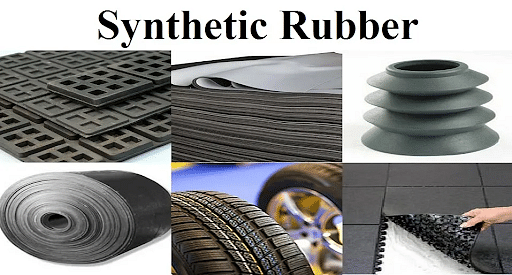
Synthetic Rubber
Based on the chemicals which are being added and properties related to it, the synthetic rubber can be as harder as a bowling ball, as soft as a sponge, or as resilient as a rubber band. Approximately 70% of all rubber that is being used today is one that is from a wide variety of synthetic rubber. Synthetic rubber is synthetically prepared from petrochemical feedstock’s and crude oil is the principal raw substance for them. Synthetic rubbers are stored in dry places while a few others are stored in cool places. Synthetic rubbers can be stored for up to 5 years and if required can be extended to the next 2 years.
Also Read: Imperfections in Solids
History of Synthetic Rubber
[Click Here for Sample Questions]
The motor vehicle tires starting in the era of 1980s created an increased demand for rubber after the extended use of motor vehicles. Also, a team which was headed by Fritz Hofmann got succeeded in the experiment of Polymerization of Isoprene.

The United States effectively reserved a huge inventory of natural rubbers in 1940 and it doubled the normal quantity of import around 0.5 million tons per year. But Japan played took a very harsh step and captured South-East Asia in 1941 by suspending the supply of natural rubber for the US. In the very first comeback of this supply crisis, the US Government managed the situation somehow and ordered the Plantation of thousands of acres of Guayule. This was a kind of shrub that was developed in western areas of the US and Mexico containing a kind of rubber latex, but the major problem with this shrub was that the yielding of rubber was a very difficult task at that time. The plant must be ground up and extracted hence a constant supply of new plants was required.
At the end of this war, petroleum worked as a base for synthetic rubbers. On one side the manufacturing process of usage of petroleum was very complex, also the petroleum chemical was cheaper and progress was very fast. The largest successive producer of synthetic rubber during the war was B.F. Goodrich due to his early contribution in the synthesis of rubbers. The US firms made 51 synthetic rubber factories between 1942-45. During this time period, production was increased from 24,640 tons to more than 784000 tons in the year 1942-45.
Also Read: Solid State
Production of Synthetic Rubber
[Click Here for Previous Year Questions]
The main unbaked material to produce synthetic rubber types are Petrochemical Feedstock’s and Crude Oil acts as a key component here. To produce the general types of rubbers in the category of synthetic rubber, two types of gases are used mainly and those gases are Butadiene used to make Butadiene Rubber and Styrene used to make Styrene Butadiene Rubber. The result of petroleum refining is Butadiene and Styrene is received either via cooking process or as a result of petroleum refining. When these 2 gases are blended together in the existence of Soapsuds in a reactor, liquid latex is produced as a result. This is a milky liquid in which a dry rubber is consolidated into crumbs, washed, dried, and make ready to deliver.
Also Read: Copolymers
Classification of Synthetic Rubbers
[Click Here for Sample Questions]
There are approximately 20 diverse types of chemicals to make different classes of synthetic rubber. Following are the commonly found synthetic rubber.
- Acrylic Rubber (ACM)
- Butadiene Rubber (BR)
- Butyl Rubber (IIR)
- Chlorosulfonated Polyethylene (CSM) / Hypalon
- Ethylene Propylene Diene Monomer (EPDM)
- Fluoroelastomer (FRM)/ Viton
- Isoprene Rubber (IR)
- Nitrile Rubber (NBR)
- Perfluroelastomer (FFKM)
- Polychloroprene (CR)/ Neoprene
- Polysulfide Rubber (PSR)
- Silicon Rubber (SIR)
- Styrene-Butadiene Rubber (SBR)

Classification of Synthetic Rubbers
Also Read: Packing Efficiency
Data Facts about Synthetic Rubber
As per the research reports, the global need for industrial rubber production is predicted to increase to 4.3% annually through 2013 to $97.8 Billion.
The categorization between natural and synthetic rubber is about 40% for natural & 60% for synthetic rubber on a global basis and is not expected to change a lot in upcoming years.
Also Read: Solutions
World Demand for Synthetic Rubber
[Click Here for Previous Year Questions]
The requirement for synthetic rubber is provoked by increasing growth for non-tire products, rising motor vehicle production, and stable price. The demand for non-tire rubber is conventional to outpace the economic growth of the world due to growth in industrialization levels in developing regions of the world. As per the latest data, world tire demand is estimated to expand by 2.6% every year, with OEM tire demand growth by strong gains in the global motor vehicle industry.

World Demand for Synthetic Rubber
Also Read: Fuel Cells
Packaging of Synthetic Rubber
[Click Here for Sample Questions]
- The bales of synthetic rubber are wrapped in plastic or polyethylene sheets or in boxes lined with polyethylene.
- Cardboard boxes or paper sacks are used to wrap powdered synthetic rubbers and then palletized.
- Polythene sacks and pallets are used to wrap synthetic rubber in granules.
Also Read:
Natural Rubber Versus Synthetic Rubber
[Click Here for Previous Year Questions]
Natural rubbers are obtained from natural resources like animals and plants. Examples are Cellulose, starch, rubber, etc.
Synthetic Rubbers on the other hand are generally prepared in an artificial manner and hold a wide range of applications in daily life and in industrial use as well. Examples include Styrene, Butadiene, and Neoprene, etc.
Also Read: Williamson Ether Synthesis
Synthetic Rubber Applications
[Click Here for Sample Questions]
- Synthetic rubber is extensively used in the transport industry.
- It is also used to make products such as erasers, good footwear, and sports items, etc.
- Polybutadiene Rubber (BR) is used to manufacture tires, clutches, engine bearings, conveyor belts, technical products, drinking water seals.
- Isoprene Rubber is used in heating hoses, cooling hoses for vehicles, high-performance tiers, foodstuffs utensils, etc.
- Acrylonitrile Butadiene Rubber (NBR) is used to make mats, plates, seals, rollers, and foodstuffs like milk.
- Butyl Rubber is used in Automotive hoses, seals, membranes, tire inner liners, rubberized fabric, hoses, cable installation, etc.
Also Read: Ligands
Things to Remember
- Synthetic rubber is a good option for natural rubber in many cases especially when an improved material property is a must requirement.
- The motor vehicle tires starting in the era of 1980s created an increased demand for rubber after the extended use of motor vehicles. Also, a team which was headed by Fritz Hofmann got succeeded in the experiment of Polymerization of Isoprene.
- To produce the general types of rubbers in the category of synthetic rubber, two types of gases are used mainly and those gases are Butadiene used to make Butadiene Rubber and Styrene used to make Styrene Butadiene Rubber.
- The result of petroleum refining is Butadiene and Styrene is received either via cooking process or as a result of petroleum refining.
- The requirement for synthetic rubber is provoked by increasing growth for non-tire products, rising motor vehicle production, and stable price. The demand for non-tire rubber is conventional to outpace the economic growth of the world due to growth in industrialization levels in developing regions of the world.
- As per the latest data, world tire demand is estimated to expand by 2.6% every year, with OEM tire demand growth by strong gains in the global motor vehicle industry.
- Polybutadiene Rubber (BR) is used to manufacture tires, clutches, engine bearings, conveyor belts, technical products, drinking water seals.
- Isoprene Rubber is used in heating hoses, cooling hoses for vehicles, high-performance tiers, foodstuffs utensils, etc.
Also Read: Lewis Acid and Lewis Base
Previous Year Questions
- Which one of the following molecules will form a linear polymeric structure due to hydrogen bonding?...[Neet 2000]
- The biodegradable polymer is….[Neet 2019]
- Peptide bond is a key feature in...[Neet 1994]
- Bakelite is a product of the reaction between….[Neet 1992]
- Which one of the following is a chain growth polymer?...[Neet 2004]
- Which of the following polymers is prepared by condensation polymerisation?...[Neet 2007]
- The condensation polymer among the following is….[KCET 2009]
- Among the following, the branched chain polymer is...[KCET 2018]
- Cis-1, 4-polyisoprene is called...[KCET 2019]
- Which of the following is not a biodegradable polymer?...[KCET 2017]
- Which of the following is used in tyre cords?….[KEAM]
- A cross-linked polymer is….
- The monomer of the polymer….
- Rayon is a semisynthetic polymer whose properties are better than natural cotton. Mechanical and aesthetic properties of cellulose can be improved by acetylation....[JEE MAIN 2016]
- Which polymer is used in the manufacture of paints and lacquers?...[JEE MAIN 2015]
- Which of the following is a thermosetting polymer?...[JEE MAIN 2019]
- Which of the following is a condensation polymer?...[JEE MAIN 2019]
Sample Questions
Ques: Is Synthetic Rubber Renewable? (3 marks)
Ans: Synthetic rubber is not biodegradable at all for the reason that it is composed of inorganic materials. Because natural rubber is obtained from plants hence it is biodegradable, and also a resource that can be renewed, which is one of the key advantages for it. Rubber has been collected for up to 3,500 years.
Ques: Why is Natural Rubber being more useful than Synthetic Rubber? (3 marks)
Ans: Natural rubber has many advantages and one of them compared to synthetic rubber is given as it accommodates excessive tear resistance, low odor, higher tensile strength, compared to I.R. Additionally, synthetic rubbers have generally excellent heat resistance, improvements in heat aging, and lower temperature resistance.
Ques: Where is synthetic rubber used? (3 marks)
Ans: Synthetic rubbers are extensively used in tires, clutches, engine bearings, conveyor belts, industrial goods, seals for drinking water, synthetic rubber is used. Acrylonitrile butadiene rubber (NBR): because this rubber is resistant to fuel and oil, has good temperature properties, and is resistant to abrasion as well.
Ques: How do we manufacture synthetic rubber? (3 marks)
Ans: Synthetic rubber production originates with oil, coal, or other hydrocarbon processing. During the refining process, Naphtha is produced. The naphtha is pulled out and can then be blended with natural gas to create monomers such as styrene and isoprene which are essential components for synthetic rubber manufacture.
Ques: What is the various classification of synthetic rubber? (2 marks)
Ans: The wide variety of synthetic rubber include neoprene, Buna rubbers, and butyl rubbers, and they are generally refined for specialist applications having some specific properties. Butadiene rubber and Styrene-butadiene rubber are commonly used in the production of tires.
Ques: When did the US start producing Synthetic Rubber? (2 marks)
Ans: Between the years 1942 and 1945, US firms built nearly 51 factories for synthetic rubber. Throughout the same period, production increased abruptly from 24,640 tons of synthetic rubber to more than 784000 tons.
Ques: How Naphtha material is used to make synthetic rubber? (2 marks)
Ans: Naphtha is one of the materials which is produced during the refining process. The naphtha is first extracted and then it is put together with natural gas to create monomers such as styrene and isoprene, which are themselves crucial for the manufacturing of synthetic rubber.
Ques: What kind of gas is used to make synthetic rubber? (2 marks)
Ans: Synthetic rubber production starts with the processing of oil, coal, or another hydrocarbon. During the refining process, Naphtha is produced. The naphtha is then extracted and put together with natural gas to manufacture monomers such as styrene and isoprene, essential for synthetic rubber manufacture.
Ques: What is the Machinery Used in Rubber Manufacturing? (2 marks)
Ans: Rubber manufacturing companies are required to have a powerfully built program of heavy machinery to create high-quality rubber. Rubber mixer and Hydraulic press are the two most crucial rubber manufacturing machines.
Rubber Mixer- It comes in many sizes varying from 5 to 110 liters. The main purpose of this is to powerfully combine the raw materials required to make rubber.
Hydraulic Press- It also comes in a wide variety of smaller and larger sizes. To apply incredible amounts of pressure to compress materials these machines are used. When flattening natural latex into sheets or molding rubber into the desired shape is required for the end application, then this is an ideal component.
For Latest Updates on Upcoming Board Exams, Click Here: https://t.me/class_10_12_board_updates
Also check:



Comments