



Content Curator
Have you ever wondered how our wrist moves so flexibly? What is the reason behind the flexibility of our wrist? Well, our wrist is made up of several tiny bones and joints that allow our hands to move in different directions as needed. These bones are called carpal bones or carpus. Let’s understand more about the wrist and the bones of the wrist.
| Table of Content 1.Wrist |
Wrist
Wrist is the joint or the region of the joint between the hand and the arm.
Our wrist is composed of eight tiny bones called carpal bones or carpus. These bones connect our hand to the two long bones already present in our forearm, namely the radius and ulna. Wrist carpal bones come in tiny squared, oval, and triangular shapes. The flexibility of our wrist depends on the combination of many carpal bones.
These carpal bones are responsible for the flexible movement of our wrist. Our hand and wrist movements would be different if our wrist joint was just made up of one or two bigger bones.
Carpal Bones of the Wrist
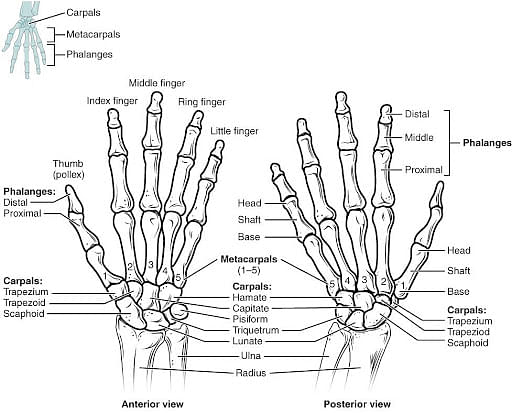
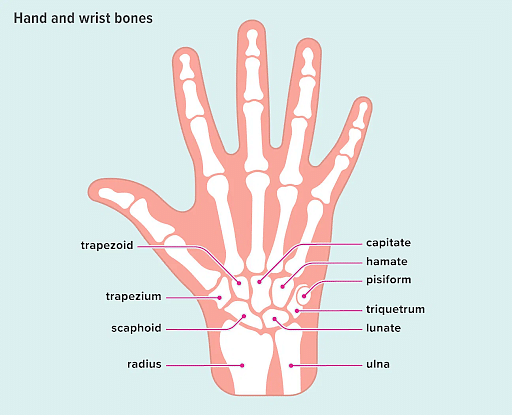
The wrist is made up of eight small bones called the carpal bones or the carpus. The cluster of carpal bones in the wrist is responsible for the flexibility of our wrist. There are eight carpal bones in the wrist. They are:
- Scaphoid: It is a boat-shaped bone under our thumb.
- Lunate: A crescent-shaped bone right beside the scaphoid
- Trapezium: A rounded square-shaped bone right above the scaphoid and under the thumb.
- Trapezoid: A bone shaped like a wedge that sits right beside the trapezium.
- Capitate: An oval or head-shaped bone in the middle of the wrist.
- Hamate: The bone right under the pinky finger on the right side of the hand.
- Triquetrum: A pyramid-shaped bone under the hamate.
- Pisiform: A small rounded bone that sits on top of the triquetrum.
Joints of Wrist
The wrist has three major joints. These joints are responsible for maintaining the stability in the wrist. They allow the wrist and hand to move freely. The three joints of the wrist are as follows:
- Radiocarpal Joint: This is the joint at which the radius and the thicker forearm bone joins with the bottom row of wrist bones: the scaphoid, lunate, and triquetrum. This joint is mostly located on the thumb side of the wrist.
- Ulnocarpal Joint: This is the joint that connects the ulna (the thinner forearm bone) to the lunate and triquetrum wrist bones. This is located on the side of the pinky finger.
- Distal Radioulnar Joint: This is a wrist joint that does not contain the wrist bones. It joins the radius and ulna at their bases.
Tissues of Wrist
Bones and joints are not the only things that wrists have. They also consist of blood vessels, nerves, skin and the major soft tissues. These soft tissues are:
- Ligaments: Ligaments connect the wrist bones to one another as well as the hand and forearm bones. Ligaments act like elastic bands that hold bones together. They cross the wrist from one side to the other to keep the bones together.
- Tendons: Tendons are also a type of elastic connective tissue that connects muscles to bones. This allows the movement of the wrist and other bones.
- Bursae: Bursae are fluid-filled sacs that surround the wrist bones. These soft sacs prevent the friction of tendons and bones.
Wrist Injuries
Just like any other body part, wrist bones, tissues, nerves, muscles and tendons can also be damaged. The most common wrist Injuries are:
-
Sprain:
A sprain occurs when a ligament is damaged. A person can have a sprain if they stretch their wrist too much or carry something heavy. The most common site for a wrist sprain is the ulnocarpal joint.
-
Impaction Syndrome:
Impaction syndrome is also called ulnocarpal stump. This wrist condition occurs when the arm bone of the ulna is slightly longer than the radius. This makes the ulnocarpal joint between this bone and the wrist bones less stable. Impact syndrome can lead to increased contact between the ulna and the carpal bones, resulting in pain and weakness.
-
Arthritis Pain:
Our wrist joint aches because of the arthritis. This can take place from ordinary tears or damage to the wrist. Arthritis can also be caused due to immune system imbalance. It can take place in any of the wrist joints.
-
Fracture:
Fracture can happen in any of the bones because of a fall or a different injury. Distal radius fracture is one of the major types of fracture seen in the wrist.
-
Repetitive Stress Injuries:
Most wrist injuries take place by doing the same actions together with the palms and wrists again and again for an extended time. These actions consist of typing, texting, writing, and playing tennis. They can also cause swelling, numbness, and ache withinside the wrist and hand.
Things to Remember Based on the Bones of the Wrist
- Wrist is the joint or the region of the joint between the hand and the arm.
- The wrist is made up of eight small bones called the carpal bones or the carpus.
- Scaphoid is a boat-shaped bone under our thumb and Lunate is a crescent-shaped bone right beside the scaphoid
- A rounded square-shaped bone right above the scaphoid and under the thumb is called Trapezium whereas the wedge shaped bone that sits right beside the trapezium is named as Trapezoid
- An oval or head-shaped bone in the middle of the wrist is called Capitate and the bone located right under the pinky finger is called Hamate.
- Triquetrum is a pyramid-shaped bone under the hamate.
- A small rounded bone that sits on top of the triquetrum is called Pisiform.
Important Questions Based on the Bones of the Wrist
Ques: Which of the following bones is of the wrist? (1 Mark)
- Trapezoid
- Trapezium
- Scaphoid
- All of the Above
Ans: Option 4. All of the Above
Explanation: All the above-mentioned bones; Trapezoid, Trapezium and Scaphoid are a part of the wrist bone structure. Apart from these bones, the other bones are Lunate, Capitate, Hamate, Triquetrum and Pisiform.
Ques: Which of the following is not a bone of the Wrist? (1 Mark)
- Capitate
- Pisiform
- Cranium
- None of the Above
Ans: Option 3. Cranium
Explanation: Apart from Cranium all the other bones are part of a wrist. Cranium on the other hand is a part of the skull that encloses the brain.
Ques: Which of the following is not a bone of the wrist? (1 Mark)
- Hamate
- Triquetrum
- Pubic Symphysis
- None of the above
Ans: Option 3. Pubic Symphysis
Explanation: The Pubic Symphysis is not a bone of the wrist it is a secondary cartilaginous joint between the left and right superior rami of the pubis of the hip bones.
Ques: The wrist is made up of (___) small bones plus (___) long bones in the forearm (1 Mark)
- 8,2
- 10,5
- 5,4
- None of the above
Ans: Option 1. 8,2
Explanation: The wrist is made up of 8 small bones and 2 long bones.
Ques: The wrist is made up of eight bones called the: (1 Mark)
- Carpal Bones
- Coccyx
- Phalanges
- None of the Above
Ans: Option 1. Carpal Bones
Explanation: A coccyx is a bone at the base of the spine, whereas phalanges are the bones of fingers and toes.
Ques: How many types of joints are there in our body? Name them. (2 Marks)
Ans: There are five types of joints in our body:
- Ball and socket joints
- Gliding joints
- Fixed joints.
- Pivotal joints
- Hinge joints
Ques: What is arthritis? (2 Marks)
Ans: Arthritis is a disease which is caused by the inflammation of the joints. In Arthritis, the synovial membrane secretes extra fluid as a result the joints swell and the person suffers a lot of pain in the joints. In this, the hard tissues also get deposited over the articular cartilages due to which the joints become stiff.
Ques: What is joint? Name the joints related to the following organs :
(i) Joint of knee
(ii) Joint between glenoid cavity of pectoral girdle and acetabulum cavity of pelvic girdle with the humerus and femur
(iii) Elbow joint
(iv) Joint between skull bones
(v) Joint between carpals and metacarpals of thumb
(vi) Ankle joint (3 Marks)
Ans: The region at which two or more bones of a skeleton come in contact and move freely is called Joint.
(i) The joint of knee is called hinge joint
(ii) Ball and Socket joint
(iii) Hinge joint
(iv) Immovable joint
(v) Saddle joint
(vi) Hinge joint
Ques: Name the type of joints found in the following :
(a) Atlas and axis
(b) Carpal and metacarpal of thumb
(c) Between phalanges
(d) Femur and acetabulum
(e) Between bones of skull
(f) Between pubic bones of pelvic girdle (3 Marks)
Ans: (a) Pivot joint
(b) Saddle joint
(c) Hinge joint
(d) Ball and socket joint
(e) Fibrous joint (sutures)
(f) Cartilaginous joint.



Comments