



Education Journalist | Study Abroad Lead
The nervous system refers to that part of our bodies without which living beings can't work because it develops coordination between actions and sensations. The nervous system of the body is organized into two parts: the central nervous system (CNS) and the peripheral nervous system (PNS). Both these parts play a vital role in the human body for its proper functioning. In this article, we will have a look at the central nervous system, neurons, brain, and spinal cord.
| Table of Content 1.What is Central Nervous System? 2.Brain 4.Cells of the Central Nervous System i.Neurons ii.Glial cells |
What is Central Nervous System?
The central nervous system refers to a fundamental unit present in an organism. It is considered the center because it sets in motion all the information and coordinates all the activities within a body. CNS consists of the spinal cord and the brain. The peripheral nervous system on the other hand is a system that is divided into two parts, i.e., the automatic nervous system that controls the involuntary actions performed by the body, and the other one is the Somatic nervous system that controls the movement of muscles. The central nervous system is mainly made up of:
- Brain
- Spinal Cord

Brain
The brain is the most complex part of the body, which is also an information processing unit that commands and controls various actions in a body. The brain is responsible for the following actions:
- It creates voluntary movements.
- It controls the balance of the body.
- It helps in the functioning of vital body organs like the heart, lungs, etc.
- It controls the glands and rhythms of the body.
- It also processes vision, memory, intelligence, thoughts, and emotions.
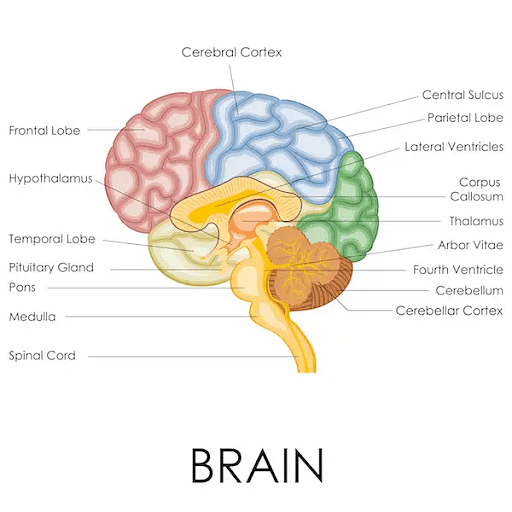
The brain is protected by the skull and is divided into three parts that are:
- Forebrain
- Midbrain
- Hindbrain
-
Forebrain
It comprises of cerebrum, thalamus, and hypothalamus.
- The cerebrum refers to the major portion of the brain that is again divided into two halves known as the left cerebral hemisphere and the right cerebral hemisphere. The hemisphere layer is called the cerebral cortex and is referred to as the grey matter because it appears greyish. Neuron cells are responsible for providing color to the cerebral cortex.
- The cerebral cortex contains motor and sensory areas and simultaneously carries large regions that are association areas handling complex functioning like communication and memory. The inner part of the cerebral hemisphere is covered with a myelin sheath that provides an opaque white appearance to layers knows as white matter.
- Thalamus: It is a structure at the center of the brain that wraps around the cerebrum that is responsible for setting coordination for sensory and motor signaling. This part receives the sensory and motor inputs and passes them on to the cerebral cortex. The regulation of sleep, awareness, or alertness is handled by this part of the brain.
- Hypothalamus: This part lies at the foot of the thalamus. This part is responsible for controlling temperature and creates an urge inside the body to eat and drink. This part also contains some kind of hormones known as hypothalamic hormones. The brain stem is formed with the help of the midbrain and hindbrain.
-
Midbrain
The brain stem is formed with the help of the midbrain and hindbrain and it is located between the thalamus and hypothalamus. A cerebral aqueduct is a canal that passes through this part. This part is more like four swelling of lobes that are known as corpora quadrigemina.

-
Hindbrain
This part of the brain comprises further three parts known as the pons, the cerebellum, and the medulla. The different regions of the brain are connected with fiber tracts that come inside the pons. The cerebellum is a complicated surface that provides extra space for neurons. The medulla is attached to the spinal cord, and it directs the reflexes, secretions, and respirations.

Spinal Cord
The other essential part of the central nervous system is the spinal cord which is a tightly packed structure of nerve tissues that goes down from the brainstem to the central column of the spine. It is a small bundle of tissues that weighs around 35g and is 1cm in diameter. The spinal cord carries nerve signals from the brain to the rest of the body parts. It gets sensory input, then processes it at a partial level, then transmits that information to the brain. It provides neural circuits for reflexes and carries sensory and motor signals between the periphery and the brain. The spinal cord has white and grey matter inside them, and this matter carries axons that help other parts of the spinal cord to communicate easily and smoothly. Some of them take signals to the brain, and others deliver signals from the brain to the neurons that are present in the body.

The spinal nerves in the body consist of two rows that are a bundle of axons. These bundles can appear on any side of the vertebrae. 31 pairs of these nerves are present that shows a segment of a spinal cord that is divided into 5 regions:
- Cervical neck 8 (Cervical)
- Chest 12 (Thoracic)
- Abdominal 5 (Lumbar)
- Pelvic 5 (Sacral)
- Tailbone 1 (Coccygeal)

The spinal cord also consists of some circuits that help in the generation of movements like walking. If at times the inputs are not supplied from the brain, spinal nerves coordinate with all other muscles that help them to walk.
Cells Of Central Nervous System
The brain and the spinal cord consist of glial cells and neurons.
Neurons
They are made up of different components like cell body, dendrite, axon, axon terminal, and Schwann cells.
- The cell body is the center of neural metabolism as this is the site of metabolism.
- Axon arises from the cell body and it helps to transport signal to the axon terminal which further transports the signal to neurons.
- Dendrites process the signal from the cell body and extend it outwards.

Glial Cells
The Spinal Cord and brain also consist of Glial Cells and they are made up of three types of cells that are astrocytes, oligodendrocytes, and Microglia.
- Astrocytes are star-shaped glial cells within the brain and spinal cord as they help in metabolic support. Astrocytes stores lactate as fuel during energy consumption. They also help in the regulation of the extracellular ionic environment and also perform as neurotransmitters.
- Oligodendrocytes are responsible for insulating the axons in the central nervous system.
- Microglia are immune cells of the brain as they help to clear dead and dying cells. This clean-up process plays an important role in the recovery of function following a spinal injury.

In the end, the central nervous system is essential for the body because no one body can work without the brain and spinal cord as both these help to communicate between the organs so all the body can work in a definite manner. Sometimes, the retina, olfactory epithelium, optic nerves, and olfactory nerves are also considered a part of the CNS as they directly connect with the brain tissues without any nerve fibers. The Spinal Cord on the other hand acts as a link between the brain and the rest of the body.
Things To Remember
- The central nervous system consists of two parts - the brain and spinal cord and both these are essential to work properly.
- The brain has its own functions and the spinal cord has its own and together they make the working of the human body easy.
- The spinal cord has bones that help the body to transmit the neurons signals and help the body to work easily.
- The brain will help to transmit these signals to various parts of the body and then the body will respond.
- The brain and the spinal cord consist of glial cells and neurons.
- Sometimes, the retina, olfactory epithelium, optic nerves, and olfactory nerves are also considered a part of the CNS
- The cerebral cortex contains motor and sensory areas and simultaneously carries large regions that are association areas handling complex functioning like communication and memory.
Sample Questions
Ques: What is the outer structure of the brain? 2 marks
Ans: Cranium refers to the 8 cranial outer bones that cover the brain. After that Meninges are the membranes and there is Cerebrospinal fluid that is present between the spaces of the cranium and meninges.
Ques: What does the white and grey matter in the brain indicate? 2 marks
Ans: Grey matters refer to the cerebral cortex and it appears grey due to the presence of neurons. Myelin sheath is covered with fibers tracts that make the inner part of the cerebral hemisphere that provides an opaque structure-like layer that appears white in color.
Ques: What are the divisions of the spinal cord? 3 marks
Ans: The spinal cord is divided into 5 regions:
- Cervical neck 8 (Cervical)
- Chest 12 (Thoracic)
- Abdominal 5 (Lumbar)
- Pelvic 5 (Sacral)
- Tailbone 1 (Coccygeal)
Ques: What are the three parts of the forebrain? 1 mark
Ans: The three parts of the forebrain are the cerebrum, hypothalamus, and thalamus.
Ques: What is the function of the thalamus? 1 mark
Ans: The thalamus helps in the relaying of motors and sensory signals that are sent to the cerebral cortex. It helps in the regulation of sleep and alertness.
Ques: Explain various parts of the brain. 5 marks
Ans: The brain is the main functioning organ of the body. The brain consists of three major components that are Forebrain, Midbrain, and Hindbrain.
- The forebrain consists of the cerebrum, hypothalamus, and thalamus. The cerebrum is the largest part of the brain and it is responsible for controlling speech, planning, and movements. It is made up of some subcortical structures and the cerebral cortex.
The cerebral cortex is further divided into four lobes which are responsible for visual processing, auditory movements, and speech functioning. Hypothalamus is responsible for controlling the body temperature, hunger, moods, and emotions of an individual. Hypothalamus is a small part of the brain which is located under the thalamus. Thalamus is a small part that helps in coordination in movements as it helps in relaying sensory information from sense organs. Thalmus also captures past experiences and helps to remember new memories.
- Midbrain consists of two parts as tectum and tegmentum. Midbrain is associated with vision, alertness, and sleep regulations. Midbrain is almost 1.5 cm long and is sandwiched in the diencephalon and the pons. The tectum is the roof of the midbrain and is formed by the superior and inferior colliculi.
The superior colliculus is responsible for visual reflexes whereas the inferior colliculus helps in the audio relay of the body. Tegmentum is present in front of the tectum. Tegmentum forms a platform for the midbrain to join with the thalamus and spinal cord. It also helps in audio-video reflexes.
- The hindbrain is made up of the cerebellum, medulla, and pons. The cerebellum is the second largest part of the brain as it helps to maintain balance while walking, swimming, and maintains body posture. It also helps in eye movements and maintains equilibrium. The medulla controls the heartbeat, breathing, and digestion process. The medulla is a small structure present in the lower part of the brain. Pons maintain sleep cycles, helps to identify taste and hearing.
Ques: Describe neurons and their functions. 5 marks
Ans: Neurons are the main cells of the nervous system which helps to transmit information to different parts of the body. Neurons have a cell body, an axon, and dendrites. The cell body contains cytoplasm and nucleus. The axon extends from the cell body and gives rise to other smaller branches. Dendrites function by receiving messages from other neurons. The contact point of two neurons is known as Synapses. The dendrites are covered with synapses formed by the ends of axons from other neurons. Neurons are used to transmit signals using action potentials and action potential is generated by chemical and electric synapses.
Electrical synapses are generated by the ions production between the gap in two neurons. The gap between two neurons is quite small which facilitates the direct transmission of a positive electrical signal.
Ques: Explain the functions of the spinal cord. 3 marks
Ans: The main function of the spinal cord is to send signals from the brain to the rest of the body which allow different parts of the body to communicate with the brain Walking is also majorly connected with the spinal cord as taking steps is a central pattern generated by neurons which are present in the spinal cord which sends signals to the muscles of legs to generate movement. Reflexes are involuntary responses resulting from the stimuli by the brain, spinal cord, and nerves. It also forms a connecting link between the brain and the peripheral nervous system. The spinal cord provides a framework to the body as it helps to maintain posture.



Comments