



Content Curator
Static friction is friction that prevents the object from moving on a surface. Friction basically means the resistance that one object experiences while moving over another. This process takes place in two ways; one is Kinetic Friction and the other is Static Friction. Kinetic friction acts on an object that moves on the surface, while static friction prevents the object from moving onto the surface. For every pair of materials that contact each other, the coefficient is found to be different. The friction is described as a ratio between the frictional force and the normal force.
Read Also: Newton’s Second Law of Motion
| Table of Content |
What do you mean by Static Friction?
[Click Here for Sample Questions]
The static friction is termed as the maximum ration of applied force with no motion. Frictional force opposes the motion.
- If you apply force to an object which is at rest, there is a point up to which the object resists moving.
- In order to move the object, the applied force should be greater to overcome the resistance.
- When this maximum resistive force by an object goes against the applied force to continue moving it is called the Coefficient of Static Friction.
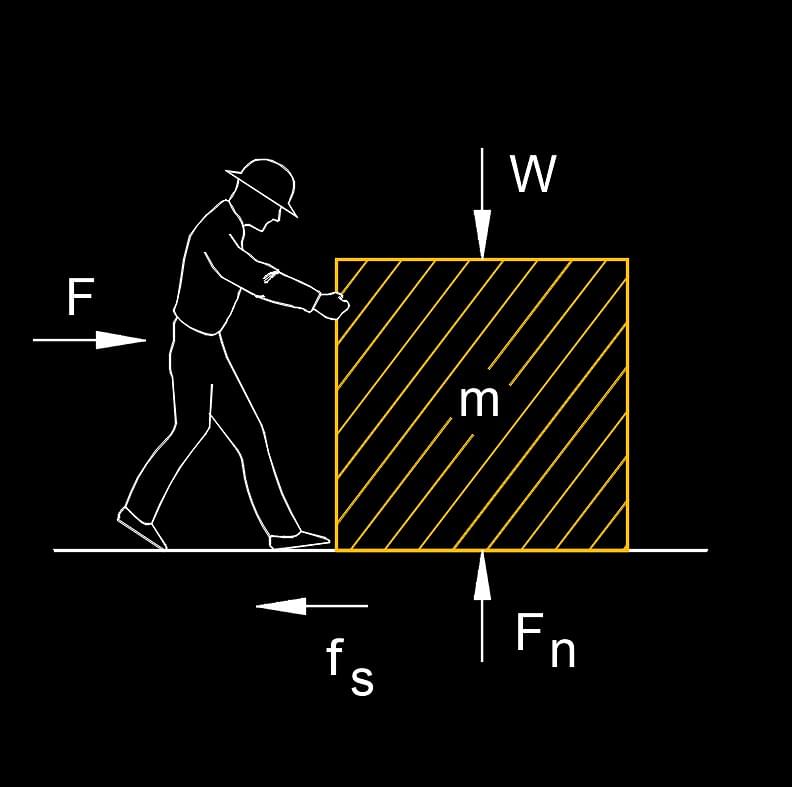
Static Friction
Check Important Static Friction Formula
Formula of Coefficient of Static Friction
[Click Here for Sample Questions]
The magnitude of the frictional force depends upon the two following factors-
- The heaviness of the material
- The roughness of the surface
Here, the roughness of the surface is measured by the parameter which is called the Coefficient of Static friction. Mathematically it is expressed as the ratio of applied force to the normal reaction. The coefficient of static friction is represented by the Greek alphabet μs.
\(\mu s = \frac{\overrightarrow{F}S}{\overrightarrow{F}N}\)
Also Read:
Units of Coefficient of Static Friction
[Click Here for Sample Questions]
The coefficient of Static Friction has no unit. It is a unitless quantity. Because it is the ratio of two forces, the S.I. units get canceled. It is also a dimensionless quantity. It implies that the direction of the force shall not affect the physical quantity, because it is a scalar quantity. The objects that cause friction set the value of the coefficient of static friction. The value is usually between 0 and 1, but sometimes it can be greater than 1. The value 0 means no friction between two objects.
Things to Remember
[Click Here for Sample Questions]
- The coefficient of static friction is represented by the Greek alphabet μs.
- The coefficient of static friction is the maximum ratio of applied force to the normal force with zero motion.
- Force of static friction = (Coefficient of static friction) × (Normal force)
Fs = μs × N
- The coefficient of friction is quantity less and dimensionless.
Read More: Newton’s Third Law of Motion
Sample Questions
Ques. The normal force and the static frictional force of an object are 50N and 80N. What will be the coefficient of static friction? (3 marks)
Ans. Given,
N = 50N, F =80N and μs =?
The formula to find out coefficient of static friction is,
μs = F/ N
= 80/50
= 1.6
Therefore, the coefficient of static friction is 1.6.
Ques. An object having a mass of 10 kg is placed on a smooth surface. Static friction between these two surfaces is given as the 15 N. Find the coefficient of static friction. (5 marks)
Ans. Given,
m = 10 kg
F = 30 N
μs =?
As we know,
Normal force, N = mg
So, N = 10 × 9.81
= 98.1 N
The formula for coefficient static friction is,
μs = F/ N
= 30/98.1
= 0.305
Hence, the coefficient of static friction is 0.305.
Ques. A 5500 N force is applied to a sled. The skis of the sled have a coefficient of static friction μs = 0.75 with the snow. If fully loaded sled has a mass of 700 kg. What is the maximum force of static friction and is the force applied enough to overcome it? Get the solution by using a coefficient of static friction formula. (5 marks)
Ans. On a flat surface, the normal force on an object is N = mg.
Using this, the force of static friction can be found:
Fs= μs N
= μs mg
= 0.75 ×700kg × 9.8 m/s2
= 5145 kg* m/s2
= 5145 N
The maximum force of static friction is 5145 N and thus the applied force of 5500 N is enough to bear it, and begin moving the sled.
Ques. A 5kg block of wood is sitting on a table. If the coefficient of static friction is .35, what will be the force of static friction? (3 marks)
Ans. There is no inclination. So, the normal force is the same magnitude as the weight of the object.
N = (5 kg) (9.8 m/s2)
N = 49 kg m/s2=49 N
To find the force of static friction, multiply the coefficient of static friction by the normal force.
fs = (.35) (49 N)
fs = 17.15 N
Ques. A block of mass 0.1 kg is held against a wall applying a horizontal force of 5N on the block. If the coefficient of friction between the block and the wall is 0.5, the magnitude of the frictional force acting on the block will be _____. (3 marks)
Ans. Consider the forces, acting on the block in vertical directions.
Force of friction = f = μR
Or f = 0.5 ×5
= 2.5 N
So, the magnitude of the frictional force acting on the block will be 2.5 N.
Ques. A force of 300N is acted on some box of 5kg put static on the floor. If the coefficient of friction is 0.3, then what will be the static friction by using the static friction formula? (3 marks)
Ans. Known values are given above,
Normal force, Fn = 300N
Coefficient of friction, μs = 0.3,
Static friction is given by the formula:
Fs = μs × Fn
= 0.3 × 300 N
= 90 N.
Hence, the static friction will be 90 N.
Ques. A person is pushing a toy car of mass 4kg which as at rest position on the floor. If 100 N is the value of the static frictional force, then determine the frictional coefficient? (5 marks)
Ans. Given values are as follows,
Mass, m= 4 kg
Static Frictional force, Fs = 100 N,
Normal force, Fn = m × g
Fn = 5 ×10, for acceleration due to gravity, g= 100 ms-2
Fn = 50 N
Now, formula is,
Fs = μs × Fn
After rearranging it,
μs =FsFn
Putting the values,
μs =10050
μs = 2
Hence, the friction coefficient is 2.
Ques. What is static friction? (2 marks)
Ans. The force of friction on which the object is not moving is known as static friction. In static friction, the object remains at rest until the force of static friction overcomes it. The value of static friction ranges between zero and the smallest force is important to start motion.
Ques. Explain the difference between static friction and kinetic friction. (4 marks)
Ans. The retarding force between two objects that are moving against each other is known as Kinetic Friction. The friction depends on the type of contacting surfaces. Kinetic friction is less on smooth surfaces and high on dry and rough surfaces. The coefficient of kinetic friction is μk. It is lower than the coefficient of static friction.
Static friction is the force that has to be overcome to get the moving object. Static friction is the force that prevents an object from sliding when placed on a sloped surface. It is less on smooth surfaces and high on dry and rough surfaces. The coefficient of static friction is μs.
Ques. What is the coefficient of static friction? (3 marks)
Ans. The ratio of the highest static friction force between the two surfaces in contact before movement happens to the normal force is known as the coefficient of static friction. The coefficient of static friction is dependent on the surface of an object. The relative speed of the surfaces and the surface area of contact is the other factors on which the coefficient of friction depends. The coefficient of static friction is μs.
Physics Related Links:



Comments