



Content Curator
Rolling Friction is a force that resists the motion of a rolling object on a surface. Rolling friction is also known as the rolling resistance. A solid moving body has two types of friction forces acting on it: rolling friction and sliding friction.
| Table of Content |
Key Terms: Laws of Rolling Friction, Causes of Rolling Friction, Rolling Friction Examples, Sliding Friction, Rolling Resistance
Rolling Friction?
[Click Here for Sample Questions]
Rolling friction is the resistive force offered by any surface which opposes the rolling motion of any object that rolls over it, thus causing it to slow down and eventually stop. Rolling friction is generated when a round or a spherical object rolls across a surface. It is also sometimes called rolling resistance or rolling drag.
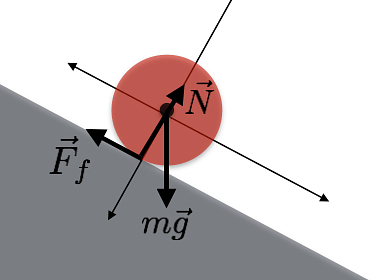
Rolling Friction
| Advantages and Disadvantages of Rolling Friction Advantages:
Disadvantages:
|
Laws of Rolling Friction
[Click Here for Sample Questions]
The three laws that are related to rolling friction are:
- The force of rolling friction reduces with increased smoothness.
- Rolling friction can be represented as a product of load and constant to a fractional power: F = kLn
- Rolling friction force is directly proportional to load and inversely proportional to the curvature radius: F = μ×W/r
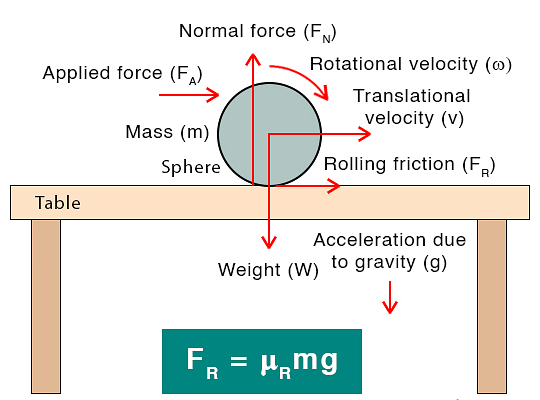
Rolling Friction Explanation
Check out:
Causes of Rolling Friction
[Click Here for Sample Questions]
There are certain things that happen when an item rolls on the surface. They are:
- At the point of contact with the surface, the item is deformed.
- At the point of contact of the item, the surface is deformed.
- As a result of the above principles, the motion is formed under the surface.

The fundamental reason for this friction is because the deformation energy is larger than the recovery energy. In addition, there is a continuous adhesive force between the two surfaces.
The amount of friction depends on a number of parameters, for example:
- The quality of sliding body
- The quality of the surface
- Load
- The rolling object's diameter
- The body’s surface area
Coefficient of Rolling Friction
[Click Here for Sample Questions]
Although determining the coefficient of rolling friction is more complicated in comparison to sliding friction, it can very well be made easy with the help of the below statement and formula.
“Coefficient of Rolling Friction refers to the ratio of the rolling friction force to the total weight of the object.”
Formula:
Fr =μrW
Where,
- Fr means the resistive force of rolling resistance
- μr means the coefficient of rolling resistance
- W refers to the rolling body’s weight
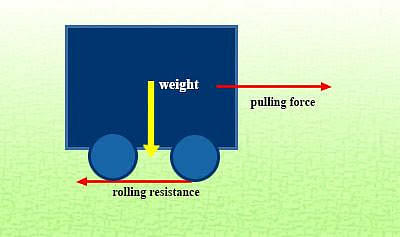
Here, the object is pushing down on the wheels, preventing them from rolling backward while making it easier for the pulling force.
| Coefficient of Rolling Friction Solved Example Example: Coefficient of rolling resistance for a steel wheel of 200 mm diameter that rolls on a horizontal steel roll, is 0.3 mm. The steel wheel carries a load of 600 N. The force necessary to roll the wheel along the rail is: (a) 90N (b) 180N (c) 90kN (d) 270N Solution: The length of contact is the coefficient of rolling resistance. The force necessary to roll the wheel is given by \({{F}_{R}}=\frac{{{\mu }_{R}}W}{R}\) Where μR is the coefficient of rolling resistance
Calculation: We know, D = 200 mm, \(R=\frac{D}{2}=100~\text{mm}\), FR = 600 N, μR = 0.3 mm \({{F}_{R}}=\frac{{{\mu }_{R}}W}{R}=\frac{600\times 0.3}{100}=1.8~N~\) |
Examples of Rolling Friction
[Click Here for Sample Questions]
- A ball rolling on a field will travel less than a ball on a concrete floor since the friction on the former surface will be larger.
- A basketball rolled on the court will end up stopping because of rolling friction.
- Because of the higher rolling friction, a bike with a broad tire will burn more fuel.
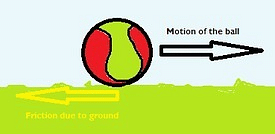
Examples of Rolling Friction
Difference Between Rolling And Sliding Friction
[Click Here for Sample Questions]
Difference Between Rolling And Sliding Friction is that Rolling friction takes place when an object rolls on the surface while Sliding friction occurs when two surfaces are rubbed against each other.
| Rolling Friction | Sliding Friction |
|---|---|
| When an item rolls on the surface, friction is rolling. | The friction sliding happens if two surfaces are brushed. |
| Rolling friction occurs because of surface deformation. | Due to interlocking between tiny surfaces, sliding friction occurs. |
| The rolling friction coefficient will depend on the rolling object radius, the depth to which it may sink, and the surface strength. | The sliding friction coefficient varies to some extent on the surface roughness and the temperature. It is externally independent. |
| Rolling Friction coefficient: Fr = μrN | Sliding friction coefficient: Fk = μrN |
Things to Remember based on Rolling Friction
- Rolling friction is the resistive force offered by any surface which opposes the rolling motion of any object that rolls over it, thus causing it to slow down and eventually stop.
- The force of rolling friction reduces with increased smoothness.
- Rolling friction force is directly proportional to load and inversely proportional to the curvature radius.
- The item and the surface are deformed at the point of contact.
- A ball rolling on a field will travel lesser than a ball on a concrete floor since the friction on the former surface will be larger.
Check out:
Sample Questions based on Rolling Friction
Ques. Give the formula for the coefficient of rolling resistance. (1 mark)
Ans. The formula for the coefficient for rolling friction is:
Fr=μrW
Ques. What is rolling friction? (2 marks)
Ans. Rolling Friction is referred to as the force that resists the motion of a rolling object on a surface. This is also known as the rolling resistance. A solid moving body has two types of friction forces acting on it: rolling friction and sliding friction
Ques. Rolling friction depends on which factors? (2 marks)
Ans. Rolling friction force is directly proportional to load and inversely proportional to curvature radius.
Ques. State the effects of rolling friction. (3 marks)
Ans. As a result of rolling friction, certain changes take place. They are:
- At the point of contact with the surface, the item is deformed.
- At the point of contact of the item, the surface is deformed.
- As a result of the above principles, the motion is formed under the surface.
Ques. When two surfaces are rubbed together, what kind of friction is created? (2 marks)
Ans. Sliding friction may be defined as the resistance generated by both objects as they slide against one other. This friction is also referred to as kinetic friction and the force required to keep a surface moving over another surface.
Ques. What are the causes of rolling friction? (3 marks)
Ans. The fundamental reason for this friction is that the deformation energy is larger than the recovery energy. In addition, there is a continuous adhesive force between the two surfaces.
The amount of friction depends on a number of parameters, for example:
- The quality of sliding body
- The quality of the surface
- Load
- The rolling object's diameter
- The body’s surface area
Previous Year Questions
- A brick of mass 2kg slides down an incline of height 5m and angle 30∘… [BITSAT 2019]
- A block of mass 2 kg rests on a plane inclined at an angle of… [JCECE 2005]
- In figure, two blocks are separated by a uniform strut attached to… [BITSAT 2015]
- A block of mass m is placed on a smooth wedge of… [NEET 2004]
- A block of mass m is in contact with the cart… [NEET 2010]
- A boy of mass 50 kg is standing on a weighing machine placed at the floor of a… [AP EAPCET]
- An object flying in air with velocity… [NEET 2019]
- 250 N force is required to raise 75 kg mass from a pulley… [NEET 1989]
- Three blocks of mass 4kg, 2kg,1kg, respectively are in contact on… [NEET 2015]
- A bullet of mass 10g moving horizontally with a velocity of… [NEET 2016]
- Two identical balls A and B having velocities of… [NEET 1994]
- A 600kg rocket is set for a vertical fring. If the exhaust speed is… [NEET 1990]
- A balloon with mass m is descending down with an acceleration a… [NEET 2014]
- The mass of a lift is 2000kg. When the tension in the supporting cable is… [NEET 2009]
- A cricketer catches a ball of mass 150 gm in 0.1 sec moving with speed… [NEET 2001]
- A 1 kg stationary bomb is exploded in three parts having mass… [NEET 2001]
- A block A of mass m1 rests on a horizontal table. A light string connected to it… [NEET 2015]
- A block has been placed on a inclined plane with the slope angle… [NEET 1993]
- A block of mass 10kg is in contact against the inner wall of a hollow cylindrical… [NEET 2019]
- A man fires a bullet of mass 200gm at a speed of… [NEET 1996]
Also check:



Comments