



Education Journalist | Study Abroad Lead
Condensed Structural Formula is a system for writing organic compounds in a single line. It is a method that uses shorthand notation that contains more information than the chemical formula. When compared to the conventional structural formula, it can be easily noticed that a condensed formula is less lengthy. Condensed Structural Formula is a means of expressing molecules entirely in language. For basic hydrocarbons like propane, the condensed structural formula is CH3CH2CH3. For complex compounds such as morphine, it's difficult to write its condensed structural formula.
Table of Content
| Table of Content
|
Key Terms: Formula, Geometry, Organic Compound, Carbon, Atom, Molecular Formula, Bond, Functional Group
What is Condensed Structural Formula?
[Click Here for Sample Questions]
The condensed structural formula is a short method for determining the geometry of an organic compound. The condensed formula is depicted on a single line of text and specifies the atoms in the order in which they are found in the molecule. It also displays the functional groups present in the molecule, such as amine -NH2, alcohol -OH, and parentheses are used to indicate that polyatomic groups are linked together.
Methane and propanol, for example, have condensed structural formulas of CH4 and CH3(CH2)2OH, respectively. This indicates that the first carbon atom has three hydrogen atoms attached to it, the second carbon atom has two hydrogen atoms, the third carbon atom has three hydrogen atoms and the fourth carbon atom has three hydrogen atoms.
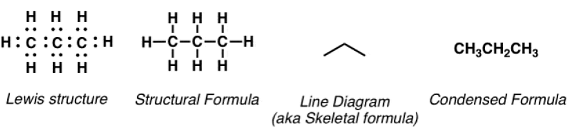
Four Ways of Depicting Propane
Condensed Structural Formula
[Click Here for Sample Questions]
There are three types of organic chemistry formulas as mentioned below:
- Formula for a molecule which indicates the number of atoms in an element such as C5H12O.
- The structural formula in which all the atoms of a molecule are visible. However, vertical linkages and polyatomic groups are hidden by parenthesis.
- Formula for the structure which shows all of the bond connections.
As a result, lines between bound atoms are also used in the condensed structural formula. However, because it ignores the carbon and hydrogen bonds, it is a simpler and shorter approach to build the line-bond structural formula.
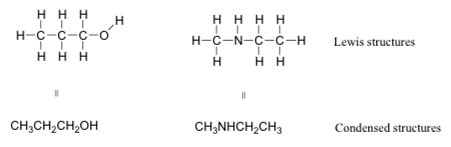
Condensed Structure and Line Structure of Simple Hydrocarbon
Note: The condensed structural formula is useful in situations but the same chemical formula might result in several structures like Isomers which are the structures with the same number of atoms and mass/ weight but various functional groups or the same functional groups but in different places.
Use of Condensed Structural Formula
[Click Here for Sample Questions]
Some of the uses of Condensed Structural Formula are:
- This formula is very useful to display a molecule's functional groups. In reality, the functional groups are the ones that give all molecules their chemical and physical features.
- The geometry of certain molecules is also shown in the condensed structural formula.
- This formula is also an important trait in recognizing the property of chemical substances.
Things to Remember
[Click Here for Sample Questions]
- Every carbon atom is represented separately in the condensed structural formula, and the following carbon atoms are assigned to the atoms that are bound to that specific carbon atom.
- When there are two CH2 groups in the centre of the molecule, another more condensed way of stating the structural formula is to put (CH2)2 in the middle of the structural formula.
- Only the types and quantities of atoms in a molecule are shown in a molecular formula. The chemical formula C4H10, for example, indicates that a molecule has 4 carbon atoms and 10 hydrogen atoms, but it does not discriminate between butane and isobutane.
- The carbon and hydrogen atoms, as well as the bonds that connect them, are shown in a structural formula. As a result, structural formulae identify individual isomers by displaying the sequence in which the different atoms are attached.
- The condensed structural formula is useful in situations like the one mentioned above, when the same chemical formula might result in several structures.
Solved Questions
Ques. What is the Condensed Formula?Give a suitable example. (5 marks)
Ans. The kinds and spatial arrangement of bonds in a simple chemical substance can be represented by a condensed chemical formula, although it does not always define isomers or complicated structures.
- Ethane, for example, is made up of two carbon atoms that are single-bonded to one other, with three hydrogen atoms connected to each carbon atom. The molecular formula for this substance is CH3CH3. Because there is a double bond between the carbon atoms in ethylene, the chemical formula is CH2CH2.
- The fact that there is a double bond between the carbons is implied by the fact that carbon has a valence of four. However, writing H2C=CH2.
- Molecules having several functional groups that are the same can be represented using round brackets to enclose the repetitive group. Isobutane, for example, can be represented as (CH3)3CH.
- This condensed structural formula denotes a different level of connectedness than other molecules that may be made with the same atoms in the same amounts (isomers).
- A core carbon atom is coupled to one hydrogen atom and three CH3 groups in the formula (CH3)3CH. A straight chain molecule, n-butane: CH3CH2CH2CH3, may be made with the same number of atoms of each element.
Ques. How are Polymers represented via Condensed Formula? (2 marks)
Ans. Parentheses are used to surround the repeating unit in polymers with condensed chemical formulas. A hydrocarbon molecule defined as CH3(CH2)50CH3, for example, is a molecule having fifty repeating units. The letter n might be used to represent this formula: CH3(CH2)nCH3 if the number of repeating units is unknown or changeable.
Ques. Write examples of condensed formulas? (3 marks)
Ans. Hexane has a chemical formula of C6H14 and is a six-carbon hydrocarbon. The molecular formula specifies the quantity and kind of atoms but not the bonds that connect them. CH3(CH2)4CH3 is the condensed formula. The condensed formula for hexane is CH3CH2CH2CH2CH2CH3. It's simpler to picture a molecule using its condensed formula rather than its molecular formula, especially when the chemical bonds might form in a variety of ways.
CH3CH(OH)CH3 and (CH3)CHOH are two methods to express the condensed formula of propan-2-ol. Here are some more concise formula examples:
- CH3CH=CH2 is the formula for propene.
- (CH3)2CHOCH3 isopropyl methyl ether.
Ques. What is the structural formula and the skeletal formula? (5 marks)
Ans. A chemical compound's structural formula is a visual depiction of the molecular structure (derived by structural chemistry methods) that shows how the atoms may be organised in real three-dimensional space. The chemical bonding of the molecule is also illustrated, either explicitly or indirectly. Unlike chemical formulae, which have a restricted number of symbols and can only describe a limited number of molecular structures, structural formulas give a more comprehensive geometric depiction of the molecular structure. Many chemical compounds, for example, exist in several isomeric forms, each with a distinct enantiomeric structure but the same chemical formula.
- For increasingly complicated organic compounds, skeletal formulas are the conventional nomenclature. The carbon atoms are inferred to be situated at the vertices (corners) and ends of line segments rather than being shown with the atomic symbol C in this sort of figure, which was initially employed by organic chemist Friedrich August Kekulé von Stradonitz.
- The number of hydrogen atoms coupled to carbon atoms is not specified; each carbon atom is assumed to be associated with enough hydrogen atoms to give it four bonds. One of the inferred hydrogen atoms is replaced by the existence of a positive or negative charge on a carbon atom.
Ques. Differentiate between a condensed formula & a structured formula? (3 marks)
Ans. The bonds between the atoms are represented by lines in a structural formula. Most or all of the bonds are omitted in a simplified structural formula.
- A molecule's condensed formula is the formula in which the atom symbols are written in the order in which they exist in the molecule's structure, with bond dashes deleted or limited.
- While horizontal bonds are seldom used to designate polyatomic groups, vertical bonds are usually removed.
- The polyatomic group associated with the centre atom to the right of the parenthesis is indicated by parentheses in a condensed formula. A truly condensed formula is one that may be written on a single line with no branching above or below it.
Ques. How are ions represented via a condensed formula? (5 marks)
Ans. A right-hand superscript can be used to indicate the charge on a specific atom in ions. For instance, Na+ or Cu2+. This method may also be used to display the total charge on a charged molecule or a polyatomic ion. For instance, H3O+ or SO4. It's worth noting that + and - are substituted for +1 and -1, respectively.
- Brackets [] are frequently used to encapsulate the ionic formula for more complicated ions, as in [B12H12]2, which may be found in compounds like Cs2[B12H12]. To denote a repeating unit, parentheses () can be nested inside brackets, as in [Co(NH3)6]3+Cl3. [] encloses the complete formula of the ion with charge +3, and (NH3)6 denotes that the ion has six NH3 groups linked to cobalt.
- Hexammine cobalt(III) chloride can be expressed as [Co(NH3)6]3+Cl3 or [Co(NH3)6]Cl3. This is completely optional; a chemical formula is valid with or without ionisation information. Brackets, like parenthesis, act as grouping devices in chemistry, bringing together concepts that aren't necessarily related to ionisation states. The parenthesis in this example show six groups, all of the same form, joined to another group of size one (the cobalt atom), and finally the entire bundle is attached to three chlorine atoms as a group. It is evident in the first situation that the link between the chlorines is ionic rather than covalent.
Ques. Give the hexanedial's condensed formula.
a)OHC(CH2)4CHO
b)OHC(CH2)3CHO
c)OHC(CH2)4COOH
d)COOH(CH2)3COOH
Ans. b. OHC(CH2)3CHO
Explanation: We need to determine the hexanedial's condensed formula, hence we need to know that the condensed formula is the one that can be crammed into a little space. We're also discussing the hexanedial, which denotes a six-carbon molecule with two aldehyde groups attached. More about aldehydes, namely the hexanedial, will be discussed in the future. So, we know that when we find a CHO as a functional group, we get aldehydes. We should also be aware that volatile aldehydes have a strong odour.
Ques. What are atoms made of? (2 marks)
Ans. The two types of basic particles that make up an atom are electrons and quarks. Electrons fill the space around an atom's nucleus. Each electron has a -1 electrical charge. Quarks are the building blocks of protons and neutrons, which make up the nucleus of an atom. Each proton and neutron have three quarks. A quark is a type of energy particle that moves quickly. Quarks are available in a wide range of forms and sizes. The two types of quarks that make up protons and neutrons are up and down quarks.
Ques. Identify the Lewis structure of following the condensed structure of oleic acid, a fatty acid found naturally in a variety of animal and plant fats and oils: CH3(CH2)7CH = CH(CH2)7COOH (2 marks)
Ans. 
Begin by sketching the CH3. The (CH2)7 stands for a repeating unit, which means you must draw seven CH2s one after the other, each bound to a CH, and then another seven CH2s. A carboxylic acid is represented by the COOH, which indicates you have a C=O coupled to an O-H. Double-check your structure to make sure each carbon has four bonds. When you do this, you'll notice that the two CH are required to be doubly bonded.
Ques. How to write Condensed Formulas? (3 marks)
Ans. The condensed structural formula, often known as the semi-structural formula, is written as follows:
Step 1: Draw the molecule's 2-dimensional structural formula.
Step 2: In the structural formula, look for the carbon backbone (or skeleton) and any branches or side-chains, as well as any functional groups like halogen (group 17) atoms.
Step 3: In the 2-dimensional structural formula, identify groupings of atoms along the carbon backbone.
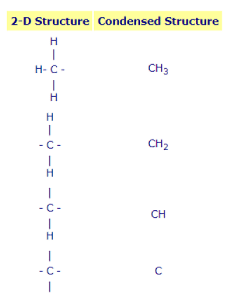
Step 4: Redraw the formula by substituting the condensed structure, or semi-structural formula, for the identified groups of atoms in the two-dimensional structural formula.
Step 5: Break the backbone or skeleton's single carbon-carbon covalent connections.
Step 6: If the molecule has branches or side chains, do the following:
- Reduce the structure to that of a carbon backbone.
- surround groups of atoms linked to the chain with parentheses (round brackets).
- indicate the number of times this group appears at that position with a subscript number.
- write this group to the right of the backbone's carbon atom at the position where it is found.
Read More:



Comments