



Education Journalist | Study Abroad Lead
Benzyl Alcohol is an organic compound widely used in cosmetic products as well as in injectable pharmaceutical preparations. This compound has a slightly aromatic smell because of the presence of a benzene ring. A variety of plants produce benzyl alcohol naturally. For example, hyacinth, jasmine, and ylang-ylang contain this compound and pass it to the essential oils produced with them.
| Table of Content |
Keyterms: Benzyl, Alcohol, Anion, Benzylate, Hydroxyl Group, Hydogen, Phenyl Methanol, Carboxylic Acid, Organic Solvent
Benzyl Alcohol
[Click Here for Sample Questions]
- The chemical formula for benzyl alcohol is C6H5CH2OH.
- It is a colorless liquid at room temperature.
- The IUPAC name of benzyl alcohol is phenyl methanol.
- After benzyl alcohol is deprotonated, it leads to the production of anion called benzylate.
Also Read:
| Related Articles | ||
|---|---|---|
| Ether Preparation | Dference between Ethanol and Methanol | Dehydration Synthesis |
| Difference Between Aldehydes and Ketones | Propan 2 ol Formula | What is Hydroboration |
Structure of Benzyl Alcohol
[Click Here for Sample Questions]
In Benzyl Alcohol, the methyl group is attached to a hydroxyl group. These two attached elements are also attached to an aromatic ring. Due to resonance, the pi electrons are already delocalized in the benzene ring.
The structure of this compound represents that of a toluene molecule. However, in this benzyl group, the hydroxyl group replaces one of the hydrogen atoms.
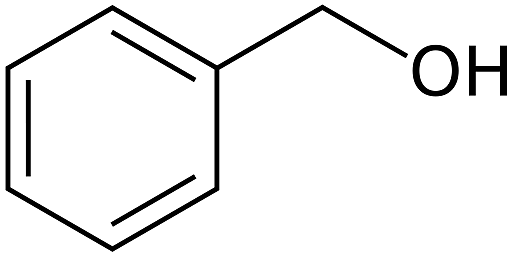
Preparation of Benzyl Alcohol
[Click Here for Sample Questions]
Benzyl alcohol can be prepared by using two methods:
- Benzyl alcohol can be prepared through a Grignard reaction between phenylmagnesium bromide and formaldehyde.

- The hydrolysis of benzyl chloride in the presence of sodium hydroxide leads to the production of sodium chloride and benzyl alcohol as the final output.

Chemical Properties of Benzyl Alcohol
[Click Here for Sample Questions]
- When benzyl alcohol is dehydronated, the output is benzylate anion.
- The reaction between Benzyl Alcohol and carboxylic acids results in the formulation of esters.
- Benzyl alcohol yields N-benzyl acrylamide while undergoing a jitter reaction with acrylonitrile.
- It is soluble in water at 20oC (3.5g/100mL) and 25o C (4.29g/100mL).
- Benzyl alcohol has a boiling point of 205.3oC (478.4 K) and a melting point of -15.2oC (257.9 K).
Physical Properties of Benzyl Alcohol
[Click Here for Sample Questions]
- Benzyl alcohol is soluble with acetone, benzene, ether, methanol, and several other organic solvents.
- It is colorless in nature.
- Benzyl alcohol is a little aromatic liquid under standard conditions.
- It has a density of 1.044 grams per cubic centimeter.
- Benzyl alcohol’s molar mass is 108.14 grams per mole.
Uses of Benzyl Alcohol
[Click Here for Sample Questions]
Benzyl alcohol has many uses. These include:
- Due to its antibacterial and antifungal properties, benzyl alcohol is used during the production of shampoos, soaps, and skin lotions.
- Benzyl alcohol is also used as a solvent for epoxide in paints, inks, and other coatings.
- Solutions that contain a 5% concentration of benzyl alcohol can be used for getting rid of head lice.
- It is often used in the phenomenon of dielectrophoresis as a dielectric solvent for reworking some of the nanowires.
- Benzyl Alcohol is used as a taste enhancer in electronic cigarettes. It is added to the fluid mixture.
- It is also a precursor for producing several esters.
- Solutions that contain a 10% concentration of benzyl alcohol can be used as an antimicrobial agent.
- Sometimes 10% concentration of benzyl alcohol is also used as a local anesthetic.
Things to Remember
- Benzyl alcohol is an organic compound and its formula is C6H5CH2OH.
- Benzyl alcohol isn’t soluble in water but it is soluble in diethyl ether and other alcohols.
- It is soluble in water at 20oC (3.5g/100mL) and 25o C (4.29g/100mL).
- Benzyl alcohol has a boiling point of 205.3oC (478.4 K) and a melting point of -15.2oC (257.9 K).
- It has a density of 1.044 grams per cubic centimeter.
- Benzyl alcohol’s molar mass is 108.14 grams per mole.
- After benzyl alcohol is deprotonated, it results in an anion called benzylate.
- Benzyl alcohol can be prepared through the Grignard reaction.
- It is also produced through the hydrolysis of benzyl chloride.
- Benzyl alcohol is used in the production of shampoos, soaps, and skin lotions.
- It is also used as a taste enhancer in electronic cigarettes.
- Solutions that contain a 10% concentration of benzyl alcohol can be used as an antimicrobial agent.
Also Read:
Sample Questions
Ques: State the difference between the use of isopropyl alcohol and benzyl alcohol. (1 Mark)
Ans: Isopropyl alcohol is used as an antiseptic or a disinfectant whereas benzyl alcohol is used for its antifungal and antibacterial properties and also as local anesthesia.
Ques: When sodium hydroxide is used during hydrolysis of benzyl chloride, the result is the formation of benzyl alcohol and: (1 Mark)
(a) Sodium Carbonate
(b) Sodium Hydroxide
(c) Sodium Chloride
(d) Sodium Hypochlorite
Ans: c) Sodium Chloride
Ques: What is a hydroboration-oxidation reaction? (2 Marks)
Ans: In hydroboration-oxidation reaction, oxidation is done by using borane.

Ques: How is benzyl alcohol prepared? (2 Marks)
Ans: Benzyl alcohol can be prepared in two ways.
- Through a Grignard reaction between phenylmagnesium bromide and formaldehyde.
- By the hydrolysis of benzyl chloride in the presence of sodium hydroxide.
Ques: Ortho nitrophenol is more acidic than ortho methoxyphenol. Give reasons. (2 Marks)
Ans: When the nitro group is in the ortho position, the O – H bond's electron density decreases. Though the group is an electron-withdrawing group, due to ortho position the proton is easily given away. Resonance stabilizes the loss of proton and o–nitrophenoxide ion is formed. This is the reason, ortho nitrophenol is more acidic than ortho methoxyphenol. As a methoxy group is an electron–releasing group, the O–H bond's electron density increases. So, it isn't able to lose the proton.
Ques: How can one identify benzyl alcohol based on its physical properties? (2 Marks)
Ans: Benzyl alcohol is colorless. It is a little aromatic liquid under standard conditions. This compound is soluble with acetone, benzene, ether, methanol, and several other organic solvents. It is soluble in water at 20oC (3.5g/100mL) and 25o C (4.29g/100mL).
Ques: What are the various methods for the preparation of alcohol? (3 Marks)
Ans: Alcohols can be prepared by following methods:
- Alcohols can be prepared from alkenes by hydroboration – oxidation or by acid catalyzed hydration.
- Alcohol can be produced from Grignard reagents.
- Alcohols can also be prepared from carbonyl compounds by reducing aldehydes and ketones or by reducing carboxylic acids and esters.
Ques: What reagents are used while oxidation of primary alcohol to carboxylic acid and while oxidation of primary alcohol to aldehyde? (2 Marks)
Ans: While oxidation of primary alcohol to carboxylic acid, Sodium borohydride or Lithium aluminum hydride is used to acidify potassium permanganate. While oxidation of primary alcohol to aldehyde, Pyridinium chlorochromate is used.
Ques: List out some common ethers and their IUPAC names. (3 Marks)
Ans: Here are some common ethers:
- Diethyl ether (Ethoxyethane)
- Methyl n-propyl ether (1-Methoxypropane)
- Dimethyl ether (Methoxymethane)
- Methyl isopropyl ether (2-Methoxypropane)
- Methyl phenyl ether (Methoxybenzene)
- Ethyl phenyl ether (Ethoxybenzene)
- Phenyl isopentyl ether (3- Methylbutyl Benzene)
For Latest Updates on Upcoming Board Exams, Click Here: https://t.me/class_10_12_board_updates
Check-Out:



Comments