



Content Curator
Constructing SAS triangles entails two known triangle sides and one angle measurement. You can simply construct a Side-Angle-Side triangle using a compass and a ruler. One of the qualities of comparable triangles is SAS. In this lesson, we will learn how to build a triangle with side-angle-side similarity. SAS congruence, also called Side Angle Side congruence, is a phrase used to define the relationship between two congruent figures.
| Table of Content |
Key Takeaways: Sides, segment, angle, triangle, SAS, construction SAS triangle
Also read: Isosceles Triangle Theorems
What are SAS triangles?
[Click Here for Sample Questions]
If the two sides of a triangle are identical to the two sides of another triangle, and the angle created by these sides in the two triangles is equal, these two triangles are congruent according to this condition. The 'Side-Angle-Side' triangle congruence theorem is known as the SAS Criterion.
Also read: Definite Integral Formula
Steps for Construction of SAS Triangle
[Click Here for Sample Questions]
Two sides and an enclosed angle must be given (or known) to meet the SAS requirement. When any other angle is specified, the structure is impossible. It has two line segments and one angle, which means it has two line segments and one angle. A triangle should be built in such a way that the angle is included between the two line segments when it is made. The SAS triangle will be built in the following order:
- A copy of a segment
- A copy of an angle
- Again a copy of the segment.
Instruments Required: A Ruler and a Compass are required for the building of the triangle utilising SAS criteria.
Let's say the lengths of the sides of a triangle ABC are AB = 5 cm, AC = 8 cm, and CAB = 60 degrees. The following are the steps involved in its construction:
Step 1: Draw a straight line and label it as A on the left end.
Step 2: Adjust the compass to a 5 cm width.
Step 3: Cut an arc on the line with the compass's pointer head at A.
Step 4: Draw a line through the point where the arc crosses the line and label it as B.

Step 5: With line AB at point A, create a 60-degree angle.

Step 6: Set the compass to a width of 8 cm
Step 7: With the compass's pointer head at A, cut an arc on the 60-degree line.
Step 8: Draw a circle around the spot where the arc crosses the line and label it as C.

Step 9: Using a ruler, connect points B and C.

As a result, you have a triangle ABC with all of the needed measurements.
Rules for SAS triangle
[Click Here for Sample Questions]
SAS Congruence Rule
The SAS Congruence Rule is a rule that ensures that data is consistent. The Side-Angle-Side theorem of congruence asserts that two triangles are congruent if two sides and the angle created by these two sides are equivalent to two sides and the included angle of another triangle.
SAS Similarity Rule
If two sides of one triangle are proportionate to two corresponding sides of another, and the included angles are equal, the two triangles are similar, according to the SAS similarity criterion.
Also read: Differential Equation
Points to Remember
Following are some important points:
- You can easily construct a Side-Angle-Side triangle using a compass and a ruler.
- To prove the congruence or resemblance of two triangles, various SAS Triangle formulas are utilised.
- Side-Angle-Side is an acronym for Side-Angle-Side.
- One Rule is the Congruence rule is SAS and the other rule is the Similarity rule.
Also read: Difference between Sequence and Series
Sample Questions
Ques: Triangle ABC is an isosceles triangle and the line segment AD is the angle bisector of the angle A. 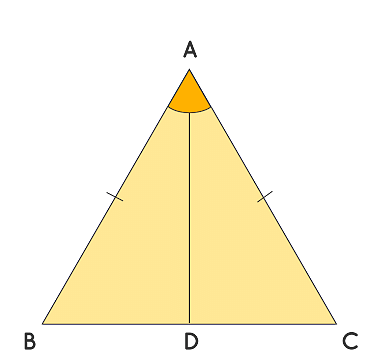 Can you prove that ΔADBΔADB is congruent to the ΔADC by using SAS triangle formula? What do you know about BD and CD? (3 Marks)
Ans: To Prove: ΔADBΔADB is congruent to the ΔADCΔADC
Given: ΔABC is an isosceles, with AC = AB.
Also, the side AD is common in both the triangles ΔADB and ΔADC.
As the line segment AD is that the angle bisector of the angle A Thus, it divides ∠A into two equal parts.
Therefore, ∠BAD=∠CAD
So, consistent with the SAS rule, the 2 triangles are congruent.
Hence proved that,
ΔADB≅ΔADC
Therefore, the opposite side and also the other two angles are congruent in nature. BD = CD
Answer: ΔADB≅ΔADC and BD = CD
Ques: Prove that the given triangles are similar.  (3 Marks)
Ans: To Prove: ΔDEF is analogous to ΔABC.
Given: DE/AB=DF/AC and ∠D=∠A.
Construction: Follow below steps:
- Take a degree X on AB such AX = DE.
- Draw a segment of line through X which in which XY ? BC and intersecting AC at Y.

Proof: Since XY II BC, therefore, ΔAXY ~ ΔABC, and thus: AX/AB = AY/AC....(eq1) Now, to point out ΔAXY and ΔDEF are congruent. it's provided that DE/AB=DF/AC....(eq2) Since AX=DE (By construction) and from (eq1) and (eq2),
we have: DE/AB = AX/AB = AY/AC = DF/AC.
Thus, AY=DF
Now, using SAS congruency criterion, ΔAXY≅ΔDEF⇒ΔAXY∼ΔDEF
We know that, ΔAXY ~ ΔABC.
This means ΔDEF and ΔABC are similar.
Hence Proved.
Ques: Prove that the two triangles are congruent. (3 Marks)
Ans: Given: AB=PQ, BC=QR, and ∠B=∠Q.
To prove: ΔABC ≅ ΔPQR

Proof:
- Since, AB=PQ, so point A falls on point P.
- Since, ∠B=∠Q, that the side BC will fall along the side QR.
- BC=QR, so point C falls on point R.
This means that BC coincides with QR. This would also make AC coincides with PR.
Ques: Check if the given triangles below are congruent and state the criterion test for congruence in triangles.  (3 Marks)
Ans: Given: EF = MO = 3in,
FG = NO = 4.5in,
∠EFG = ∠MON = 110°.
Thus, ΔEFG ≅ ΔMNO ( Using SAS rule ).
Therefore, These triangles are congruent by the SAS rule.
Ques: PQR is an isosceles triangle. On the equal sides of the triangle, L and M are the midpoints of those equal sides. N is the midpoint of the third side. Prove that LN=MN.  (3 Marks)
Ans: Given that, ΔPQR is an isosceles triangle. L is that the midpoint of PQ and M is that the midpoint of QR.
To prove: LN = MN
Proof: We can prove ΔLPN ≅ ΔMRN first to prove that LN is adequate MN.
Using what’s given,
PQ = QR (Two sides are equal in an isosceles triangle)
∠QPR = ∠PRQ (Angles are equal opposite to equal sides)
PL = LQ = QM = MR (L and M are midpoints of PQ and QR and PQ = QR)
In ΔLPN and ΔMRN, we have,
- LP = MR (L and M are midpoints and PQ = QR)
- ∠LPN = ∠MRN (Since ∠QPR = ∠QRP)
- PN = NR (N is that the midpoint of PR)
Then by SAS rule of congruence in triangles, ΔLPN ≅ ΔMRN. Since corresponding parts of congruent triangles are equal, therefore, we are able to say that LN = MN.
Hence proved.
Ques: Is the pair of triangles congruent? If so, write the congruence statement and why.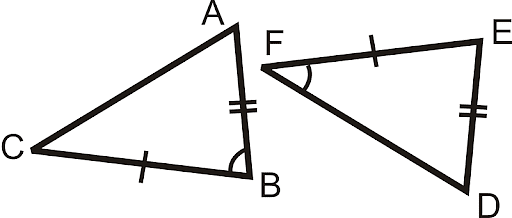 (2 Marks)
Ans: While the triangles have two pairs of congruent sides and one pair of congruent angles, the angle in each triangle is not in the same spot. The first triangle corresponds to SAS, while the second triangle corresponds to SSA. We don't have enough information to determine whether these triangles are congruent.
Ques: In the following figure, AB = BC and AD = CD. Show that BD bisects AC at right angles.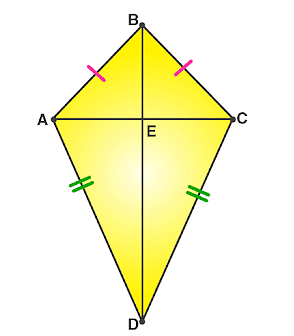 (3 Marks)
Ans: To prove: ∠BEA = ∠BEC = 90° and AE = EC.
Firstly, Consider ΔABD and ΔCBD,
AB = BC (Given)
AD = CD (Given)
BD = BD (Common)
Therefore, ΔABD ≅ ΔCBD (By SSS congruence)
∠ABD = ∠CBD (CPCTC)
Now, we consider ΔABE and ΔCBE,
AB = BC (Given)
∠ABD = ∠CBD (Proved above)
BE = BE (Common)
Therefore, ΔABE≅ ΔCBE (By SAS congruence)
∠BEA = ∠BEC (CPCTC)
And ∠BEA +∠BEC = 180° (Linear pair)
2∠BEA = 180° (∠BEA = ∠BEC)
∠BEA = 180°/2 = 90° = ∠BEC
AE = EC (CPCTC)
Answer: Therefore, BD is a perpendicular bisector of AC.
Ques: Describe the type of congruence in two triangles given by; ΔABC, AB = 7 cm, BC = 5 cm, ∠B = 50° and ΔDEF, DE = 5 cm, EF = 7 cm, ∠E = 50° (3 Marks)
Ans: Given:
AB = EF = 7 cm,
BC = DE = 5 cm and
∠B =∠E = 50°
Answer: Therefore, ΔABC ≅ ΔFED (Using SAS congruence rule)
Ques: Given that ∠ABC = (2x + 30) °, ∠PQR = 55 ° and ∠ RPQ = 65 °, find the value of x.  (3 Marks)
Ans: To find: x
ΔABC ≅ ΔPQR
Therefore,
55 ° + 65 ° + (2x + 30) ° = 180°
120° + 2x + 30° = 180°
150° + 2x = 180°
2x = 30°
x = 15°
Answer: therefore, x = 15°
Read More:



Comments