NCERT Solutions for Class 9 Maths Chapter 5: Introduction to Euclid’s Geometry

Collegedunia Team logo

Collegedunia Team

Content Curator

The NCERT Solutions for class 9 Maths Chapter 5 Introduction to Euclid's Geometry are provided in the article below. Euclidean geometry deals with points, lines, circles, curves, angles, planes, solids, etc.

Class 9 Maths Chapter 5 Introduction to Euclid’s Geometry belong to Unit 4 Geometry which has a weightage of 27 marks in the Class 9 Maths Examination. Class 9 Mathematics Chapter 5 has the following important concepts: 

  1. Postulates of Euclid Geometry
  2. Euclid’s Axioms
  3. Non-Euclidean Geometry

Download: NCERT Solutions for Class 9 Mathematics Chapter 5 pdf


NCERT Solutions for Class 9 Maths Chapter 5

The Chapter 5 Class 9 Maths are given below:
NCERT SolutionsNCERT SolutionsNCERT SolutionsNCERT SolutionsNCERT SolutionsNCERT SolutionsNCERT SolutionsNCERT SolutionsNCERT SolutionsNCERT SolutionsNCERT SolutionsNCERT Solutions

Important Topics in Class 9 Maths Chapter 5 Introduction to Euclid’s Geometry

Important Topics in Class 9 Maths Chapter 5 Introduction to Euclid’s Geometry are elaborated below:

Postulates of Euclid Geometry

Euclid’s geometry is the study of shapes of geometrical figures and planes. Euclid’ geometry can be further classified into 5 postulates.

The five postulates are:

  • A straight line can be drawn from one point to another.
  • A terminated/closed line can be generated indefinitely.
  • A circle can be drawn with any center and radius.
  • All right angles are equal to each other.
  • If the interior angles formed when two straight lines fall on a third are less than two right angles on the same side, then the lines will intersect if extended far enough.

Euclid’s Axioms

Euclid's axioms are several assumptions of the obvious universal truths that have not yet been proven entirely.

One of the many Euclid’s axioms includes:

  • Euclid's axioms states that objects equal to the same thing are equal. For example, if p = q and q = r, we can say that p = r.

Non-Euclidean Geometry

Non-Euclidean geometry is a sub-discipline of geometry. The things that do not arrive within Euclidean geometry is referred to as non-Euclidean geometry.

Important Points of Non-Euclidean Geometry:

  • Non-Euclidean geometry is bsically the antonym of euclidean geometry.
  • Non-Euclidean geometry discusses about hyperbolic and spherical figures.
  • It is otherwise known as hyperbolic geometry.

NCERT Solutions for Class 9 Maths Chapter 5 Exercises:

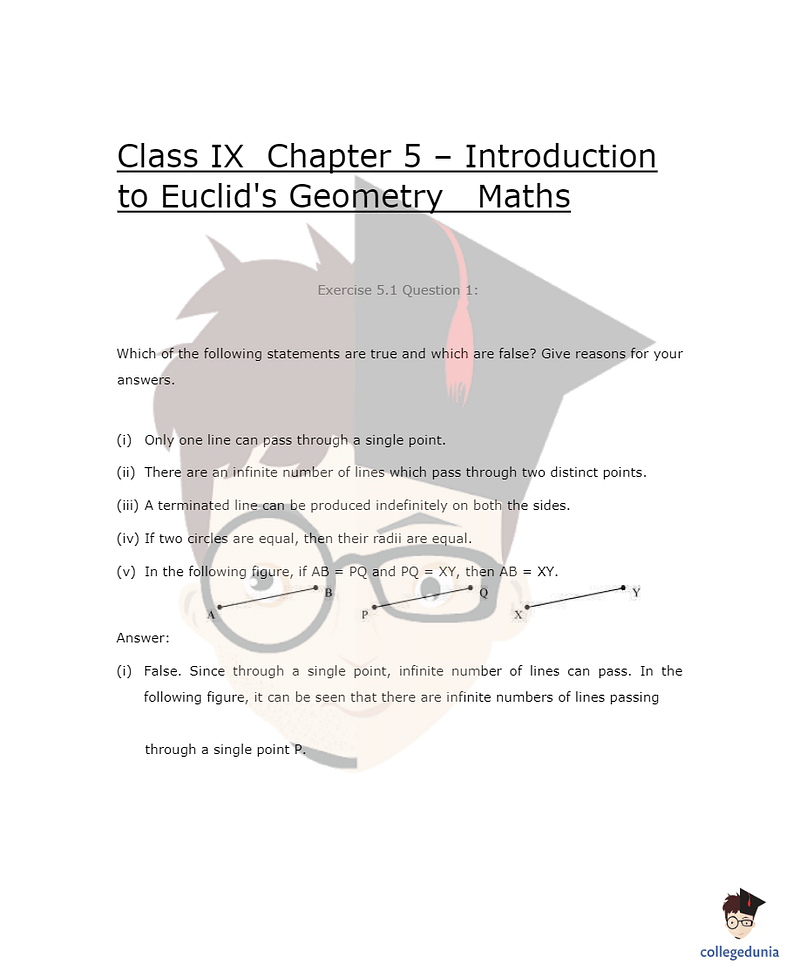
The detailed solutions for all the NCERT Solutions for Introduction to Euclid’s Geometry under different exercises are:

Also Read:

Also Read:

CBSE X Related Questions

  • 1.
    Use graphical method to solve the system of linear equations : $x = -3$ and $5x - 2y = -5$.


      • 2.
        PQ and PR are two tangents to a circle with centre O and radius 5 cm. AB is another tangent to the circle at C which lies on OP. If OP = 13 cm, then find the length AB and PA.


          • 3.
            The dimensions of a window are $156\text{ cm} \times 216\text{ cm}$. Arjun wants to put grill on the window creating complete squares of maximum size. Determine the side length of the square and hence find the number of squares formed.


              • 4.
                In the given figure, $AB \parallel DE$ and $AC \parallel DF$. Show that $\Delta ABC \sim \Delta DEF$. If $BC = 10\text{ cm}$, $EB = CF = 5\text{ cm}$ and $AB = 7\text{ cm}$, then find the length $DE$.


                  • 5.
                    Assertion (A) : The system of linear equations $3x - 5y + 7 = 0$ and $-6x + 10y + 14 = 0$ is inconsistent.
                    Reason (R) : When two linear equations don't have unique solution, they always represent parallel lines.

                      • Both Assertion (A) and Reason (R) are true and Reason (R) is the correct explanation of the Assertion (A).
                      • Both Assertion (A) and Reason (R) are true, but Reason (R) is not the correct explanation of the Assertion (A).
                      • Assertion (A) is true, but Reason (R) is false.
                      • Assertion (A) is false, but Reason (R) is true.

                    • 6.
                      A chord of a circle, of radius 14 cm, subtends an angle of $60^\circ$ at the centre. Find the area of the smaller sector and perimeter of the smaller segment.

                        Comments


                        No Comments To Show