



Exams Prep Master
Parallel Lines, in geometry, can be defined as two lines on the same plane that never intersect each other and can be extended indefinitely on both sides if needed. The symbol that represents the parallel line is ‘II’. It’s easy to find parallel lines from our daily lives. Suppose you are doing your literature homework on a ruled exercise book. Have you ever noticed those lines on a rule page? A typical example of parallel lines. Another example of parallel lines is the railway tracks. Here we will learn some of the properties and the construction of parallel lines from an external point.
| Table of Content |
Key takeaways: Parallel Lines, Properties of Parallel lines, Parallel lines construction, Transverse
Also read: Isosceles Triangle Theorems
Properties of Parallel Lines
[Click Here for Sample Questions]
- The most important and prominent property of a Parallel Line is two parallel lines will never intersect each other.
- The distance at any point will remain the same between the two parallel lines.
- Every alternate Interior and Exterior angles formed are always equal.
- If needed, a pair of parallel lines can be extended indefinitely.
Look at the picture below for reference. These lines AB and CD are parallel lines, these lines will never intersect each other and the distance between them at any point is the same. Also if you try to measure any Interior and Exterior angles that can be formed on these two lines will always be equal.

Also read: Calculus Formula
How to Construct Parallel Lines External Points?
[Click Here for Sample Questions]
Requirements: You will need a few things to construct Parallel lines. They're
- A pencil
- A Ruler
- A Compass
- An eraser (if needed) and
- A paper or math exercise book to draw.
Steps to Construct Parallel Lines from an External Point
[Click Here for Sample Questions]
Constructing a Parallel Line from an external Point is not too complicated as it might seem. We can learn this easily through a few simple steps.
Step 1: First, we have to start by drawing a straight line on blank paper. For that, we have to take two points on the same plane, for example, point L and point D. And then connect these two points by drawing a straight line with the help of a ruler and pencil.

Step 2: Now, take an external point above the straight line. We can name the point U.

Step 3: Here, we need to create a transverse using this point U, that will intersect the original line. Now, what is a Transverse you might ask! Well, a Transverse is “Transversal is the line that intersects both the parallel lines at distinct points.”
Now, take the point which is created by the transverse on the main straight line, and name it with another unused letter. Suppose the name of that point is E.

Step 4: At this point, use the compass and pencil to draw two arcs with the same measurements. (An arc is a part of a circle.)
In this part, we will discuss the process of drawing those arcs in two steps, so that it would be easier for you to understand.
- To draw the first arc, point E needs to be considered as the center point.
- To draw the next arc, we have to consider point U as the center.

Step 5: Use your compass carefully. We have to put the sharp end of the compass at the point where the first arc has intersected the line EU, while the other leg of the compass will be put on the point where the arc is intersecting the line ED.
Hence, in this way, we can measure the exact distance between those two points perfectly. Look at the picture below.

Step 6: Now, with this measured distance, we need to lift the compass very cautiously. Then we have to put the sharp end of the compass on point U and create a cross mark on the second arc with the other end.
Let’s call this crossing point M for better understanding just like the picture below.

Step 7: Now finally, we need to connect the two points- U and M. After connecting those points, the tiny straight line we get needs to be extended from both ends. Let’s name the extended straight line JB.
Finally, we can see that the line JB has been created as a parallel line to LD.

Also read: Difference between Sequence and Series
Things to Remember
- Parallel Lines can be defined as the two lines that will never intersect each other.
- Two examples of parallel lines- Railway track, Ruled paper.
- The two most important properties of parallel lines are- 1. Those two lines will never intersect each other and 2. The distance between two parallel lines will be the same at any point.
- A transverse line can be defined as “ The line that intersects both the parallel lines at distinct points”
- While drawing a parallel line the use of a compass should be done very carefully.
Also read: Determinant Formula
Sample Questions
Ques. Define the following: Parallel LinesTransverse line (2 marks)
Ans: Parallel Line: Parallel line can be defined as two lines on the same plane that will never intersect each other. It is represented with the symbol ll.
Transverse Line: Transverse line can be defined as the line which can intersect both parallel lines at different points.
Ques. What are the properties of Parallel lines? (2 marks)
Ans: Parallel Lines can be defined as two lines on the same plane that never intersect each other and can be extended indefinitely on both sides if needed.
Therefore the most important properties are-
- The most important and prominent property of a Parallel Line is that two parallel lines will never intersect each other.
- The distance at any point will remain the same between the two parallel lines.
- Every alternate Interior and Exterior angles formed are always equal.
- If needed, a pair of parallel lines can be extended indefinitely.
Ques. Draw a line, say AB, take a point C outside it. Through C, draw a line parallel to AB using a ruler and compass only. (NCERT) (3 marks)
Ans: Here are the steps of the construction:
- As mentioned in the question, the line AB has been drawn.
- Next an external point C is marked outside the line AB.
- A point- D has been taken on the line AB.
- After marking points D, C, and D need to be connected.
- In the next step, keeping D as a center, we need to draw a tiny arc that would intersect the line AB at point E and line CD at point F.
- Keeping C as the center, we need to draw another arc with the same radius. This arc GH would intersect CD at point I.
- With the same measurement, another arc has been drawn which will intersect GH at point J.
- At this final step, we just need to join JC and extend the line from both ends. This will make the parallel line we aimed for.

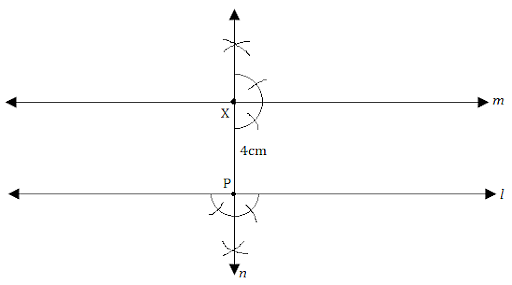
Ques. Draw a line l. Draw a perpendicular to l and any point on l. On this perpendicular choose a point X, 4cm away from l. Through X, draw a line m parallel to l. (NCERT) (3 marks)
Ans: Here are the steps that need to be followed to construct a parallel line according to question-
- At first, we need to draw a line- l and decide a point on that line. Suppose the point is P.
- Next, we need to draw a perpendicular line. Here it is named n.
- Now as mentioned in the question, on the line n, PX= 4cm.
- We need to draw another perpendicular line m at X. This m is the line we aimed for.
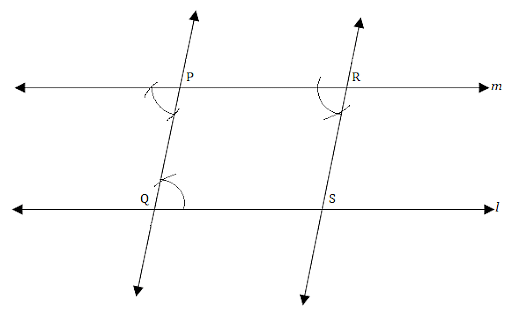
Ques. Let l be a line and P be a point not on l. Through P, draw a line m parallel to l. Now join P to any point Q on l. Choose any other point R on m. Through R, draw a line parallel to PQ. Let this meet l at S. What shape do the two sets of parallel lines enclose? (3 marks)
Ans: As given in the question, a pair of parallel lines need to intersect another part of parallel lines. Therefore we need to follow some simple steps for this construction.
- At first, we need to draw the line l and decide a point- p outside l as instructed.
- Then as instructed, the point Q is taken on line l.
- Let’s connect P and Q then.
- Now, we need to draw the equal angle i.e. ∠Q = ∠P.
- Then we need to extend the line from point P so that we can get the line m.
- Just like the previous steps, we have to take another point R, and draw the equal angles ∠P = ∠R, just the way mentioned in the question.
- By extending the line from point R, which will intersect on line l at point S, we will be able to create the line RS.
- Hence we get the formation of PQRS, which is a Parallelogram.
Ques. Give one prominent example of parallel lines from our daily life with explanations. (2 marks)
Ans: Whenever we travel via train, we can observe the railway tracks. This is a perfect example of parallel lines.
The railway tracks never intersect each other. The distance between them at any point remains the same. Hence, we can conclude the railway tracks are parallel lines.
Ques. In the given figure, ∠1 = ∠2, and then prove l||m.  (3 marks)
Ans: We know, a transverse line is a line that intersects two parallel lines at two different points.
Here, in the question, it is mentioned that ∠1 = ∠2
Hence, we need to prove l is parallel to m.
Now, ∠1 = ∠2 (mentioned in the question)
So, ∠1 = ∠3 (as we know that the opposite vertical angles are equal)
Therefore, ∠2 = ∠3
According to the properties of parallel lines, as the corresponding angles are equal, we can easily conclude that l is parallel to m.
Mathematics Related Links:



Comments