NCERT Solutions for Class 7 Mathematics Chapter 14: Symmetry

NCERT Solutions for class 7 Mathematics Chapter 14 Symmetry are provided in the article below. If two or more parts of a figure are identical after folding or flipping then it is said to be symmetry. To be symmetrical the two halves of a shape must be of same shape and size. If the shape is not symmetrical then it is said to be asymmetrical. Some of the important topics in Symmetry chapter include:

Download PDF: NCERT Solutions for Class 7 Mathematics Chapter 14 pdf


NCERT Solutions for Class 7 Mathematics Chapter 14

NCERT Solutions for Class 7 Mathematics Chapter 14 Symmetry is given below.

NCERT SolutionsNCERT SolutionsNCERT SolutionsNCERT SolutionsNCERT SolutionsNCERT SolutionsNCERT SolutionsNCERT SolutionsNCERT SolutionsNCERT SolutionsNCERT SolutionsNCERT SolutionsNCERT SolutionsNCERT SolutionsNCERT SolutionsNCERT SolutionsNCERT SolutionsNCERT SolutionsNCERT SolutionsNCERT Solutions

NCERT Solutions for Class 7 Mathematics

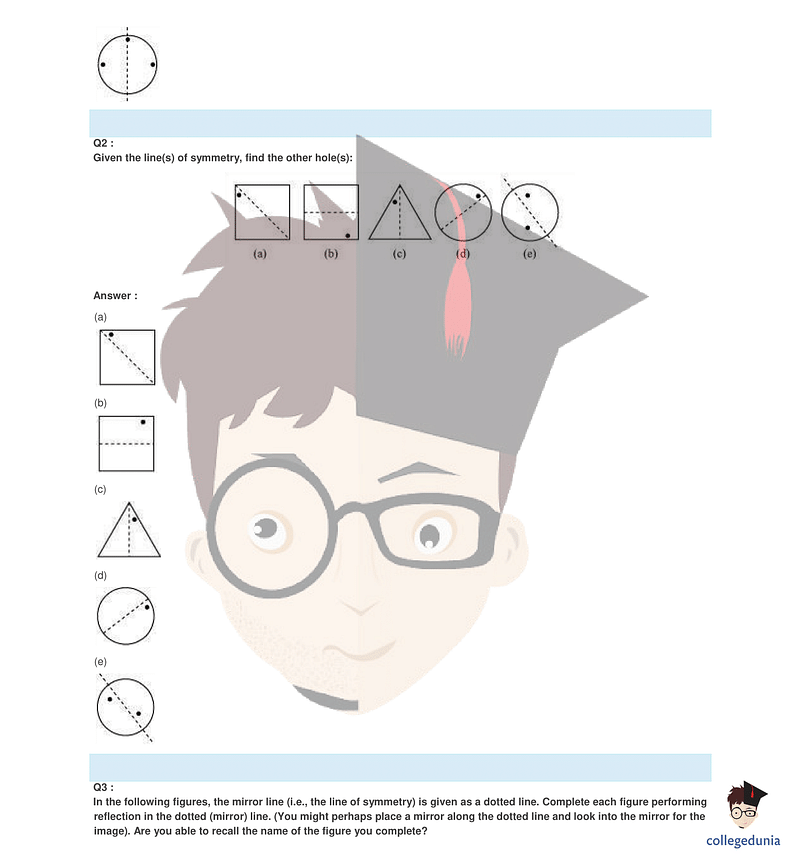
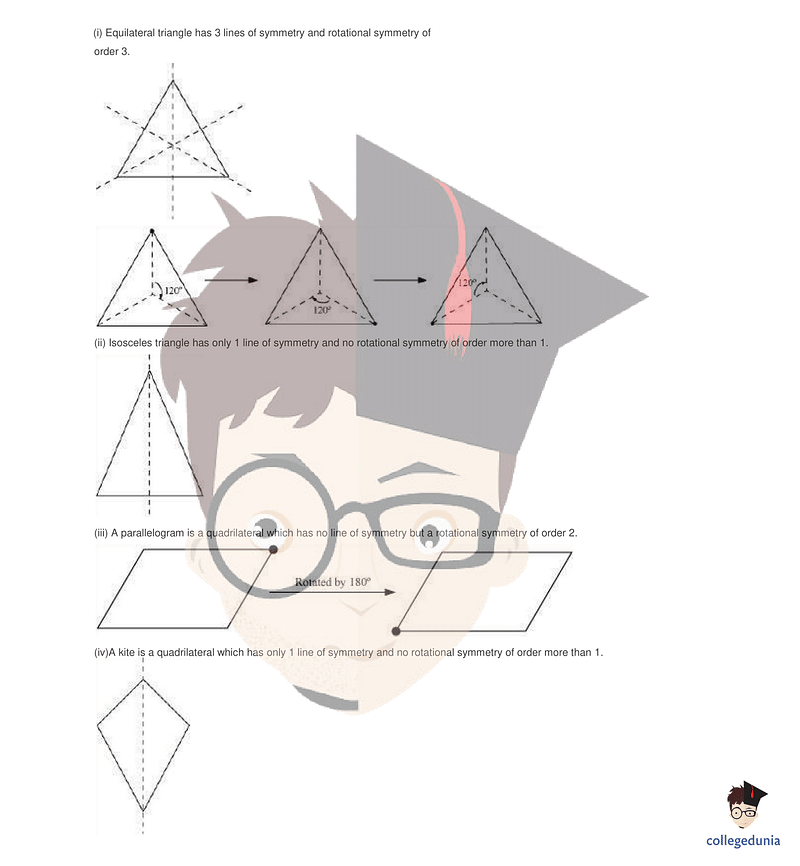
Symmetry: A figure is said to be symmetrical if one half of the figure is a mirror image of the other.

Depending on the lines of symmetry, symmetrical figures can be classified into:

  • No Line of Symmetry (for the asymmetrical figure)
  • One Line of Symmetry 
  • Two Line of Symmetry 
  • Multiple (more than 2) Line of Symmetry
  • Infinite Line of Symmetry

NCERT Solutions for Class 7 Maths Chapter 14 Exercises

NCERT Solutions for Class 7 Maths Chapter 14 Symmetry Exercises is given below.

Read More:

Class 7 Maths Guide:

CBSE X Related Questions

  • 1.
    The dimensions of a window are $156\text{ cm} \times 216\text{ cm}$. Arjun wants to put grill on the window creating complete squares of maximum size. Determine the side length of the square and hence find the number of squares formed.


      • 2.
        Assertion (A) : The system of linear equations $3x - 5y + 7 = 0$ and $-6x + 10y + 14 = 0$ is inconsistent.
        Reason (R) : When two linear equations don't have unique solution, they always represent parallel lines.

          • Both Assertion (A) and Reason (R) are true and Reason (R) is the correct explanation of the Assertion (A).
          • Both Assertion (A) and Reason (R) are true, but Reason (R) is not the correct explanation of the Assertion (A).
          • Assertion (A) is true, but Reason (R) is false.
          • Assertion (A) is false, but Reason (R) is true.

        • 3.
          Prove that: $\frac{\tan \theta}{1 - \cot \theta} + \frac{\cot \theta}{1 - \tan \theta} = 1 + \tan \theta + \cot \theta$


            • 4.
              In the given figure, point D divides the side BC of $\Delta ABC$ in the ratio $1 : 2$. Find length AD.


                • 5.
                  A chord of a circle, of radius 14 cm, subtends an angle of $60^\circ$ at the centre. Find the area of the smaller sector and perimeter of the smaller segment.


                    • 6.
                      Two dice are rolled together. The probability of getting an outcome $(x, y)$ where $x \gt y$, is

                        • $\frac{5}{12}$
                        • $\frac{5}{6}$
                        • $1$
                        • $0$

                      Comments


                      No Comments To Show