



Content Curator
Cretinism is an iodine deficiency disorder that is the result of underactivity of thyroid glands during infancy or early childhood. Two types of cretinism are congenital cretinism and endemic cretinism. The cause of congenital cretinism is genetic defect in enzymes that aid thyroid hormone synthesis. Endemic cretinism is mostly caused by maternal hypothyroidism. Several symptoms of cretinism are decrease in IQ, goitre, dwarfism, enlarged tongue, delayed reflexes, and mental retardation.
Read more: Iodine
Key Terms: Cretinism, Congenital Cretinism, Endemic Cretinism, Maternal hyperestrogenism
Introduction to Cretinism
[Click Here for Sample Questions]
Cretinism is the result of underactivity of thyroid gland during childhood that leads to iodine deficiency disorder. The people suffering from this disease were mentally challenged. Cretinism can be a result of endemic cretinism (extreme iodine deficiency) or sporadic cretinism. Early diagnosis and treatment is essential to avoid irreversible damage.

Cretinism
The video below explains this:
Cretinism Detailed Video Explanation:
Types of Cretinism
[Click Here for Sample Questions]
Cretinism is of two types: Congenital cretinism and endemic cretinism.
Congenital Cretinism
An iodine deficient endemic area has an incidence of 1:30000 to 1:4000. The cause of congenital cretinism is genetic defect in enzymes that aid thyroid hormone synthesis. These include thyroglobulin, thyroid-stimulating hormone, and iodotyrosine deiodinase.
Another name for this hypothyroidism is congenital hypothyroidism non-goitrous. Various genes mutated to develop five types of congenital hypothyroidism non-goitrous. It is the most prevelant inborn disorder.

Congenital and Endemic Cretinism
Endemic Cretinism
Endemic cretinism occurs in children that live in geographical locations where there is a deficiency of iodine. Normal thyroid levels should be regained and retained during early life through iodine supplements or supplementing thyroid hormone. Endemic cretinism is mostly caused by maternal hypothyroidism.
In maternal hypothyroidism, the mother is affected by hypothyroidism during pregnancy. If the mother is exposed to radioactive iodine during pregnancy, it can cause cretinism. Neurological cretinism is characterized by mental retardation, retarded growth, and motor spasticity. Myxedematous cretinism is characterized by retarted growth, dry skin, dry hair and eyebrows, delayed sexual maturation, and mental retardation.
Causes of Cretinism
[Click Here for Sample Questions]
Cretinism can be a cause of:
- Inability or failure of thyroid gland to produce thyroid hormone, also known as congenital iodine deficiency syndrome.
- Deficiency of iodine in diet, also known as endemic cretinism.
- Maternal hyperestrogenism can be a cause of neonatal cretinism.
Hypothyroidism leads to cretinism in children. Maternal hyperestrogenism may lead to an increase in level of thyroxine binding globulin (TBG). This increase in level of thyroxine binding globulin (TBG) normalized the T3 and T4 level.
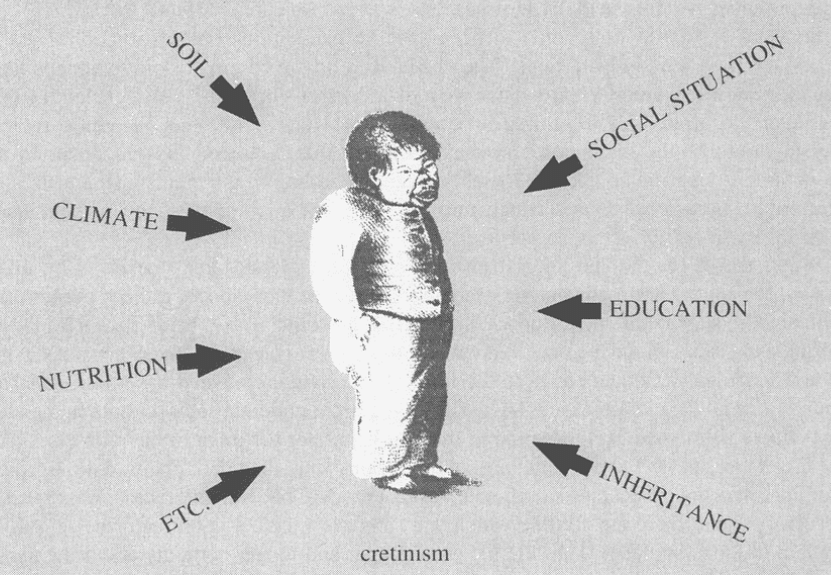
Causes of Cretinism
Symptoms of Cretinism
[Click Here for Sample Questions]
Several symptoms of cretinism are:
- Retarded growth
- Defects in speech and hearing
- Dwarfism
- Mental retardation
- Goitre (enlargement of thyroid gland)
- Myxoedema
- Decrease in IQ (intelligent quotient)
- Enlargement of tongue
- Thick and dry skin
- Reduced muscle coordination
- Hoarse and deep voice
- Delayed reflexes
- Inability to maintain balance and posture
- Neurological impairment
- Delayed sexual maturation

Symptoms of Cretinism
Diagnosis of Cretinism
[Click Here for Sample Questions]
Diagnosis of cretinism can be done by various tests such as:
- Antenatal screening test
- Postnatal blood spot test
- Guthrie test
- Radioactive iodine test
- Technetium thyroid scan
Cretinism can also be diagnosed by detecting the increase in Thyroid binding globulin or T3 levels or decrease in T4 levels.

Diagnosis of Cretinism
Treatment of Cretinism
[Click Here for Sample Questions]
Early treatment is important in cretinism, preferably started within the first two weeks after diagnosis. Some symptoms of cretinism (such as developmental abnormalities or retarded mental abilities) are irreversible so treatment should be started before they appear.
The treatment is done through thyroid hormone replacement therapy. The dose is increased with increase in age. Thyroxine can be used for everyday treatment. Early treatment can help revive physical development and growth.
Things to Remember
[Click Here for Sample Questions]
- Cretinism is an iodine deficiency disorder that is the result of underactivity of thyroid glands during infancy or early childhood.
- Cretinism is of two types: Congenital cretinism and endemic cretinism.
- Symptoms of cretinism are reduced muscle coordination, dry skin, retarded growth, defects in speech, mental retardation, hoarse voice, and neurological impairment.
- Cretinism can be diagnosed by Antenatal screening test, radioactive iodine test, or technetium thyroid scan.
- The treatment of cretinism is done through thyroid hormone replacement therapy or thyroxine.
Read more:
Sample Questions
Ques. Write a note on Thyroid Gland. (3 Marks)
Ans. Thyroid gland is located in the front part of the neck. It is a ductless endocrine gland. Thyroid gland is mainly responsible for releasing two hormones Thyroxine and Triiodothyronine. Thyroid gland is prone to many diseases and disorders.
Most common thyroid disorders are goitre, hypothyroidism, hyperthyroidism, and thyroid cancer. Several symptoms of thyroid problems are high cholesterol, increase in weight, increase in heart rate, fluctuations in menstrual cycle, nervousness, lack of concentration, and muscle pain.
Ques. What is Hyperthyroidism? (3 Marks)
Ans. A disorder in which the thyroid gland is underactive and doesn’t release enough thyroid hormones is Hyperthyroidism. Hyperthyroidism symptoms include fatigue, memory issues, increase in weight, irritability, constipation, infertility, lack of energy, depression, and abnormal menstruation.
Hypothyroidism is caused due to damage to thyroid gland, iodine deficiency, medications, or pituitary gland disorder. Hypothyroidism can be prevented by regular exercise, consuming a balanced diet, regular hormonal tests, and staying hydrated.
Ques. Write a note on Pituitary Gland. (4 Marks)
Ans. Pituitary gland is located at the base of the brain. It releases some of the most important hormones so it is also called the ‘master gland’. The pituitary gland can be divided into three lobes: anterior pituitary, intermediate pituitary, and posterior pituitary. The pituitary gland secretes the following hormones:
- Thyroid Stimulating Hormone
- Human Growth Hormone
- Prolactin
- Follicle Stimulating Hormone
- Luteinising Hormone
- Melanocyte Stimulating Hormone
- Adrenocorticotropic Hormone
- Oxytocin
- Antidiuretic Hormone
Ques. What are the functions of thyroid hormones? (3 Marks)
Ans. Thyroid hormones perform many important functions:
- They play an important role in protein synthesis
- Thyroid hormones help regulate the metabolism of proteins, carbohydrates, and fats
- They aid brain development
- Thyroid hormones supplement bone health
- They also aid development of cell
Ques. Write a note on melatonin hormone. (3 Marks)
Ans. Melatonin is also known as the ‘hormone of darkness’ as the body secretes it during night. Melatonin hormone is secreted by the pineal gland. It is also known as sleep hormone as melatonin regulates the sleep wake cycle of the body.
Melatonin also regulates reproductive processes of the body and woman’s menstrual cycle. The level of melatonin in the body keeps increasing and decreasing. It can be maintained by consuming a balanced diet, getting enough sleep, consuming supplements, and eating food that is rich in calcium and Vitamin B3.
Ques. What is the Endocrine system and what are various endocrine glands? (3 Marks)
Ans. Endocrine system is the system that includes nine primary glands that secrete various hormones that affect the bodily functions. Endocrine system also includes organs that aid auxiliary functions.
The major endocrine glands are:
- Pineal gland
- Pituitary gland
- Gonads
- Parathyroid glands
- Adrenal glands
- Thyroid gland
- Pancreas
- Testis
- Ovary
Ques. What are symptoms of acromegaly? (2 Marks)
Ans. Acromegaly is a hormonal illness that is caused due to excessive secretion of growth hormone. It leads to unusual growth of body parts. Some symptoms of Acromegaly are abnormal increase in weight, impaired vision, fatigue, development of tags on skin, development of body odour, weakness in muscles, sleeplessness, croaky voice, constant headaches, swelling in joints, and enlargement of sebaceous glands. Acromegaly can be treated through medicine, surgery, and radiation therapy.
Ques. Write a note on hormones of heart, kidney and gastrointestinal tract. (3 Marks)
Ans. Non-endocrine tissues heart, kidney and gastrointestinal tract also secrete hormones. Heart cells release Atrial natriuretic factor (also known as Atrial natriuretic peptide) that regulates the blood pressure and blood volume.
Kidney releases Erythropoietin (also known as hemopoietin) that aids the production of red blood cells in the bone marrow. Gastrointestinal tract releases secretin, gastrin, gastric inhibitory peptide, and cholecystokinin. All these hormones together aid the release of gastric juices and enzymes.
Also read:



Comments