



Content Curator
Cytoskeleton is part of cytoplasm that provides internal support and also helps in various types of movement. It is a network of microtubules, microfilaments and intermediate filaments that contribute to mechanical support and motility. Inside this are cells like threads and tubes. Thread and tube-like structure provide shape and strength with the help of proteins.
Read More: Prokaryotic and Eukaryotic Cells
Key Terms:
Cytoskeleton of cell, cytoskeleton definition, cytoskeleton microtubules, cytoskeletal filament, cytoskeleton in prokaryotesWhat is Cytoskeleton?
[Click Here for Sample Questions]
Cytoplasm has interconnected filaments and tubules that form eukaryotic cells, prokaryotic cells and archaeans. It grows alongside the cell and cytoplasm. Cytoplasm refers to all the substances inside the cell except the nucleus. Fibres inside the cell have a complex mesh of protein filaments as well as motor proteins that help in the movement of the cell. The following areas in which the cytoplasm helps.
- To help intracellular organelles to communicate with one another.
- To help in cell mobility and protoplasm movement, known as cyclosis.
- It gives the cell form and support, as well as organising the organelles.
- To help in the movement of chromosomes, membranes, and granules, as well as the creation of membrane protrusions (microvilli).
- To help in the transport of molecules, cell division, and cell signalling.
Read More: Gemmule Formation
Cytoskeleton Structure
[Click Here for Sample Questions]
Nucleus of a eukaryotic cell is very complex and eukaryotic cells are found in plants, animal fungi and protists while the nucleus of a prokaryotic cell is not complex because it has no true nucleus and organelles other than ribosome and is found in single-celled organisms like bacteria and archaea.
Cytoskeleton provides shape, stability, energy, motility as well as cellular scaffolding that organizes cellular organization. Many ribosomes are attached to the cytoskeleton. Combining three types of fibres, the structure of a cyclo skeleton is prepared, which is given below.
- Microfilaments
- Microtubules
- Intermediate filaments
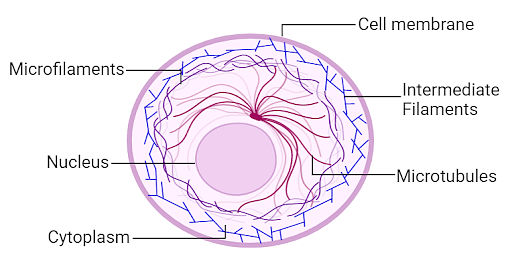
Cytoskeleton Structure
Read More: Binary Fission
Microfilaments
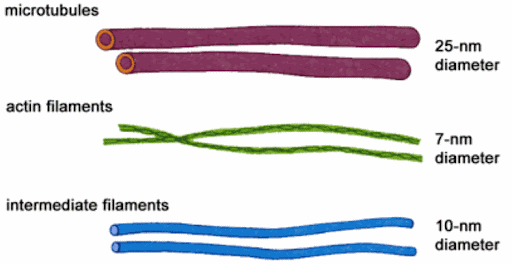
Microfilaments are the thinnest fibre and look like thread-like protein fibre. Its thickness is about 3 to 6 nanometers in diameter and it is found in muscle cells which consist of the protein actin. By the way, it is responsible for muscle contraction as well as cellular movement including cytokinesis, contraction and gliding. Its main component is protein action, which is a globular protein with a weight of about 42 KD. The sequence of amino acids separates the non-muscle actin from the muscle actin.
Microfilaments
Microfilament can also be called actin filaments because it is made up of actin proteins. It has many functions such as helping in the cytokinesis, which divides the cytoplasm and makes two daughter cells. It runs from the nucleus to the cell membrane in numerous types of cells. The intricate network that such filaments generate in the cytoplasm, also allows them to connect with other cytoskeleton components.
Along with motility, it also helps in the movement of bacteria called a single-celled organism. Microfilaments have also contributed to cytoplasmic streaming that transports nutrients and cell organelles. The two components that are used in muscle contraction are Actin and Myosin.
Read More: Microfilament
Microtubules
Microtubules are the largest fibres found in the cytoskeleton and these are 23 nanometers in diameter and have a length of several millimetres. They are like holo tubes and consist of alpha and beta tubulin. 13 tubulins together form a single tube and tubulin is nothing but a single type of globular protein.
It is mostly found in the cell organelle of the animal cell which we call centrosome which is the microtubules organizing centre (MTOC). Centrosome is located in the centre of the cell while the microtubule is outside it. Microtubules, like microfilaments, are frequently bundled by cells.
Some microtubules are unstable as a result of their growth cycles and population shrinking. This helps to form the spindle apparatus and the mitotic spindle which separates the sister chromatids so that one copy each goes to both the daughter cells at the time of cell division. It also helps to move molecules in the cell and also forms the cell wall in the plant. Its structure is quite dynamic, which changes quickly and keeps on growing and shrinking. It also helps in chromosome division at the time of cell division.
Read More: Difference Between Cytoplasm and Protoplasm
Intermediate Filaments
Intermediate filament is about 8 to 12 nanometers in diameter. As an intermediate in its name, this is because the length it has is between the microfilament and the microtubules. It is made from different proteins like keratin, vimentin, desmin and lamin out of which keratin is found in the scale and horns in animals also in hair and nails.
All intermediate filaments are in the cytoplasm except for lamin proteins. Lamin protein is present in the nucleus and supports the nuclear envelope. It helps maintain the shape of the cell, bears tension in the cytoplasm and also provides structural support.
Read More: Sexual Reproduction in Fungi
Cytoskeleton Functions
[Click Here for Sample Questions]
Cytoskeleton has several functions such as it gives form to cells, apart from this it has different importance, which does not have the cell wall and if the cell is thick from outside then it does not give shape to the cell. Cells can crawl and migrate because microfilaments and microtubules can disintegrate, reassemble, and contract. Microtubules can aid in the formation of cell-movement structures such as cilia and flagella.
- It aids in the development of vacuoles.
- It assists the cell in maintaining its form and provides support.
- The cytoskeleton helps cells communicate by transporting signals between them.
- The cytoskeleton is a dynamic framework that may deconstruct and rearrange its components to allow for internal and overall cell mobility.
- In some cells, it creates cellular appendage-like protrusions like cilia and flagella.
- Cell mobility is required for tissue construction and repair, cytokinesis (cytoplasm division) in the generation of daughter cells, and immune cell responses to pathogens, all of which require the cytoskeleton.
- The cytoskeleton keeps a variety of cellular organelles in place.

Cytoskeleton Functions
Things to Remember
[Click Here for Sample Questions]
- Depending on the organism and cell type, the cytoskeleton's structure, function, and dynamic activity can be quite varied.
- The cytoskeleton, with the exception of bacteria and archaea, is a complex, dynamic network of interlinking protein filaments found in the cytoplasm of all cells.
- The microfilament is a key component of the cytoskeleton that helps reveal the true function of muscle contraction. Microfilaments are made up of actin, the most abundant cellular protein.
- Despite being the cytoskeleton's smallest components, microfilaments are very diverse and flexible.
Sample Questions
Ques. What are the three different types of cytoskeletons? (3 Marks)
Ans. The cytoskeleton is made up of three types of filaments: actin filaments, microtubules, and intermediate filaments. Actin filaments are found in a cell in the form of meshworks or bundles of parallel fibres, and they aid in the cell's structure and adhesion to the substrate. Microtubules are spherical, hollow tubes with a diameter of around 24 nanometers.
Tubulin is a protein that makes them up. A single tubulin tube is made up of thirteen tubulins linked together. Microtubules are highly dynamic structures that exhibit their ability to change rapidly. The intermediate filaments have a diameter of around 10 nm and provide the cell with tensile strength. Keratin and neurofilament production is aided by them.
Ques. What are the functions of the cytoskeleton? (3 Marks)
Ans. The following are some of the most important cytoskeleton functions:
- It gives the cell form and support.
- It aids in the development of vacuoles.
- It keeps the various cell organelles in place.
- It helps with cell signalling.
- It facilitates intracellular motions such as cell organelle migration and vesicle trafficking in and out of the cell.
Ques. Does the cytoskeleton exist in both plant and animal cells? (1 Mark)
Ans. A nucleus, Golgi complex, endoplasmic reticulum, ribosomes, mitochondria, peroxisomes, cytoskeleton, and cell (plasma) membrane are some of the cell components that are shared by animal and plant cells.
Ques. Why is the cytoskeleton the most important organelle? (2 Marks)
Ans. The most significant organelle is the cytoskeleton. Because it is required for cells to alter shape, complete cell division, and migrate, the cytoskeleton is extremely active. The cytoskeleton is crucial in cell division because it ensures that the chromosomes are evenly distributed across the subsequent cells.
Ques. Is cytoskeleton prokaryotic or eukaryotic? (2 Marks)
Ans. The cytoskeleton was assumed to be unique to eukaryotes until 1992 when it was shown to be present in prokaryotes as well. After discovering that bacteria have proteins that are similar to tubulin and actin, the key components of the eukaryotic cytoskeleton, this discovery was made.
Ques. What does a centrosome look like? (2 Marks)
Ans. Centrosomes are made up of two centrioles in which microtubules look barrel-shaped and a complex of proteins that aid in the formation of new microtubules. Because it helps organise the spindle fibres during mitosis.
Ques. What is Cytoplasmic streaming? (3 Marks)
Ans. The active movement of a cell's contents along the components of the cytoskeleton is known as cytoplasmic streaming. While this process is most commonly seen in plants, it is used by all cell types to transfer waste, nutrients, and organelles to other areas of the cell.
Because plant and algal cells are larger than most other cells, cytoplasmic streaming is crucial in these cells. This is due to the additional volume of the cell, which necessitates cytoplasmic streaming in order to transport organelles across the entire cell.
Also read:



Comments