


Answer: Homologous series are organic compound series with the same functional group and share similar chemical properties. They differ only in Carbon chain length. The members of homologous series are called homologue.
Examples of homologous series:
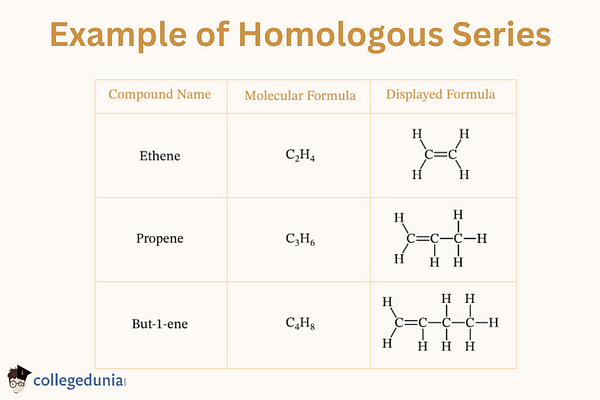
Alkane-
- CH4 – methane
- C2H6 – ethane
- C3H8 – propane
Alcohol-
- CH3OH - Methanol
- CH3CH2OH - Ethanol
- CH3(CH2)2OH - Propanol
- CH3(CH2)3OH - Butanol
- CH3(CH2)4OH - Pentanol
General Formula
- Alkane series having general formula CnH2n+2 : CH4, C2H6, C3H8, ...
- Alkene series having general formula CnH2n : C2H4, C3H6, C4H8, …
Check Classification of Organic Compounds
Listed below are the characteristics of homologous series:
- Homologous series have the same functional group.
- They share the same general formula.
- All the members of the series have almost the same chemical properties due to the same functional group.
- They have different physical properties
- They have a common general method of preparation.
- They have difference of – CH2– between two successive members and the difference between their masses is 14 amu.
- They show gradation in physical properties like melting and boiling point increase with the increase in molecular weight.
- Solubility in particular solvents shows gradation with increase in the molecular weight.
Check Carbon and its Compounds



Comments