



Content Curator
Asteroids and meteoroids are celestial bodies sharing a few common characteristics like staying close to the planets and orbiting the sun. An asteroid is an object made of rock, metal, or carbon. It is a leftover from the formation of the solar system. A meteoroid is a small particle separated or accidentally detached from a comet or asteroid. Both of them inspire awe and wonder in humans.
Read about: Differences Between Asteroids and Comets
Key Terms: Meteoroids, Asteroids, Asteroid belt, Apophis, Trojan asteroids, Dwarf planet ceres
What are Asteroids?
[Click Here for Sample Questions]
Asteroids are also known as minor planets or planetoids of the inner solar system. They are found mainly in the asteroid belt between Jupiter and Mars. There are millions of asteroids in the asteroid belt. They are rocky bodies that do not have an atmosphere but because of their size, they have a gravitational pull. A few of them have their own moons. They are said to be remains of planetesimal bodies within the sun’s solar nebula which never grew to become full-grown planets. Currently, the known asteroid count is 1,113, 527.
Also read: Dwarf Planets
Asteroids fall into three categories based on their composition.
- C-type or carbonaceous asteroids
They are most common grayish-colored asteroids that inhabit the main belt's outer regions. They probably consist of clay and stony silicate rocks and include more than 75% of known asteroids.
- The S-type or silicaceous asteroids
They are greenish and reddish asteroids that dominate the inner asteroid belt. They appear to be made of silicate materials and nickel-iron and account for almost 17% of known asteroids.
- The M-type or metallic asteroids
They are reddish color asteroids that dwell in the middle region of the main asteroid belt. They make up most of the rest of the asteroids. They seem like they are made up of nickel-iron.
There are also other types of asteroids made up of rare compositions.

Asteroids
Read More:
Characteristics of Asteroids
[Click Here for Sample Questions]
- Almost all asteroids are irregularly shaped although some of the large ones are nearly spherical.
- They are pitted or cratered and their surfaces are covered in dust.
- Asteroids revolve around the sun in elliptical orbits but they also rotate, tumbling quite erratically.
- The average temperature of the surface of a typical asteroid is minus 100 degrees Fahrenheit.
What are Meteoroids?
[Click Here for Sample Questions]
Meteoroids are pieces of interplanetary matter that are frequently only the size of millimeters. When they enter the atmosphere of the Earth, they vaporize completely and might never reach the surface. Meteoroids burn during descent and create a trail of light. This trail of light leads them to be sometimes called a shooting star. In general, meteoroids are harmless but some of the larger meteoroids may explode in the atmosphere and create shock waves.
Characteristics of Meteoroids
[Click Here for Sample Questions]
- Most meteoroids are the size of a pebble.
- They revolve around the sun at various speeds.
- The fastest meteoroids move at about 42 kilometers per second.
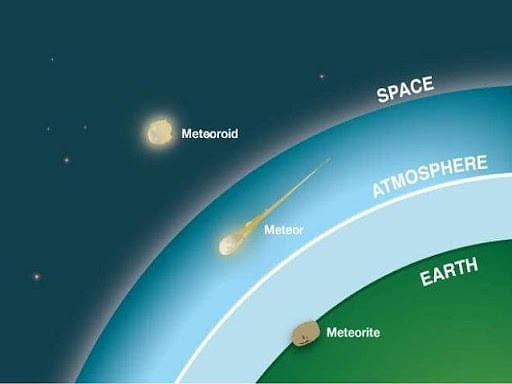
Meteoroid
Difference Between Asteroids and Meteoroids
[Click Here for Sample Questions]
Key differences between Asteroids and Meteoroids are:
| Asteroids | Meteoroids |
| They are minor planets. | They are falling stars. |
| They orbit the sun and their orbital shape is elliptical | They orbit the sun and their orbital shape is elliptical. But they get pulled into larger bodies. |
| They are believed to be leftovers from the planetesimal bodies within the sun’s solar nebula. | They are believed to be small disintegrated elements of a comet or asteroid. |
| They are rocky bodies that do not have an atmosphere. | They do not have an atmosphere but burn up when entering the earth’s atmosphere. |
| Their size ranges from 1 km to more than 100 kilometers in diameter. | They are typically less than 10 meters in diameter. |
Things to Remember
[Click Here for Sample Questions]
- Asteroids are also known as minor planets or planetoids of the inner solar system.
- Asteroids are rocky bodies that do not have an atmosphere but because of their size, they have a gravitational pull.
- Almost all asteroids are irregularly shaped although some of the large ones are nearly spherical.
- Meteoroids are pieces of interplanetary matter that are frequently only the size of millimeters.
- Meteoroids revolve around the sun at various speeds.
- The fastest meteoroids move at about 42 kilometers per second.
- When meteoroids enter the atmosphere of the Earth, they vaporize completely and might never reach the surface.
- When meteoroids enter the earth’s atmosphere at extremely high speeds in parallel trajectories, the meteors formed as a result are observed to radiate or originate from one point in the night sky. The phenomenon is called a meteor shower.
Also read: Value of g on Moon
Sample Questions
Ques. How are asteroids formed? (3 Marks)
Ans. Asteroids are the leftovers from the formation of the solar system almost 4.6 billion years ago. The birth of Jupiter prevented any planets from being formed between Jupiter and Mars. This caused the small objects there to collide with each other and form asteroids.
Ques. Do asteroids have an atmosphere? (3 Marks)
Ans. Asteroids don’t have an atmosphere but many large asteroids exert a gravitational pull. Some asteroids have one or two companion moons. Sometimes, asteroids form binary systems in which two similarly sized asteroids orbit each other.
Ques. What happens when an asteroid hits earth? (3 Marks)
Ans. In the event of an asteroid hitting the earth, dust and smoke rise into the atmosphere and prevent sunlight from reaching the earth. This causes a drop in the temperature all over the world. The event can cause the death of many living things. A particularly large asteroid hitting the earth can potentially destroy a small city.
Ques. Where do meteoroids come from? (2 Marks)
Ans. Many meteoroids are formed from the collisions of asteroids that orbit the sun in the asteroid belt. As asteroids smash into each other, they form debris called meteoroids.
Ques. How close do meteoroids get to earth? (2 Marks)
Ans. A meteoroid would have to be about the size of a marble for a portion of it to get to the earth’s surface. Smaller particles than that burn up in the atmosphere at about 50 to 75 miles (80 to 120 kilometers) above the Earth.
Ques. In which sphere of the atmosphere do meteoroids burn up? (3 Marks)
Ans. Meteoroids are also called shooting stars. They make it through the exosphere and thermosphere without burning up because those layers do not have much air. But when they reach the mesosphere, there are enough gases there to cause friction and create heat. The heat causes them to burn up.
Ques. Can meteors cause fires? (2 Marks)
Ans. Rocks are poor conductors of heat. Although meteors burn when they streak through the earth’s atmosphere, even the largest meteor falls do not cause fires.
Ques. Are asteroids and comets the same? (2 Marks)
Ans. No. Asteroids and comets differ in their composition. Asteroids are made of metals and rocky materials. Comets on the other hand are made of ice, dust, and rocky materials. Asteroids are also formed much closer to the sun than comets.
Also read:



Comments