



Content Curator
Wave motion is referred to as the energy and momentum movement from one point to another in a medium instead of actually transfering the substances between the places. In other words, it is the propagation of disturbances across a medium that is caused by repetitive vibrations of particles around their mean locations. Waves create disruption as a function of time, and this function is referred to as the wave function. In the case of string, it may be particle displacement, and in the case of sound waves, it could be a change in pressure or density.
| Table of Content |
Key Takeaways: Amplitude, Waves, Frequency, Path Difference, Phase Difference and Time.
Characteristics of Wave Motion
[Click Here for Sample Questions]
Waves include the following characteristics:
(i) The particles of the medium traversed by a wave vibrate only slightly about their mean locations, but they are not permanently displaced in the wave's propagation direction.
(ii) Along/perpendicular to the wave's path of passage, each subsequent particle of the medium performs a motion quite identical to its predecessors.
(iii) During wave motion, only energy is transferred, but not a component of the medium.
Mechanical or elastic waves, electromagnetic waves, and matter waves are the three primary forms of waves.
Also Read:
Mechanical Waves
[Click Here for Sample Questions]
Mechanical waves which are also known as elastic waves are considered to be the ones which require a medium for their propagation. The particles present in the medium exert a periodic motion at the mean position during the propagation of waves within the medium.
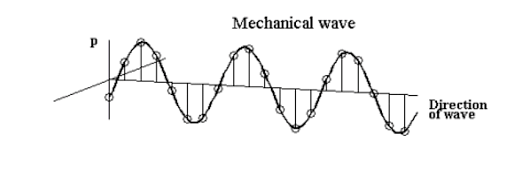
Mechanical Waves
Transverse Wave
There is a presence of oscillations in the transverse wave which is perpendicular to the wave's advance direction. A longitudinal wave, on the other hand, travels in the direction of its oscillations. Because of the shear stress created, transverse waves often arise in elastic materials; the oscillations in this case are the displacement of the solid particles away from their relaxed position in directions perpendicular to the wave propagation. These displacements correlate to the material's local shear deformation. As a result, a transverse wave of this type is referred to as a shear wave.
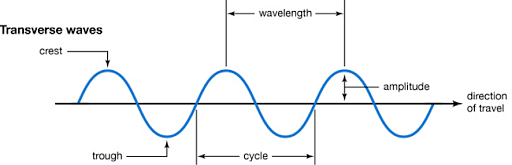
Transverse Waves
Longitudinal Wave
Longitudinal waves are referred to the waves in which the vibrations in a medium are parallel to the direction of the movement of the wave. The displacement of the medium remains in the similar or opposite direction as the propagation of the wave. Mechanical longitudinal waves are also known as compressional or compression waves because they create compression and rarefaction as they move through a material, as well as pressure waves because they generate pressure changes. An excellent visualisation is a wave down the length of a stretched Slinky toy, where the distance between coils rises and shrinks. Sound waves (pressure vibrations, a particle of displacement, and particle velocity pr) are real-world instances.

Longitudinal Waves
Surface Waves
A surface wave is a mechanical wave that travels along the boundary between two mediums. Gravity waves on the surface of liquids, such as ocean waves, are a frequent example. Within liquids, gravity waves can form at the interface between two fluids of differing densities. Rayleigh and Love waves are examples of elastic surface waves that may move along the surface of solids. Electromagnetic waves can also travel as "surface waves," following a refractive index gradient or passing via an interface between two substances with different dielectric constants. A ground wave is a guided wave that propagates near to the Earth's surface in radio transmission.

Surface Waves
Non-Mechanical Waves
[Click Here for Sample Questions]
Waves that do not require a medium to convey their energy are known as non-mechanical waves. The only non-mechanical waves are electromagnetic waves. They have the ability to move across space's vacuum. It takes hundreds of millions of years for light from faraway stars to reach us. Despite the fact that electromagnetic radiation has a wide range of wavelengths and frequencies, it all travels at 3 x 10⁸ m/sec, or c, the speed of light, in a vacuum.
Also Read:
Periodic Waves
[Click Here for Sample Questions]
The wave created is known as a periodic wave if the disturbance is continuous and periodic in character. A sinusoidal periodic wave is a periodic wave that varies sinusoidally. When a sinusoidal periodic wave travels through the medium, the particles perform simple harmonic motion (SHM).

Periodic Waves
Non-Periodic Waves
[Click Here for Sample Questions]
Non-periodic Waves - Non-periodic waves have a pattern that does not recur after one wavelength or a single time period and does not have the same pattern throughout its propagation.

Non-Periodic Waves
Significant Relationships in Wave Motion
[Click Here for Sample Questions]
- v =\(\lambda\)/T = f\(\lambda\)
- \(\omega\) = 2\(\pi\)/T = 2\(\pi\)f = circular frequency/angular frequency
- \(\omega\) = angular frequency is a term used to describe the frequency with which something happens
- t = stands for time.
- Δt = time difference
- k = the number of angular waves.
- x = position of the particle
- Δx = path difference
- Φ = phase angle
- Δ(Φ) = phase difference
- Velocity of wave (v) = fλ
- Velocity of oscillation or transverse velocity or particle velocity = dy/dt.
Path and Phase Difference
[Click Here for Sample Questions]
Consider the propagation of a wave in the x-direction.
Consider two points A and B in the medium that the wave passes through.
Let (x2 - x1) =x be the route difference between two places.
We already know that the phase difference corresponding to is 2.
As a result, the phase difference associated with x is 2x/.
= 2x/2x/2x/2x/2x/2x/2x/2x/2x/2x/2x
Furthermore, because a path difference (x) equates to a time difference (T), a path difference (x) corresponds to a time difference of (x/)T.

Phase Difference vs Path Difference
Things to Remember
[Click Here for Sample Questions]
- Amplitude of the wave is referred to as the maximum displacement of any particle present in the medium from the point of its equilibrium.
- Time is the period within which the particles complete one vibration within the medium.
- Wavelength is the distance between two particles present in the medium.
- Frequency is the number of vibrations per second completed by any particle within the medium.
- Phase difference: Δ(Φ) = Φ? - Φ?
Also Read:
Sample Questions
Ques 1. The velocity of radio waves is 3 × 10⁸ m s?¹. Determine the wavelength of radio waves emitted at a 500 KHz frequency. (1 mark)
Solution: Here the radio wave velocity, v = 3*108 m/s?¹ Frequency, n = 500 KHz = 500,000 Hz
WaveLength = v/n = 3*108/500000 = 600m is obtained by using the relation v = n.
Ques 2. How does our sound travel through the air? (1 mark)
Ans. The acoustic energy that we produce is transmitted in waves from one point to another. The sound energy we create is carried via compression and refraction sound waves.
Ques 3. Determine the duration of waves and classify them accordingly. (1 mark)
Ans. Waves are divided into two types based on their duration: wave pulses (also known as short duration waves) and wave trains (also known as long duration waves) (are called long-duration waves).
Ques 4.What are mechanical waves and how do they work? (2 marks)
Ans. Mechanical waves are those that are generated by the vibration of material particles and must travel through a medium to propagate.
For example, sound waves, a vibrating string, and so forth. Mechanical waves are caused by a disturbance in the medium, which propagates across the media without moving the medium's material particles. Mechanical waves, in other terms, are waves that move or propagate across a medium.
Ques 5. What causes transverse waves? (2 marks)
Ans. Because the entire thread is under strain, the generation and propagation of waves is conceivable when we draw a thread upward.
This tension is caused by a tiny perturbation at one end of the molecule, which is then passed on to its neighbours. This will go on indefinitely. As a result, this tiny pulse will travel the length of the thread.
Ques 6. What are organ pipes? (2 marks)
Ans. The cylindrical pipes used to produce musical (longitudinal) sounds are known as organ pipes. There are two types of organ pipes.
- Cylindrical pipes with open ends are used in organs.
- Closed Organ Pipes are cylindrical pipes that are open on one end and closed on the other.
Ques 7. A tuning fork performs one complete vibration in 1/200 second, and sound waves travel at 340 metres per second. Determine the wavelength of the sound that the tuning fork emits. (2 marks)
Ans, sound velocity, v = 340 m/s
T = 1/200 second is the time period.
As a result, Frequency, n = 1/T = 200 vibrations per second Wavelength, = ?
Using the connection, v = n = v / n = 340/200 = 1.7 m is obtained
Ques 8. What is plane wave propagation? (2 marks)
Ans. Plane wave propagation refers to a collection of parallel planes in the field can be taken in such a way that the electric and magnetic field strengths are constant in magnitude and direction at all points of every specific member of the family, the wave is known as the plane; wavefronts is the term used for specifying the planes and the direction perpendicular to them is known as the wave normal. The wavefronts are parallel to the plane of yz if the axis of x is taken in the direction of the wave normal.



Comments