



Education Journalist | Study Abroad Lead
Black Hole is perhaps the most baffling of the mysteries of the universe. They often don't seem to make sense. Black holes have an enormous amount of matter that is packed into a minimal area. The concept can be understood by imagining a star that is ten times more massive than the sun wrapped up into a sphere that has a size approximately equal to that of New York City. As a result of this, a gravitational field is created that is so much stronger that even light can't escape it. As no light ever escapes these black holes, they are invisible and can only be discovered and identified through a space telescope. We can observe the phenomenon by observing the stars that are closer to the black hole as they behave differently than the stars that are farther away. In this article, we will have a look at the concept of black holes, their formation, and the various types of black holes that exist in our universe.
| Table of Content |
Key Terms: Black Holes, Celestial bodies, Earth, Radiations, Telescope, Star
What are Black Holes?
[Click Here for Sample Questions]
The black holes refer to a region of space-time that exhibits gravitational attraction which is so strong in nature that nothing, not the particles and not even any electromagnetic radiation like light can escape from the hole. According to the theory of general relativity, a sufficiently compact mass can form a black hole by deforming spacetime. The boundary of the region from which no light can escape is known as the event horizon, which is also known as the “point of no return”.
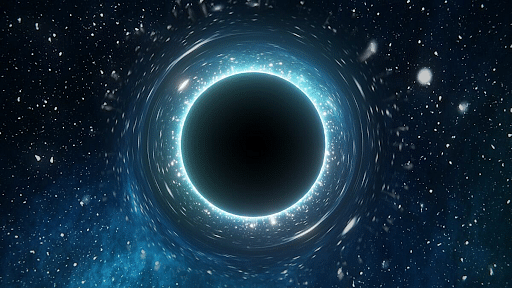
Black Holes
Black holes are extremely dense in nature and have such strong gravitational forces that even light can disappear if it comes near it. The term 'black hole' was given by John Wheeler, an American astronomer in 1967. The first-ever black hole was identified in the year 1971 while the first image of a black hole was released in 2019 by the Event Horizon Telescope (EHT) collaboration.
A black hole is known to have mainly three properties:
- Mass,
- Electric Charge and
- Angular Momentum, also known as the spin.
Generally, it is believed that all the black holes have some spin in nature. For a stellar black hole, the spin is the result of the conservation of the angular momentum of the star.
Also Read:
How are black holes formed?
[Click Here for Sample Questions]
A star is a collection of a huge number of hydrogen atoms. These hydrogen atoms fuse to form helium in the core of the star which releases a lot of energy in the process. This liberated energy is in the form of radiation that pushes against the force of gravity and therefore maintains the delicate balance that exists between the two forces of gravity and the released energy.
As long as the process of fusion continues inside the star continues, it remains stable. Stars that are much massive than the sun fuse into heavier elements in their core due to the pressure and heat that exists at the core that leads eventually into the formation of iron.
Until a certain critical point is reached, iron continues to build at the center of the core, and all of a sudden the balance between gravity and radiation is disturbed which results in collapsing of the core which then implodes into itself. More mass is fed into the core as it moves at about a quarter of the speed of light. At this very moment, all the heavier elements of the universe are formed.

Formation of a Black Hole
When a star at the very end of its life, exhausts its internal thermonuclear fuel present in its core, it becomes unstable and then collapses gravitationally inward upon itself. Hence, the star’s outer layers are blown away. The remaining matter of the star falls from all its sides and compresses the star that's already dying until a point comes where the volume of the star becomes zero and density becomes infinite, known as the singularity.
Depending on the mass of a star, when it dies undergoing a supernova explosion, they transform either into a neutron star or into a black hole. Any object that approaches the event horizon, appears to be redshifted with time due to the Doppler Effect, which can be understood as the phenomenon wherein the shifting of wavelength takes place as the wavelength of the light that is emitted becomes longer as the object moves further away from the observer.
Type of Black Holes
[Click Here for Sample Questions]
Black holes can be either big or small. As per the scientists, the smallest of the black holes can be as small as a single atom. Though the hole is very small in size, it has a mass that is equivalent to the mass of a very large mountain.
Black holes are mainly divided into four types which are as given below:
- Miniature Black Hole: These kinds of black holes are also known as micro black holes or quantum mechanical black holes.
- Intermediate Black Hole: Intermediate Black Holes have masses that are in the range of mass of over hundreds of suns of our solar system taken together. These are significantly larger than the stellar black holes but smaller in size than the supermassive black holes.
- Supermassive Black Hole: The supermassive black holes are the largest black holes. These black holes have a mass that is equivalent to the mass of 1 million suns taken together. The supermassive black hole that is present at the center of our galaxy, the Milky Way, is known as Saggitarius which has a mass equivalent to 4 million suns taken together.
- Stellar Black Hole: The mass of the stellar black hole can be 20 more times the mass of the sun of our solar system. Its formation takes place through a hypernova explosion or a gamma-ray outburst. Hypernova can be understood as a stellar explosion that is 10 or more times higher than the explosion of standard supernovae.

Types of Black Holes
Most commonly, stars are formed by Stellar death. As the stars reach the end of their lives, some of them inflate, lose mass, and cool down in order to form a white dwarf. The largest of these stars which are ten or twenty times the mass of the sun becomes either a neutron star that is super dense or a black hole of stellar mass.
Black hole and destruction of Earth
[Click Here for Sample Questions]
Earth will not get pulled by and eventually fall into a black hole. This is because no black hole is in much near proximity to our solar system for Earth to gravitate towards it. Black holes don't go about the universe destroying and swallowing all the planets or the stars. If our sun were to be replaced by a black hole, our Earth would still not get destroyed by its pull and instead would continue orbiting the black hole in the same way it orbits the sun.
Our universe is also very vast and is massive in size. The presence of a black hole has a significant gravitational impact on the limited area where it exists as compared to the entire galaxy. As the black holes or the galaxies collide, their size will be increased through the merging of for instance two black holes. However, these collisions won’t take place indefinitely as the universe is very vast and it is constantly expanding. Hence, it is highly unlikely that any kind of black hole runaway effect will be seen.

Black Hole and Space-Time Warping Effect
Scientists are trying to find the answers to the unknowns of the universe by using telescopes and spacecraft traveling in space to better understand black holes and their effects.
Important Facts Related to Black Holes
[Click Here for Sample Questions]
- Black Holes are known to distort space-time and have a warping effect.
- Space-Time can be understood as the concept of three-dimensional space and time regarded as a four-dimensional (4D) continuum.
- In general relativity, the event horizon of a black hole refers to a region in the space-time beyond which no light can escape the space.
- It was predicted by Stephen Hawking that the black holes emit radiations as a result of the quantum effects near the event horizon of these black holes. Hence, these radiations are famously known as the Hawking Radiation.
- When an object falls inside a black hole, it is evenly distributed along its horizon.
- The supermassive black hole in our universe has a mass equivalent to about four million times the mass of the sun of our solar system.
- When two black holes are near each other, they have such strong gravity, that they can’t escape each other and end up colliding and forming a merged black hole, which in turn sends ripples through the fabric of space-time, known as the gravitational waves.
- Stars that have masses more than the Sun in our solar system explode into a supernova to form either a neutron star or a black hole.
- Stars that have a mass that is equivalent to the mass of the Sun in our solar system gently end their lives when the Hydrogen-Helium fusion in their core is no longer enough to sustain their lives. They do so by transforming into a planetary nebula and leaving behind a stellar remnant, often known as the “white dwarf”.
Things to Remember
- Black holes have an enormous amount of matter that is packed into a minimal area.
- The black holes refer to a region of space-time that exhibits gravitational attraction which is so strong in nature that nothing, not the particles and not even any electromagnetic radiation like light can escape from the hole.
- When a star at the very end of its life, exhausts its internal thermonuclear fuel present in its core, it becomes unstable and then collapses gravitationally inward upon itself.
- Depending on the mass of a star, when it dies undergoing a supernova explosion, they transform either into a neutron star or into a black hole.
- Miniature Black Hole
- Intermediate Black Hole
- Supermassive Black Hole
- Stellar Black Hole
- If our sun were to be replaced by a black hole, our Earth would still not get destroyed by its pull and instead would continue orbiting the black hole in the same way it orbits the sun.
- The Milky Way Galaxy comprises about 10 million to billion stellar black holes.
Also Read:
Sample Questions
Ques. What is a black hole? (2 marks)
Ans. A Black Hole refers to a region of space-time that exhibits such strong gravity that no particle, not even any electromagnetic radiation such as light can escape the region. The black holes contain a huge mass in such a limited space. In that region, the density and gravity become infinite, the space-time infinitely curves, and laws of physics no longer stay true.
Ques. How can black holes be identified? (4 marks)
Ans. We cannot see Black Hole through the human eye. No light of any form, including the rays of X-ray, can escape from the black hole through its event horizon which refers to the region of the black hole beyond which no return is possible. Black holes are however studied by looking at their surrounding environments when there is some material very close to the event horizon. The matter is heated to millions of degrees as it gets pulled toward the black hole. Hence, the matter glows in X-rays. The strong gravity of black holes also distorts space-time itself, so we can also see the influence of an invisible gravitational pull from a black hole on the stars and other objects near it.
These black holes can be detected with the help of instruments that are designed especially such as a telescope. They are mainly identified through the strong gravitational effect that these black holes exhibit on their surrounding bodies.
Ques. Explain the formation of a black hole. (5 marks)
Ans. Black Holes are formed when a massive star is at the end stage of its life as the hydrogen in its core is fully depleted.
- The death of a star occurs when the fusion of Hydrogen - Helium occurring in its core is no longer enough to provide energy to the star to live on further.
- The rest of the elements of a star fuse and form another top layer.
- The outer layers of the stars thus collapse inward and result in a bright powerful explosion which is also known as a supernova.
- The core of the star collapses into a gravitational singularity, which is a single point that contains all the mass of the original star.
- At this point, the gravity becomes so strong that all the other forces are almost eliminated.
Ques. List the various types of black holes? (4 marks)
Ans. Black Holes have been broadly categorized into four types which are as follows:
(i) Supermassive Black Hole (SMBH): The supermassive black holes are the largest black holes. These black holes have a mass that is equivalent to the mass of 1 million suns taken together.
(ii) Stellar Black Hole: The mass of the stellar black hole can be 20 more times the mass of the sun of our solar system.
(iii) Intermediate - Mass Black Hole (IMBH): Intermediate Black Holes have masses that are in the range of mass of over hundreds of suns of our solar system taken together.
(iv) Miniature Black Holes: These kinds of black holes are also known as micro black holes or quantum mechanical black holes.
Ques. Can our Sun transform into a black hole? (2 marks)
Ans. The Sun can never turn into a black hole as it is not massive enough that it can explode. However, the Sun will eventually become a dense stellar remnant which is called a white dwarf.
However, if we hypothetically think that Sun will transform into a black hole with the same mass as it has today, it would not affect any planets or their orbits as the gravitational influence of the Sun on our solar system would remain the same. Hence, the Earth would continue revolving around the Sun without being pulled into it. Although the lack of sunlight would certainly have disastrous consequences for life on Earth.
Ques. Does the size of a black hole remain the same? (5 marks)
Ans. The black holes get smaller with time. Stephen Hawking, the late physicist, proposed that while the black do holes get bigger by pulling in or “eating” material near it, they also do slowly shrink or get smaller in size as they lose some tiny amounts of energy which is known as the "Hawking radiation" after the great physicist.
Hawking radiation is a phenomenon that occurs due to empty space. The vacuum however is not empty, instead, it is a sea of particles that continually pops in out of existence. If a pair of these particles are formed near the black hole, there is a high chance that while one of them will be pulled by the black hole, the other one will escape into space. The energy of that particle that goes free comes from the black hole, hence the black hole slowly loses its mass and energy by this process.
Eventually, as per Hawking, the black holes will evaporate due to the Hawking radiation. But it would take a much longer time, even more than the entire age of our universe for most of the known and identified black holes to significantly evaporate.
Ques. What is the nearest identified black hole to the Earth? (2 marks)
Ans. The nearest black hole to Earth is V616 Monocerotis, which is also called V616 Mon. This black hole is about 3000 light-years from us. It has a mass that is equivalent to 9-16 times the mass of our Sun. Its presence is identified by the fact that it is placed in a binary system that has a star that buzzes quickly around it. This behavior of the star is only possible due to the presence of a black hole.
Ques. Can a black hole eat up or swallow our entire universe? (5 marks)
Ans. Our universe is very vast and is massive in size. The presence of a black hole has a significant gravitational impact on the limited area where it exists as compared to the entire galaxy. For instance, let us take the case of a supermassive black hole that is found in the midst of the Milky Way Galaxy. Most of the stars that are formed near the black hole have already been pulled in by its gravitational effects, however, the stars that are a little further away are safe from this pull. The black hole will only gradually increase its mass if it pulls in more stars like the Sun as it already has a mass equivalent to a few million times the mass of the sun of our Solar system. Our Earth is located nearly twenty-six thousand (26,000) light-years away from the black hole of the Milky Way galaxy, hence it is not in much danger of being pulled in.
As the black holes or the galaxies collide, their size will be increased through the merging of for instance two black holes. However, these collisions won’t take place indefinitely as the universe is very vast and it is constantly expanding. Hence, it is highly unlikely that any kind of black hole will swallow the entire universe or any black hole runaway effect will be seen.
Ques. How time is affected in a black hole? (2 marks)
Ans. To an observer, observing the black hole from a distance, the time near the black hole will appear to move slowly than for a person that is further away from the black hole. Due to the phenomenon of Time Dilation, an object that falls into a black hole seems to slow down as the object approaches the event horizon of the black hole. Hence, it appears to take an infinite amount of time to reach the black hole.
For Latest Updates on Upcoming Board Exams, Click Here: https://t.me/class_10_12_board_updates
Check-Out:



Comments