



Education Journalist | Study Abroad Lead
Bony fish and cartilaginous fish are the two types of fish that are a result of over a billion years of evolution. These fishes superficially resemble each other. There is a huge diversity of fish species found in the world. About 28,100 species of fish species are known to mankind. All living things are classified in a hierarchical order named as - Kingdom, Phylum, Class, Family, Order, Species, etc. The bony fish and cartilaginous fish are also among the 28,100 species of fish. They can be distinguished by their positions in the hierarchy, physical characteristics, etc. In this article, we will read about both the fishes and discover the major differences between bony fish and cartilaginous fish.
| Table of Content |
Read More: Montreal Protocol
Bony Fish (Osteichthyes)
Bony fish belongs to the class Osteichthyes. These fishes have skeletons that are made up of bone tissue. A huge number of fish are members of this class. These types of fishes appeared about 420 million years ago. Bony fish have a jaw and skeleton of bone with operculum. They have paired fins, a homocercal tail (symmetrical), and a swim bladder. The mucus glands are embedded in the dermal scales.
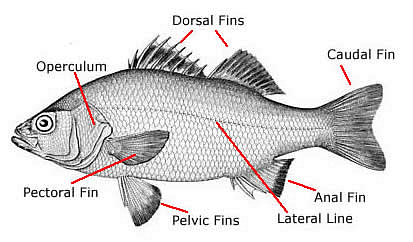
Osteichthyes - Bony Fish
-
Swim bladder:
The swim bladder of bony fish has a large air sac within it. It acts as a buoyancy organ (it doesn’t sink to the bottom). These increase in size when the fish wants to go up and decrease in size when the fish wants to go down. Because of this, these fish require very little energy to move in the water. However, there is only one depth at which a fish has neutral buoyancy, so it is important for the fish to be able to maintain the amount of gas in the swim bladder to regulate neutral buoyancy.
-
Physiology:
Osteichytes are similar to Chondrichthyes but they do not have enlarged liver. They have a U-shaped stomach. They have a long intestine but are not spiral. Bony fish have pyloric ceca which increase gut area and aids in digestion by secreting digestive enzymes. They don’t have a separate opening for the digestive system.
-
Reproduction:
Bony fishes exhibit external fertilization, but in some cases, internal fertilization depends on the species. Oviparous (egg-laying), viviparous (life-bearing), ovoviviparous (aplacental yolk sac viviparous) are all seen in bony fish. Some of them are hermaphrodites (having both male and female reproductive organs at the same time or can change)
Read More:
Cartilaginous fish (Chondrichthyes)
Cartilaginous fish belong to class Chondrichthyes. They first appeared about 450 million years ago. They have paired fins and cartilaginous skeletons. Their fins are not symmetrical - vertebral columns run into the caudal fin. Cartilaginous fishes do not have a swim bladder. Most of them are marine.
-
Anatomy:
Cartilaginous fish are made up of placoid scales which are structurally similar to vertebrate teeth. The scales are made up of dentine surrounded by enamel. Nutrients are supplied by blood vessels.
Chondrichthyes have a special type of sensing organ called the Ampullae of Lorenzini. These are receptors that can detect electromagnetic fields given off by the muscle contraction of living things. Through this, the fish can find hidden prey and differentiate patterns.
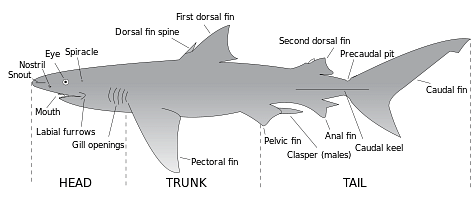
Sharks - Cartilaginous fish - Chondrichthyes
-
Physiology:
Cartilaginous fish have U-shaped stomachs but are not as complex as humans. Their stomach leads to the intestine which is called the spiral valve. Their intestines are arranged in the form of a spiral which leads to increased surface area and is short.
This intestine leads to a cloaca - an opening for the urinary, digestive, reproductive system. They have only one opening for all purposes.
-
Reproduction:
Cartilaginous fish produce less offspring than any other fish, but they are larger and they survive longer. They also have a long gestation period.
They normally undergo internal fertilization but they can undergo both types of fertilization - internal and external (exceptions)
Read More:
Difference between Bony fish and Cartilaginous fish
| Aspects | Cartilaginous fish | Bony fish |
|---|---|---|
| Habitats | The majority of cartilaginous fish survive in marine habitats | Bony fish is found in both salt water and fresh water habitats |
| Structure of Jaws The jaws are the part of the mouth that helps in intaking the food and chewing it for digestion. Its structure is different for cartilaginous fish and bony fish. | Cartilaginous fish has oral jaw. These oral jaws are made up of cartilage and separated into the upper and lower sections. Cartilaginous fish are able to regrow their teeth as they wear down over time | Bony fish has two sets of jaws - the oral and the pharyngeal jaw. The oral jaw allows to allows bony fish to catch fish and chew it. And the pharyngeal jaw is located in its throat which further processes the food for digestion. |
| Neutral Buoyancy There is an internal buoyancy system in fish that helps them in maintaining their level inside water and prevents sinking to the ground or floating above the water body. | Bony fish are able to maintain their buoyancy with the help of the swim the bladder which is a two sac organ that controls the volume of internal gases. This allows them to conserve energy or else they would be consuming their energy to maintain their position. | Cartilaginous fish maintain their neutral buoyancy through their lightweight cartilaginous skeleton in lieu of the swim bladder. Some cartilaginous fish like sharks have to come to the surface to breathe air which helps them to maintain their position underwater. |
| Digestive System | The intestine of cartilaginous fish is comparatively shorter. It spirals around internally and has a large surface area | The intestine of bony fish is longer. The intestine has no spiral shape |
| Stomach | The J-shaped stomach is found in cartilaginous fish | Various types of the stomach are found in bony fish |
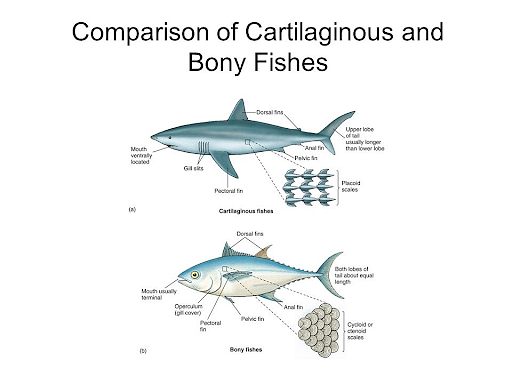
Cartilaginous fish vs Bony Fish
Read More: Microbiology
Things to remember
| Bony fish | Cartilaginous fish |
|---|---|
| Class is Osteichthyes | Class is Chondrichthyes |
| Ovoviviparous or Viviparous | Viviparous |
| Both marine and freshwater habitats | Marine habitats |
| It has both oral and pharyngeal jaw | It has only an oral jaw |
| Bony fish maintain buoyancy by the swim bladder | Cartilaginous fish maintain buoyancy by their lighter cartilaginous skeleton |
| Operculum absent | Operculum present |
| Endoskeleton is made up of bone | Endoskeleton is made up of cartilage |
| Bony fish have long and nonspiral intestine | Cartilaginous fish have short and spiral intestine |
| The exoskeleton is made up of cycloid scales. | The exoskeleton is made up of placoid scales. |
| Ex- salmonoids, tuna, eels, etc | Ex- Sharks, rays, ratfish, skates, etc. |
Sample Questions
Ques. Write a short note on cartilaginous fish. (3 marks)
Ans. Cartilaginous fish are the types of fish whose endoskeleton is made up of cartilage instead of bone. They are mostly marine in nature. Their body is covered in placoid scales which are different from flat scales. These types of fish can maintain their buoyancy by their lighter cartilaginous skeleton. Sharks belong to this class.
Ques. Write a short note on bony fish. (3 marks)
Ans. Bony fish are called bony because their endoskeleton is made up of bone which is more rigid than cartilage. They belong to class Osteichthyes. This is the largest class of vertebrates which has 96% of fish species. Bony fish have paired fins. swim bladder to help them maintain their neutral buoyancy. They are found in both types of habitats - marine and freshwater. Salmon, eels, angler fish are some examples of this class.
Read More:
Ques. Give some examples of Osteichthyes. (2 marks)
Ans. Osteichthyes are fishes having a bony skeletons. Some examples of these fishes are:
- Tuna
- Sardines
- Salmon
- Herring
- Codfish
Ques. Why do sharks need to move their body in order to swim while bony fishes don’t? (2 marks)
Ans. Bony fishes have a special organ which is known as the swim bladder or the gas bladder. The interior part of this organ can be filled up with gas which is released via gas glands. As the organ produces variation in the relative density of the body, it works as a hydrostatic organ by regulating the depth and buoyancy of fish in the water. These swim bladders are absent in Chondrichthyes. That is why sharks continuously move their body to swim and maintain depth while bony fishes do not.
Ques. How do the structure of the jaw of bony fish and cartilaginous fish vary? (2 marks)
Ans. Cartilaginous fish has oral jaw. These oral jaws are made up of cartilage and separated into the upper and lower sections. Cartilaginous fish are able to regrow their teeth as they wear down over time.
Bony fish has two sets of jaws - the oral and the pharyngeal jaw. The oral jaw allows to allows bony fish to catch fish and chew it. And the pharyngeal jaw is located in its throat which further processes the food for digestion
Ques. Give some examples of cartilaginous fish. (3 marks)
Ans. Some examples of cartilaginous fish are:
- Skates
- Rays
- Sharks
Ques. Explain the difference between bony fish and cartilaginous fish. (5 marks)
Ans. The differences between bony fishes and Cartilaginous fishes are as follows:
- Bony fish is from the Osteichthyes class while Cartilaginous fish is from the Chondrichthyes class.
- Bony fish has both oral and pharyngeal jaw while Cartilaginous fish has oral jaw only.
- Bony fish maintain buoyancy by the swim bladder while cartilaginous fish maintain buoyancy by their lighter cartilaginous skeleton.
- The operculum is absent in bony fish while it is present in cartilaginous fish.
- Examples of bony fish include salmonoids, tuna, eels, etc while examples of cartilaginous fish are sharks, rays, ratfish, skates, etc.
Also Read:



Comments