



Content Curator
Vermiculture is the process of using earthworms to decompose organic food waste into a nutrient-rich substance capable of giving vital nutrients and sustaining plant growth. The goal is to keep increasing the number of worms in order to have a sustainable crop. Excess worms can be sold to customers or used to grow a vermicomposting operation. The fundamental purpose of vermiculture is vermicompost. Worm castings are technically pure worm faeces and are a fine and nutrient-rich organic soil additive.
| Table of Contents |
Key Terms:- Vermiculture, Vermicompose, earthworms, farm, plants,nutrient-rich substance
Vermiculture Definition
[Click Here for Sample Questions]
Vermiculture is primarily defined as the scientific practise of raising worms or artificially rearing worms to break down organic food wastes into nutrient-rich material. Vermicompost is the product of vermiculture and is generated by the process in which earthworms devour farmyard manure and roughages in addition to farm trash, producing it. The resulting vermicompost is high in nutrients and other plant growth-promoting compounds, and it is capable of giving vital mineral nutrients to aid and sustain plant growth.
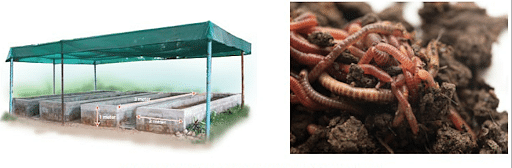
Vermiculture Unit and Earthworms
Vermiculture Techniques
[Click Here for Previous Year Questions]
In vermiculture, there are three basic methods for extracting worms. These are some examples.
-
Manual
Framers typically employ this strategy in vermiculture for small-scale worm-selling companies. The worms are extracted straight from the soil using the hands. The organic material containing earthworms is kept flat and exposed to sunshine. It should be mentioned that earthworms are light sensitive, thus when they are exposed to sunshine, they dive beneath the surface. The harvester will next remove the organic layer above and harvest the worms once they are visible.
-
Migration
Migration is another technique of vermiculture that takes use of the earthworm's proclivity to migrate to a new site in search of nourishment, and hence onion bags and screens are employed for harvesting. A box will be erected at the bottom surface of the screen to collect the worms. There are two methods for performing the migration. The downhill migration method, in which worms are pushed to travel downwards in organic material using light. They will pass through the screen mesh and be gathered in the peat moss-filled container box below. The method is repeated until the desired number of worms is obtained. It is a time-saving practice that can be seen in a variety of locations.
-
Mechanical
A mechanical harvester is used to catch worms in this procedure as a part of vermiculture. A trammel screen, also known as a rotary screen, is used to separate materials. It is approximately 11ft long and 4ft in diameter, with a cylindrical shape. The cylinder's walls are screened materials with varying mesh sizes. An electric motor drives the cylinder. The gadget would be installed at an angle on the trammel's upper side. Following that, the castings and worm beds are added. When the rotation begins, the worm castings will fall through the screen, and the worms will migrate across the trammel mechanism and into the wheelbarrow.
Read More:
Vermicomposting
[Click Here for Sample Questions]
Vermicompost is compost created by earthworms in collaboration with all other species in the compost unit. Because it reduces water stagnation, a vermicompost bed can be chosen on upland or elevated ground.
Benefits of using Vermicompost
People are aware of the advantages of using organic farming inputs. Vermicompost is an excellent organic manure for environmentally friendly agriculture. As a result, marketing vermicompost is now a lucrative and expanding industry. The retail marketing of vermicompost in metropolitan areas appears to be the most promising. Vermicompost is beautifully packaged and sold in well-designed and printed packets. People of all ages are active in the manufacture and sale of vermicompost. Vermicompost marketing might provide an additional source of revenue.
- Vermicompost contains a high concentration of critical plant nutrients.
- It enhances soil texture, aeration, and water holding capacity while also preventing soil erosion.
- Vermicompost is a nutrient-rich, environmentally acceptable soil solution for farming and terrace gardening.
- It promotes seed germination and healthy plant growth.
Vermicompost Disadvantages
- Vermicomposting takes a lengthy time (6 months).
- It does have a slight odour to it.
- The maintenance is high because it must be kept in good working order for an extended period of time.
- There is a risk of infections and pest problems if this is not taken care of.
- The procedure is time-consuming.
The Vermicomposting Method
[Click Here for Previous Year Questions]
Farmers multiply earthworms by combining large amounts of organic waste, including plant materials and animal manure, in a 1:1 ratio. After the substrate medium is created, approximately 40-50 earthworm species are released into the medium, which is then safeguarded from various environmental influences. Regular upkeep is essential for the growth of earthworms for vermicomposting. The temperature should be between 15 and 25 degrees Celsius, and the moisture level should be between 80 and 90%. The earthworms can multiply up to 300 times in one to two months, depending on the method and the elements influencing the process, and then they can be harvested.
Materials required for Vermicomposting:-
- Crop leftovers
- Vegetable scraps
- excrement from cattle
- Leaves, dried
- Agro-industrial waste
- An appropriate container
- Shed
- Pits
- Availability of water
- Earthworms
Vermicomposting Preparation:-
- An appropriate container was chosen, and a worm bed was constructed in the container's hole. This worm bed is made up of old newspapers, sugar cane waste, paddy husk, and coir waste. This mixture is covered with a thin layer of soil, and the humidity is kept at 40-45 percent.
- A mixture of organic waste, slurry from a biogas plant, and cattle manure is placed over the bed and left for two weeks for partial digestion for vermicomposting. The temperature of the mattress will rise to 50-55 degrees Celsius during this period. To eradicate dangerous germs, a 5-10% neem cake is applied.
- The earthworms are injected when the temperature has been reduced to 30 degrees. For every 100 kg of organic material, 500 earthworms are injected.
- To keep the worm safe, the bed is covered with straw and jute clothing. The temperature is controlled between 20 and 30 degrees Celsius, and the moisture content is managed between 45 and 50 percent. (pH range: 6.5-7)
Things to Remember
- Vermicompost is environmentally benign and can assist to reduce landfill waste.
- The worm liquid in the bottom of the worm bin is excellent for garden plant development. Worm tea is another name for it.
- By replenishing the soil with nutrients, worm casting can increase soil fertility.
- Worms have five hearts but no eyes or ears.
- They inhale and exhale through their skin.
- The compost pit should be protected from direct sunshine.
- Protect the worms against pests such as rats, birds, ants, and so on.
- Sprinkle water on the pit as needed to keep the moisture level stable.
Also Read:
| Related Topics To Structural Organisation in Animals | ||
|---|---|---|
| Cockroach Life Cycle | Biogeochemical Cycles | Anatomy of the Earthworm |
| Agriculture Soil | Ant Life Cycle | Components of Ecosystem |
| Plasmodium Life Cycle | Lizard and Moth Life Cycle | Silkworm Life Cycle |
Previous Year Questions
- During an injury nasal septum gets damaged and for its recovery which cartilage is preferred?...(NEET 2001)
- Haversian canals occur in...(NEET 1989)
- Histamine secreting cells are found in...(NEET 1989)
- Which of the following features is not present in Periplaneta americana?...(NEET 2016)
- Protein present in cartilage is...(NEET 1997)
- If the head of cockroach is removed, It may live for few days because..(NEET 2020)
- An epithelial tissue which has thin flat cells, arranged edge to edge so as to appear like closely packed tiles, is found to be present at...(NEET 1994)
- Areolar connective tissue joins…(NEET 2006)
- Basement membrane is made up of...(NEET 1997)
- Characteristics of smooth muscle fibres are....(NEET 1992)
- Collagen is...(NEET 2002)
- Cuboidal epithelium with brush border of microvilli is found in...(NEET 2020)
- Earthworm possesses hearts...(NEET 1991)
- Earthworms are..(NEET 2006)
Sample Questions
Ques. What is the distinction between vermiculture and vermicomposting? (2 marks)
Ans. Vermiculture is the cultivation of earthworms for the purpose of using them to decompose organic wastes into nutrient-rich fertilisers. Vermicomposting is the cultivation of earthworms for the purpose of using them to degrade organic wastes into nutrient-rich fertilisers.
Ques. What is the significance of vermiculture? (2 marks)
Ques. What is worm tea? (1 mark)
Ans. Worm tea is the name given to the worm liquid found at the bottom of the compost pit. It is extremely beneficial to the growth of garden plants.
Ques. What is vermiculture? (1 mark)
Ans. Vermiculture is the culture of specific earthworm species that actively decompose food waste into nutrient-rich compounds (manure).
Ques. What are the benefits of vermicompost over ordinary compost? (4 marks)
Ans. Benefits of vermiculture are:
- Compost created by worms is considerably superior to regular compost.
- Vermicompost has a compost particle size of less than 2 microns, which is smaller than ordinary compost.
- Soil water retention, drainage, aeration, and soil stability were all improved with vermicompost.
- Vermicompost contains more natural plant growth hormones and antibacterial capabilities than normal compost.
Ques. What advantages does vermicomposting have? (4 marks)
Ans. The following are the advantages of vermicomposting:
- It improves the soil's physical structure and nourishes it with beneficial microbes.
- Seed germination, plant growth, and agricultural output are all improved.
- It improves root growth and structure.
- Microbial activity in worm castings is 10 to 20 times greater than in the soil and organic matter consumed by the worm.
Ques. What are the various techniques of vermiculture? (5 marks)
Ans.The various techniques are:
Manual - Framers typically employ this strategy in vermiculture for small-scale worm-selling companies. The worms are extracted straight from the soil using the hands. The organic material containing earthworms is kept flat and exposed to sunshine. It should be mentioned that earthworms are light sensitive, thus when they are exposed to sunshine, they dive beneath the surface. The harvester will next remove the organic layer above and harvest the worms once they are visible.
Migration - Migration is another technique of vermiculture that takes use of the earthworm's proclivity to migrate to a new site in search of nourishment, and hence onion bags and screens are employed for harvesting. A box will be erected at the bottom surface of the screen to collect the worms. There are two methods for performing the migration. The downhill migration method, in which worms are pushed to travel downwards in organic material using light. They will pass through the screen mesh and be gathered in the peat moss-filled container box below. The method is repeated until the desired number of worms is obtained. It is a time-saving practice that can be seen in a variety of locations.
Mechanical - A mechanical is a method of vermiculture where a harvester is used to catch worms in this procedure. A trammel screen, also known as a rotary screen, is used to separate materials. It is approximately 11ft long and 4ft in diameter, with a cylindrical shape. The cylinder's walls are screened materials with varying mesh sizes. An electric motor drives the cylinder. The gadget would be installed at an angle on the trammel's upper side. Following that, the castings and worm beds are added. When the rotation begins, the worm castings will fall through the screen, and the worms will migrate across the trammel mechanism and into the wheelbarrow.
Ques. What are the disadvantages of vermicomposting? (5 marks)
Ans. The disadvantages are:
- Vermicomposting takes a lengthy time (6 months).
- It does have a slight odour to it.
- The maintenance is high because it must be kept in good working order for an extended period of time.
- There is a risk of infections and pest problems if this is not taken care of.
- The procedure is time-consuming.
Do Check Out:



Comments