



Content Curator
The cell also known as the building block of the body is the smallest unit of the living thing. All living things are made up of cells, and millions of microbes such as bacteria are nothing more than fully functional cells.
| Table of Content |
Read Also: Prokaryotic and Eukaryotic Cells
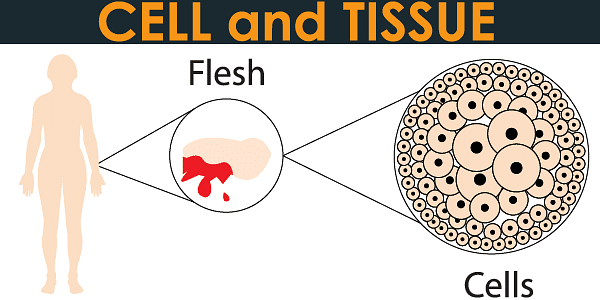
Tissues are formed by a group of cells. Tissue performing the same functions forms an organ. Tissues are thus similar to cells, but they are more organized and specialized for a certain role.

Definition of Cell
Cell, also known as the building block of the body, is the smallest unit of the living thing. All living things are made up of cells, and millions of microbes such as bacteria are nothing more than fully functional cells. These cells are also organized into tissues, organs, and organ systems in complex multicellular organisms like plants and animals.

Types of Cells
There are two types of cells based on the presence or absence of the nucleus and other membrane-bound organelles.
- Eukaryotic cells- eukaryotic cells have membrane-bound cell organelles.
- Prokaryotic (primitive) cells- Prokaryotic cells lack membrane-bound cell organelles, making them primitive.

Definition of Tissue
Tissues are formed by a group of cells. Tissue performing the same functions forms an organ. Tissues are thus similar to cells, but they are more organized and specialized for a certain role. Different tissues make up plants and animals.

Types of Tissue
In plants, tissue is of two types-
- Meristematic tissue - consist of actively dividing cells.
- Permanent tissue - differentiated on the basis of functions.
In animals, there are four types of tissues-
- Epithelial tissue - the organ and organ system's lining, membrane, and outer surface is formed by them.
- Muscle tissue - Muscles of the skeleton, voluntary muscles, and involuntary muscles are formed by them. They cause the inside and outside movement of the body.
- Connective tissues - Blood, bone, ligaments, tendons, and adipose tissues are connective tissues that connect other tissues.
- Nervous tissues - The tissues in the brain, spinal cord, and peripheral nervous system that transfer neural information for control and coordination are known as nervous tissues.

Read Also: Difference Between Gram-Positive and Gram-Negative Bacteria
Difference between cell and tissue
| Cell | Tissue |
|---|---|
| The cell is the smallest unit of the living organisms | Tissues are a group of cells that perform the same functions. |
| A group of cells performing the same function forms a tissue | A group of tissues performing the specific function forms an organ. |
| The visibility of the cell is microscopics | The visibility of the tissue is macroscopic. |
| Both unicellular and multicellular creatures contain cells. | Only the multicellular organism has a tissue-like structure or functioning |
| Within a cell, metabolism, respiration, reproduction, and growth are all important functions. | Since tissue is a group of specialized cells, they further combine to become an organ that will perform a specific function. |
| The key difference between cell and tissue is that cell mitosis and meiosis are two ways for cells to divide | Whereas tissues are formed by the regeneration of fibrosis and cells |
| The nucleus, mitochondria, lysosomes, Golgi apparatus, and other cellular organelles make up the cells. | a group of cells with similar functions make up the tissue. |
There are two types of cells-
| There are four types of tissue-
|
Things to Remember
- The cells are also known as the building block of the body and are the smallest unit of the living thing.
- All living things are made up of cells, and millions of microbes such as bacteria are nothing more than fully functional cells.
- There are two types of cells based on the presence or absence of the nucleus and other membrane-bound organelles-
- eukaryotic cells
- prokaryotic (primitive) cells.
- Tissues are formed by a group of cells. They are more organized and specialized for a certain role.
- Different tissues make up plants and animals
- Plants have two types of tissues-
- Meristematic tissue
- Permanent tissue
- In animals, there are four types of tissues-
- Epithelial tissue
- Muscle tissue
- Connective tissues
- Nervous tissues
Sample Questions
Question 1- Which one of the following is the cheek cell-
- Epithelial cell
- Epidermal cell
- Vascular cell
- Guard cell ( 2 marks )
Answer - a. Epithelial cell
Explanation - Human cheek cells are a type of epithelial cell that lines the interior of the mouth. The cheek cells are made up of squamous epithelium, which is densely packed and helps to protect against bacterial invasion. The secretion of mucin by human cheek cells aids mechanical and chemical digestion by retaining moisture in the mouth. To aid in the chewing of food. All cavities inside and outside the human body are bordered by epithelial cells, and cheek cells are epithelial cells. The main activities of cheek cells are to chew and guard against bacterial infection. While chewing, they break down the food, and the layer they occupy protects the cheek from injury.
Question 2 - The wall of the cell in plants is made up of-
- Protein
- Facts
- Plasma
- Cellulose ( 2 marks )
Answer - d. Cellulose
Explanation – The most common macromolecule on Earth, cellulose, is used to make plant cell walls. Hundreds of glucose molecules make up cellulose fibers, which are long, linear polymers. These fibers form microfibrils, which are bundles of roughly 40 fibers.
Question 3 - Organism who don’t have membrane-bound organelle cells and nucleus-
- Diploid
- Haploid
- Prokaryotes
- Eukaryotes ( 2 marks)
Answer - c. prokaryotes
Explanation - Prokaryotes are unicellular organisms with no membrane-bound structures. The nucleus is the most important structure in prokaryotes. Prokaryotic cells are small, simple cells with diameters ranging from 0.1 to 5 micrometers.
Question 4 - the brain and the spinal cord is which type of tissue -
- Nervous tissue
- Epithelial tissue
- Muscular tissue
- Connective tissue ( 2 marks)
Answer - a. nervous tissue
Explanation - Nerve tissue can be found in the brain, spinal cord, and nerves. It is in charge of coordinating and managing the functions of the body. It aids muscle contraction, increases environmental awareness, and plays a role in emotions, memory, and thought.
Question 5- the animal cell covering is known as-
- Cell wall
- Cell membrane
- Nuclear membrane
- Cytoplasm ( 2 marks)
Answer - b. Cell membrane.
Explanation - animals don’t have any outer cell walls. One of the many elements that determine whether an organism belongs to the PLANT KINGDOM or the ANIMAL KINGDOM is the presence or absence of a cell wall. Plants' cell walls are formed of cellulose, which also serves as the outermost membrane. The phospholipid bilayer cell membrane/plasma membrane is the outermost layer of the phospholipid bilayer cell membrane/plasma membrane in ANIMALS.



Comments