



Education Journalist | Study Abroad Lead
Density and Volume are fundamental concepts in science that are studied together yet are significantly distinct from one another. Density expresses how compact the mass of an object is per unit volume.The density of a thing determines whether it will float or sink in another substance. A floating object is one that is less dense than the liquid it is placed in. If the volume remains constant, an increase in mass directly increases the density. An increase in mass when added with an increase in volume, on the other hand, does not permit the increase in density, which is commonly referred to as an intense feature. Along with similarities there are many differences between Density and Volume that we will further observe in this Article.
Read Also: Relation Between Density and Volume
| Table of Content |
Key Takeaways: Density, Volume, Mass, Buoyancy, Temperature, Pressure
What is Density?
[Click Here for Sample Questions]
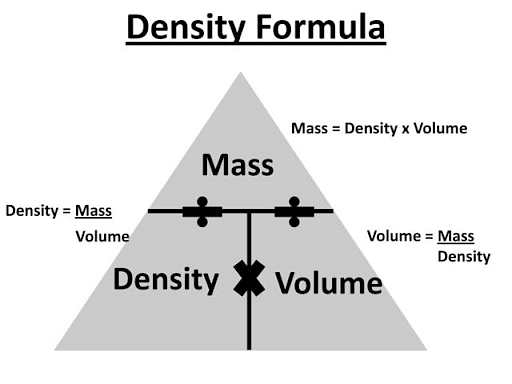
Density of a material is the mass per unit volume of that substance (also referred to as specific mass). Although the Latin letter D can also be used, the symbol for density is \(\rho\) (the lowercase Greek letter rho). In mathematics, density is defined as mass divided by volume.
In numerical terms, the density of a pure material is equal to its mass concentration. Varied materials have different densities, which can have an impact on aspects like buoyancy, purity, and packaging. Osmium and iridium are the densest known elements at standard temperatures and pressures.
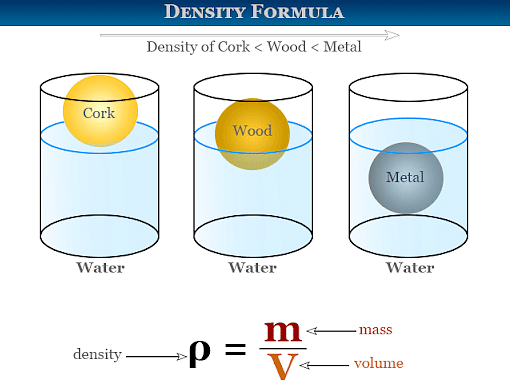
The density of a material is affected by temperature and pressure. This difference is usually minor for solids and liquids, but it is much larger for gases. When you apply greater pressure to an item, the volume reduces and the thing becomes denser. With a few exceptions, raising a substance's temperature reduces its density by expanding its volume. Heating the bottom of a fluid induces convection of heat from the bottom to the top in most materials due to the reduction in density of the heated fluid, which causes it to rise compared to denser unheated material.
Check Important Notes for Branches of Physics
Density and specific gravity are two terms that define mass and may be used to compare two distinct substances. However, these are not the same measurements. In contrast to the density of a standard or reference material, a substance's density is stated in terms of its specific gravity (usually water).

Furthermore, density is measured in units (weight in relation to size), whereas specific gravity is a one-dimensional quantity.
Check Also: Constants in Physics
What is Volume?
[Click Here for Sample Questions]
The amount of three-dimensional space enclosed by a closed surface is expressed as a scalar quantity called volume. For instance, a substance's occupied or enclosed space (solid, liquid, gas, or plasma). The cubic metre, a SI-derived measure, is widely used to measure volume.
The volume of a container is commonly believed to represent its capacity, or the amount of fluid (gas or liquid) that it can hold, rather than the amount of space it occupies. Volumes are also related to three-dimensional mathematical shapes. Arithmetic formulas can be used to compute the volumes of various simple shapes, such as regular, straight-edged, and circular shapes. If a formula for the shape's border exists, integral calculus can be used to compute the volume of difficult shapes.

The volume of a system is a key comprehensive parameter for defining its thermodynamic state in thermodynamics. Volume is a state function that is influenced by other thermodynamic characteristics like pressure and temperature. The ideal gas law, for example, relates volume to pressure and temperature in an ideal gas.
Check Important Relation Between Viscosity and Density
Difference between Density and Volume
[Click Here for Sample Questions]
The differences between density and volume are as tabulated below:
| Parameters of Comparison | Density | Volume |
|---|---|---|
| Definition | It refers to the quantity of mass contained inside a specific volume of space. | The volume of a thing is the amount of space it occupies. |
| Nature | Nature is Intensive | Nature in Extensive |
| SI unit | Kilograms per cubic meter (kg/m3) is a unit of measurement for Density. | The SI unit of Volume used for its measurement is Cubic meter (m3) |
| Formula | Density = mass/volume | Volume = length3 |
| Relation with Temperature | As the temperature increases, density decreases. | Volume of an object increases in response to a rise in temperature. |
Things to Remember
[Click Here for Sample Questions]
- The actual three-dimensional space filled by an item is referred to as volume.
- We typically use the term capacity instead of volume when dealing with the volume of objects that function as containers.
- The term "density" refers to the amount of mass per unit volume.
- When we talk about how dense an object or a liquid is in everyday life, we imply that the individual molecules in the liquid are packed very closely together. And more molecules can fit in a given amount of space when the molecules are packed close together.
- As the temperature rises, the density falls. When the temperature rises, the energy in the molecules of the material rises, and they tend to drift apart, increasing the volume of the substance.
- The major distinction between density and volume is that density indicates how much mass is present in a given amount of space, whereas volume indicates how much space an item occupies.
- Because liquids have no particular structure and hence cannot be quantified in terms of area, volume is a vital measurement.
Also Check:
Sample Questions
Ques. What exactly is mass? (3 marks)
Ans. Mass is a characteristic that represents the amount of inertia in a system. It gives us an estimate of how much matter is in the amount. Apart from length and time, it is one of the three fundamental dimensions. Although the SI unit for mass is 'kilogram,' we measure it in gram, milligram, and metric tonne.
The Imperial units system uses mass units such as the pound, grain, and stone for measurement.
Ques. Explain mass and volume in simple terms. (5 marks)
Ans. We regard mass and volume to be fundamental characteristics of matter in physics, and the two properties are intimately connected.
Only when the density is constant does mass stay proportional to volume. It is self-evident that if anything has a volume, it must also have a mass.
An insecticide spray, for example, has a volume in millilitres and also has mass, as seen by the weight of its bottle.
The density of a thing determines whether it will float or sink in another substance. A floating object is one that is less dense than the liquid it is placed in. If an object's density is greater than the density of the liquid it is immersed in, it will sink.
Ques. With an example, explain the difference between mass and volume. (5 marks)
Ans. Mass refers to what an object contains, whereas volume refers to how much room the quantity takes up. A bowling ball and a basketball, for example, have almost the same volume, yet the bowling ball has greater mass than the basketball.
The three-dimensional space occupied by matter or contained by a surface is measured in cubic units. The SI unit of volume is the cubic metre (m3), which is a derived unit.
The amount of material present and the density of the material's particles determine the volume of a substance. As a result, temperature and pressure, particularly for gases, can have a considerable impact on the volume of a substance.
Ques. Is it true that a higher density equals a higher volume? (5 marks)
Ans. The mass and volume of a thing define its density. If two objects have the same volume but one has more mass, the more massive the object is, the higher density it has.
The density of an object or quantity of substance is calculated by dividing its mass by its volume. This is usually carried out at a standard temperature and pressure of 0°C and 1 atmosphere of pressure.
Ques. Why is density more important than volume? (5 marks)
Ans. Three of an object's most fundamental attributes are mass, volume, and density. The mass of something tells you how heavy it is, while the volume tells you how big it is, and density is the mass divided by the volume. Although you deal with mass and volume on a daily basis, the concept of density is less clear and requires some consideration.
- Temperature variations have just a minimal impact on a material's density; while materials do expand when heated, the difference in size is minor.
- Density is inversely proportional to specific volume. When a substance's density doubles, its specific volume is cut in half when stated in the same base units.
- If the density is reduced to a tenth of its previous value, the specific volume increases by a factor of ten when expressed in the same base units.
Ques. What are the two methods for increasing density? (2 marks)
Ans.Adding or withdrawing mass but not affecting the volume might vary density. The volume, but not the mass, varies as the temperature rises or falls. The volume will vary when the pressure is increased or decreased, but the mass will not.
Ques. Is it possible for the relative density of soil to be negative? (3 marks)
Ans. When layers of homogeneous soils are combined together, negative relative density values are common. According to the patterns in the data, alluvial soils have relative densities ranging from 20 to 70%. According to the findings, some homogeneous gravel alluvium has lower relative densities than sand.
Physics Related Links:



Comments