



Content Curator
Density and Volume are terms that are used interchangeably. Anything with mass that occupies space consists of volume and density. Volume is a three-dimensional space or the space occupied by a matter. Whereas, density is mass per unit volume. Therefore, if you change the volume of a matter, density will also change.
Also Read: Difference between Area and Volume
| Table of Content |
Key Takeaways: Density, Volume, Mass, Temperature
What are Density and Volume?
[Click Here for Sample Questions]
Density is described as the amount of mass an object holds within its volume which can be also said as how close things are packed within a space. Solids have the highest density, then liquids and finally gases have the least density.
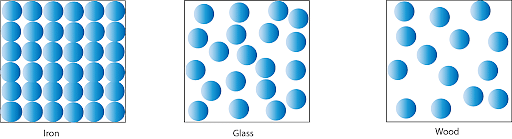
Density of different objects
Read More: Volumetric Analysis
The space that is confined within a closed 3-Dimensional space is called Volume. For example, volume of the cube is its length, height and breadth multiplied together.

Volume of Geometrical figures
Also Read:
Relation Between Density and Volume
[Click Here for Sample Questions]
In an element or a compound, density and volume are proportional to each other, this means that if we change volume, density will also change, and vice versa.
The mathematical expression for relation between volume and density is expressed as,
\(\rho\) = M/V
Where
\(\rho\) = Density
M = Mass
V = Volume
By the above formula, it is clear that density and volume are inversely proportional to each other. So, for a fixed mass, when density increases, volume decreases, and when the volume increases, density decreases.
Further, to understand the relationship between density and mass, we must understand both these terms individually.
Also Read More:
Relationship between Temperature and Density
[Click Here for Sample Questions]
We know that temperature and density both are properties of matter. We measure the amount of heat of a matter by its temperature and density is a physical property of a matter. Now, let us understand how temperature and density are related to each other.

Temperature and Density Graph
When a material is heated or if we increase its temperature the force of attraction among its particles decreases, due to which the material expands but its mass remains unchanged. So, the mass-volume ratio decreases, and hence the density also decreases. We can say that when temperature increases, density decreases, or temperature and density are inversely proportional to each other.
Also Check:
Relation Between Pressure and Density
[Click Here for Sample Questions]
Pressure is the measurement of the force that is acting per unit area and density is the ratio of mass to volume of a substance. By Boyle’s law, we know that pressure is related to volume.
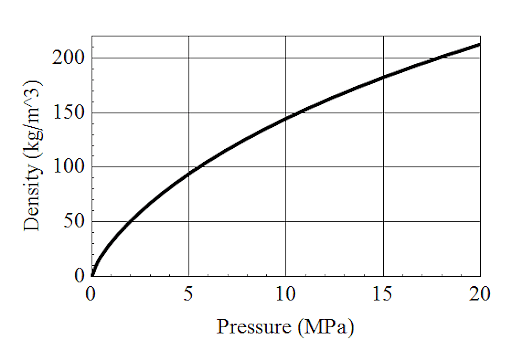
Pressure and Density Graph
When we compress a gas, naturally its volume will decrease and the mass will remain constant. Hence by the formula, \(\rho\) = M/V, the decrease in volume will increase the density of the substance. Therefore, in conclusion, we can say that if we increase the pressure the density also increases or that they are directly proportional to each other.
Check Important Notes for Density of Air
Things to Remember
[Click Here for Sample Questions]
- Density, mass, volume formula is \(\rho\) = M/V.
- Two matters don't need to have the same volume and mass.
- Density and volume are inversely proportional to each other.
- The density of cool air is more than the density of warm air.
- Although water changes its density at various temperatures, its density at 1000 C is used as the basis of reference.
Also Check More:
Sample Questions
Ques. Describe the relationship between density and volume. (2 marks)
Ans. Density and volume are inversely proportional to each other which can be understood by the formula,
\(\rho\) = M/V
Where \(\rho\) (read rho) = density
M = mass, and
V = volume
So, when the volume increases, density decreases, and when the density increases, volume decreases.
Thus density and volume are inversely proportional to each other. From the above equation, it is easy to calculate density and find volume and vice versa.
Ques. Why is the density of solids higher than the density of liquids? (2 marks)
Ans. Density is expressed by the amount of mass an object holds within its volume or how closely things are packed within a described space. So, since the molecules of a solid mass are more closely packed than a liquid, hence the density of solid is higher than the density of liquids.
Ques. How are Mass, Density, and Volume related? (2 marks)
Ans. The below formula will show how Mass, density, and volume are related
\(\rho\) = M/V
Where \(\rho\) (read rho) = density
M = mass, and
V = volume
Ques. Compare the density of Iron and Water. (2 marks)
Ans. The density of Iron is more than the density of water which is more than the density of air. Since density depends on how closely the matter is packed, Iron is packed more tightly than water.
Ques. What do you mean by linear density? (2 marks)
Ans. When we define any characteristic value concerning the length, then it is called linear density. For example, Suppose we have a rod of the length of 10 meters and its mass is 20 kg, then 1 meter of the rod has 2kg mass.
Ques. How does the density of a substance determine whether it will float or sink in a liquid? (2 marks)
Ans. Density determines which compound will float and which will sink in a liquid since if the density of the substance is less than that of the liquid it is put in, the substance will float.
Ques. What is meant by area density? (2 marks)
Ans. A two-dimensional object is computed by mass per unit area for the density of the surface area (also known as the area, surface density, or superficial density). Kilogram per square meter (kg. m-²) is the SI-derived unit.
Ques. What is the relationship between temperature and density? (2 marks)
Ans. When a material is heated or if we increase its temperature the force of attraction among its particles, atoms, or molecules decreases, due to which the material expands but its mass remains unchanged. So, the mass-volume ratio decreases, and hence the density also decreases. Therefore, in conclusion, we can say that when temperature increases, density decreases.
Ques. What is the relation between pressure and density? (2 marks)
Ans. By Boyle’s law, we know that pressure is related to volume. Also, we already discussed the relation between volume and density. When we compress a gas, then in turn its volume will decrease and the mass will remain constant. Hence by \(\rho\) = M/V, the decrease in volume will increase the density of the substance. Therefore, in conclusion, we can say that if we increase the pressure the density also increases or that they are directly proportional to each other.
Read More:



Comments