



Education Journalist | Study Abroad Lead
Fog and mist are mainly different from each other in terms of their thickness and density. Fog is much denser and thicker as compared to mist. Fog and mist are both formed by condensation of water, and hence are often confused. Fog being much denser, affects visibility more than mist does. Fog limits visibility to about one kilometer, while mist has higher visibility. Fog lasts longer than mist. Mist is formed by sudden changes in temperature and an increase in humidity. While fog is created when water vapor liquefies into water droplets suspended in the air. In this article, we will learn in detail about fog and mist and learn the differences between the two.
| Table of Contents |
Key takeaways: Fog, Mist, types of fog, visibility, condensation, water droplets, smog, temperature, humidity
What is fog?
[Click Here for Sample Questions]
Fog is more commonly formed over water bodies like ponds, rivers, oceans, or moist and wet ground. If you wake up early during winters, you must have noticed a thick layer of fog over any nearby water bodies.
- Fog is basically a thick layer of cloud formed at ground level. It is formed when the difference between dew point and air temperature falls below 2.5 celsius. The water vapors condense as the temperature falls down and reaches the dew point, and that’s when fog is formed.
- Fog can limit visibility to up to 1 km. Dense fog or fog mixed with smoke (called smog) can limit visibility to as low as 50 meters.
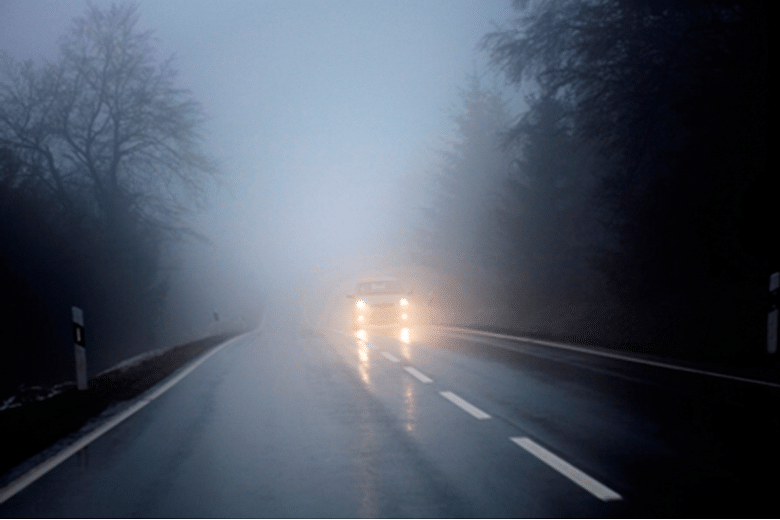
Fog
- A special type of fog, called “smog” is often formed in urban areas. The word smog comes from smoke and fog.
- It is formed when sunlight directly hits the nitrogen oxide released from car exhausts and factories. Sunlight causes the nitrogen oxide to react with VOCs (Volatile Organic Compounds) released from paints and other chemicals, to produce airborne particulate and ground-level ozone or smog.
Types of fog
There are five kinds of fog depending on how the cooling was caused:
-
Radiation fog
Soon after the sunset, the temperature of the land falls, causing a drop in the air temperature as well via thermal transmission. The air temperature drops until it reaches the dew point. As a result, fog is formed.
-
Evaporating fog
Evaporating fog is formed by the evaporation of water from the water bodies when the temperature is high enough. Then this warm evaporated water mixes with cool and dry air above causing the air to become saturated with water vapor leading to evaporating fog.

Types of fog
-
Advection fog
Advection fog is formed by cooling caused by wind at the surface. As the warm air flows over a cooler surface, the air is cooled down and becomes saturated leading to advection fog.
-
Valley or mountain fog
We all crave those magical views up from a valley as if we are living within a cloud. It is much like a dream. These fogs are formed when cold air from the top of the mountain sinks into the valleys. The air temperature in the valley reaches the dew point gradually as cold air continues to sink and eventually saturate the valley air forming valley fog.
-
Freezing fog
When the temperature is below freezing point, the suspended water droplets remain as supercooled water droplets in the air. It does not freeze until it comes into contact with some surface they can form ice crystals on. These supercooled droplets can freeze on roads and dust particles create a white landscape, causing hazards during extreme winters.
What is mist?
[Click Here for Sample Questions]
Mist is suspended water vapor at the surface of the earth caused by sudden inversion of temperature, and an increase in humidity.
- Have you noticed, when someone talks during winter nights, the exhaled air comes out their mouth? It is the mist. It is created when droplets of water are suddenly cooled down and as a result, it becomes visible to our eyes.
- The exhaled air contains water vapor, when it comes out of our nostrils or mouth the warm water vapor is subjected to the sudden change from warm to cool temperature. This causes the water vapor to become visible as we call it mist.
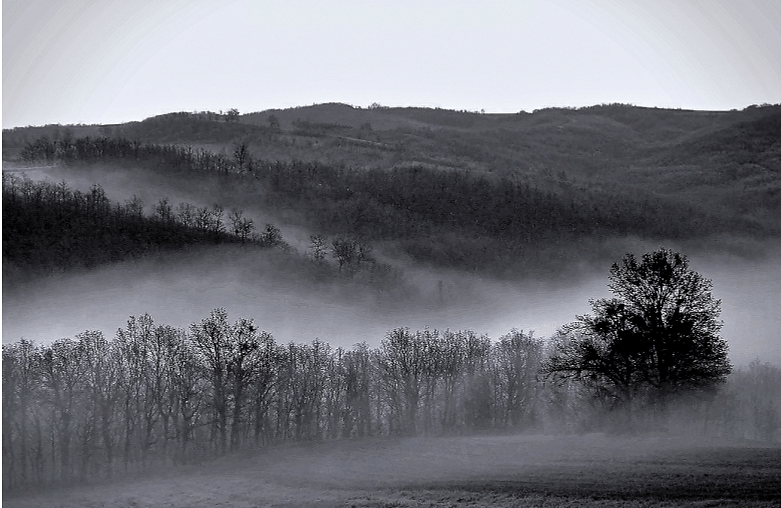
The morning mist
Difference between fog and mist
[Click Here for Sample Questions]
The differences between fog and mist are as tabulated below:
| Basis of comparison | Fog | Mist |
|---|---|---|
| Definition | Fog can be defined as a thick cloud near the surface of the earth. It consists of tiny water globules. | Mist refers to the formation of clouds due to inversion in temperature or increase in humidity. |
| Density | Fog is thicker and denser as compared to mist. | The density of mist is lower compared to fog. |
| Visibility | Fog reduces visibility to up to 1km. | Mist limits visibility to more than 1 km (up to 2 km). |
| Longevity | Fog lasts longer and is difficult to get rid of. | Mist does not persist for long. |
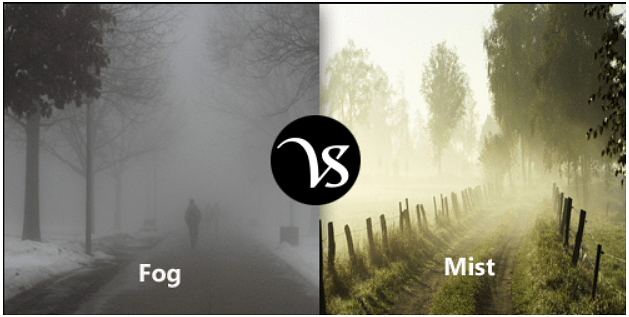
Fog vs Mist
Things to remember
- Fog and mist both are forms of condensed water vapor and tiny water droplets.
- Fog is a thick cloud on the ground level. It is formed when the difference between dew point and air temperature falls below 2.5 celsius.
- Smog is a mixture of smoke and fog. It is formed when nitrogen oxide reacts with VOCs in presence of sunlight to produce ground-level ozone and airborne particulate.
- On the other hand, mist is formed due to rapid and sudden inversion of temperature and an increase in humidity.
- Fogs can be classified on the basis of the cause of cooling into five types of fogs: Radiation fog, evaporating fog, advection fog, valley fog, and freezing fog.
- Freezing fog is hazardous as it reduces visibility greatly and makes driving unsafe.
- The major difference between fog and mist is that fog is much denser compared to mist.
Sample Questions
Ques. How is fog formed? (3 marks)
Ans. Fog is formed when water vapor condenses due to low temperature in the surrounding. Fog is more formed when the air is very humid. The condensation of water vapor occurs on the surface of dust particles and salts, this is what makes fog visible and dense. It is formed when the difference between dew point and air temperature is below 2.5 degrees celsius.
Ques. How is mist formed? Give an example. (5 marks)
Ans. Mist is formed when warm air containing suspended water droplets encounters a cooler surface or is rapidly cooled and humidity of the air also increases. The invisible water droplets become visible as the water droplets condense and appear as mist. For example, mist is formed when we exhale during cold winter nights. As our exhaled air contains water vapor, this warm water vapor comes in contact with much cooler surrounding air during winter causing the water vapor to condense and form a mist.
Ques. What is the difference between fog and mist? (5 marks)
Ans. The main points of difference between fog and mist are:
- Fog is a thick cloud containing tiny water globules while mist is the formation of those clouds due to an increase in humidity.
- Fog is thicker as compared to mist.
- Fog has a lower level of visibility as compared to mist.
- Fog lasts for a longer period of time as compared to mist.
Ques. Why is fog more commonly seen during the early morning? (3 marks)
Ans. Fog is more commonly formed during the early morning because the temperature is lowest between 4 AM to 6 AM in the morning. On clear winter nights, the ground is cooled down significantly causing the air in contact with the ground to reach dew point. So the humid air above condenses rapidly on the surfaces of dust and salts to make a thick cloud over the ground and water bodies.
Ques. What is smog? (5 marks)
Ans. Smog is a mixture of smoke and fog. This is more common in urban areas due to increased air pollution caused by factories and automobiles. The nitrogen oxide released from car exhaust, and factory emissions react with VOCs when sunlight hits them to produce airborne particles and ground-level ozone, or smog.
It greatly reduces visibility. It is also very harmful to plants and animals (including humans). It can cause significant lung damage and can be very dangerous for asthma patients.
Ques. What is freezing fog? Why is it dangerous? (5 marks)
Ans. Freezing fog is formed when the temperature is below freezing temperature. The water vapor in the air remains as supercooled liquid droplets. They remain liquid until they come into contact with some surface to form crystals. When they come in contact with a surface they form white ice crystals.
It can be dangerous while driving because freezing fog forms ice crystals on the road, this is called “black ice”. Freezing fog makes it difficult to see, and hence driving becomes dangerously difficult.
Read More:-



Comments