



Content Curator
Condensation is the transformation of a gaseous substance into a liquid state. The change is caused by a change in the substance's pressure and temperature. The Bose-Einstein condensate (BEC) is a state of matter formed when subatomic particles are cooled to near absolute zero. Reflux is the process of heating a chemical reaction for a predetermined amount of time while constantly cooling the resulting vapour back into liquid form. Vapours produced from the reaction are constantly condensed and condensate is returned to the flask.
| Table of Content |
Key takeaways: Condensation, Bose-Einstein condensate, Reflux, condenser
Condensation
Condensation is known as the change of water vapour into liquid. It is the opposite of evaporation, in which liquid water turns into vapour. Foggy mirrors, water beads on the outside of the bottle, and clouds in the sky are visible to everyone. These occur due to Condensation.
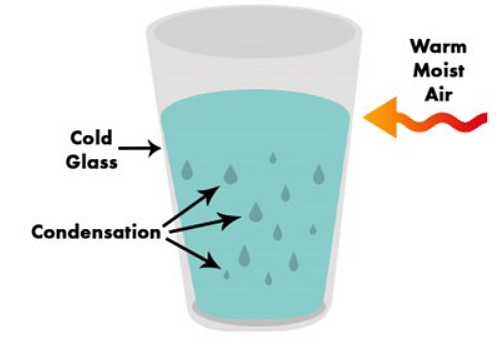
Condensation Process
Water vapour occurs when water is present in the air in a gaseous state. For example, after a hot shower, the water vapour inside the bathroom collides with the chilly mirror which condenses the water vapour into tiny droplets on the mirror surface and the temperature inside the bathroom drops.
Technically, condensation can occur at any temperature as long as the pressure of the gas in its liquid state is lower than the pressure of the condensing gas. Because the heat energy is removed during the condensation process, the molecules in the matter slow down, causing a transition within the three states of matter.
Read More:
Condensation In The Water Cycle
Condensation is important in the water cycle as it is responsible for cloud formation. Precipitation is the principal route for water to return to the Earth's surface in the water cycle, and these clouds may create it. Evaporation is the polar opposite of condensation.
Precipitation Process
The Sun's heat converts moisture (water) from seas, lakes, rivers and plants into water vapor (gas), which then dissipates into the atmosphere. This vapour rises, cools, and condenses into tiny water droplets, forming clouds. These water droplets clump together to form larger drops in the cloud. The water droplets that become too huge and heavy fall as rain.
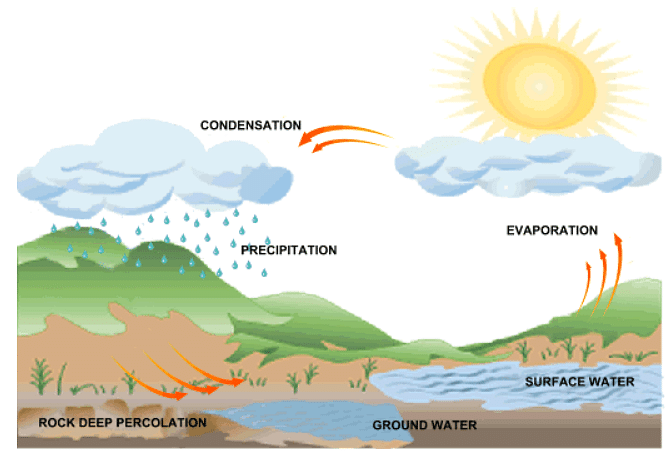
Condensation in Water Cycle
Rain is defined as large, heavy droplets that fall to the ground, whereas drizzle is defined as little droplets that fall to the ground. This natural process of conversion of water vapour into big droplets of rain is the result of condensation. The process of raining or snowing is also called precipitation.
Read More:
Condensation Examples in Daily Life
Some of the instances of Condensation process that we witness in our daily lives are as follows.
Dew Drops
Air near the ground cools to or below the dew point during night. As a result, the atmosphere's water vapour becomes saturated, condensing to form dew on the grass. This is why droplets of water are seen on the leaves of plants in the morning.
Cold Bottles
When you take your bottle out of the refrigerator, it is very common for droplets to form on the outside. This is an example of condensation. When water vapour in the air collides with the chilly surface of a bottle, it condenses into drops of water, which are commonly referred to as sweat.
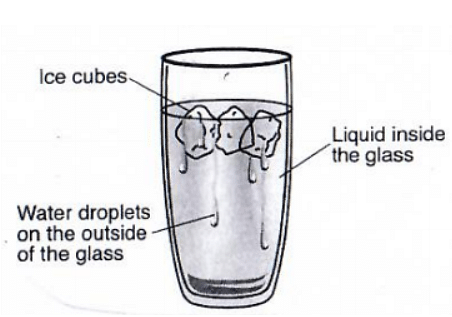
Example of Condensation
Read More: Homogeneous mixtures
Fog
Fog originates in the same way as clouds do, except it is closer to the ground than the sky. Fog is formed when water vapor condenses to liquid in the form of droplets that remain floating in the air. It only happens when the weather is humid. The fog comes in a variety of thicknesses, from light to dense.

Formation of Fog
Bose-Einstein Condensate
Bose-Einstein condensate would be a collection of atoms that have been cooled to within a few degrees of absolute zero. When they reach that temperature, atoms have essentially little free energy to move around one another. At this moment, the atoms start to clump together and enter the same energy levels. They become identical, and the entire group starts to behave as if it were a single atom. You start with a cloud of diffused gas to make a Bose-Einstein condensate. Rubidium atoms are used in many investigations. Lasers are used to cool it by removing energy from the atoms with the beams. The scientists then employ evaporative cooling to cool them even further.
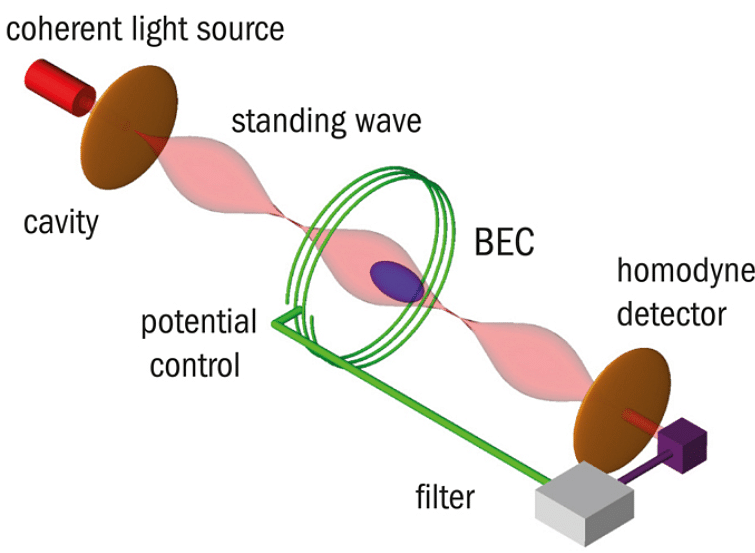
Bose-Einstein Condensate Synthesis
Superconductors and superfluids are two materials that contain Bose-Einstein condensates. Superconductors are materials that carry electricity with almost no resistance. A current that is initiated will continue to flow indefinitely in a superconductor. A superfluid's liquid also flows indefinitely. Only liquid helium-cooled to near absolute zero has this peculiar state of matter, which is characterized by seeming frictionless flow. In gyroscopes, superfluids can be used to help machines forecast information from gravity movements that aren't measurable with traditional equipment.
Read More:
Reflux
In a reflux setup, the liquid can boil and condense, with the condensed liquid recirculating to the original flask. The fundamental difference between reflux and a distillation setup is the vertical location of the condenser. During active reflux, this liquid stays at the solvent's boiling point (or solution). Reflux is the process of heating a chemical reaction for a predetermined amount of time while constantly cooling the vapour produced back into liquid form using a condenser.

Reflux Condenser
Vapours created above the reaction are constantly condensed and returned to the flask as a condensate. This ensures that the temperature of the reaction is maintained at a steady level. Reflux experiments can use both solid and liquid reactants or both liquids. The boiling points of the solvents, as well as the reflux ring, determine the temperature at which the process is heated.
Things to Remember
- The change of a gaseous substance into a liquid state is known as condensation.
- Dewdrops, fog and droplets forming on cold surfaces are examples of the condensation process.
- Condensation plays a very important role in the water cycle process.
- When subatomic particles are cooled to near absolute zero, they form the Bose-Einstein condensate (BEC).
- Reflux is the process of heating a chemical reaction for a predetermined amount of time while constantly cooling the vapour produced back into liquid form using a condenser.
Read More:
Sample Questions
Ques. Why do spectacles become foggy while having a hot beverage? Give Reasons. [2 marks]
Ans. To remove the condensation which has accumulated on the glass of the spectacles, you'll need to use a tissue or handkerchief. This happens when warm water vapor comes into touch with the spectacle's cooled surface.
Ques. Give a brief description of Sublimation and provide examples for the same. [2 marks]
Ans. Sublimation is the process of converting stuff from a solid to a gaseous state without passing through a liquid state. Dry ice, a frozen form of carbon dioxide, is the best example of sublimation. Once dry ice is exposed to air, it immediately transforms from a solid to a gaseous state, which appears as fog.
Ques. What do you mean by Vaporization? [3 marks]
Ans. Vaporization is the process of converting a substance from a liquid or solid state to a vapour state. The vaporization process is called boiling when conditions allow the creation of vapour bubbles within a liquid. To cause vaporization, heat must be applied to a solid or liquid. If the environment does not provide enough heat, it may come from the system itself in the form of a temperature drop. When water is boiled on the stove to make pasta, much of it vaporizes and generates thick steam.
Ques. What is the difference between condensation and evaporation? [5 marks]
Ans: The transition from a vapour to a condensed form is known as condensation (solid or liquid). Evaporation is the process of turning a liquid into a gas. The puddle progressively diminishes as the Sun burns the water in it. When the water in a pot boils, the level of the water decreases equivalently. Evaporation can be seen in these two examples. Although the water appears to vanish, it moves into the air as a gas known as water vapour. Drops of water outside a glass of ice water, which is an example of condensation. The drips appear to appear out of nowhere, but they are formed by airborne water vapour. Condensation can also be seen in the dew that collects overnight on grass.
When a liquid is heated, it evaporates. The heat increases the energy of the molecules in the liquid. The molecules travel quicker as a result of this energy. The molecules at the surface can break away if they gain enough energy. These molecules break apart from the liquid and become gas. When the molecules in the gas cool down, condensation occurs. The molecules lose energy as they lose heat. As a consequence, they become more sluggish. They become closer to other gas molecules as time goes on. These molecules eventually clump and form a liquid.
Read More:
Ques. Why is ice at 273 K more effective in cooling than water at the same temperature? [2 marks]
Ans. Ice at 273 K will absorb heat energy or latent heat from the medium to overcome the fusion to become water. Hence the cooling effect of ice is more than the water at the same temperature because water does not absorb this extra heat from the medium.
Ques. Explain why solids have a fixed shape but liquids and gases do not have a fixed shape. [2 marks]
Ans. Solids have fixed shape due to strong intermolecular force of attraction between them. The liquids and gases have molecules with less intermolecular force of attraction and hence they can flow and take shape of the container.
Ques. Liquids and gases can be compressed but it is difficult to compress solids. Why? [2 marks]
Ans. Liquids and gases have intermolecular space, and by applying pressure externally on them the molecules can come closer thereby minimizing the space between them. But in the case of solids, there is no intermolecular space to do so.
Read More:
Ques. A balloon, when kept in the sun, bursts after some time. Why? [2 marks]
Ans. The balloon has air filled in it. The balloon when kept in the sun gets heated and the air inside it also gets heated, the molecules of air gain energy and vibrate faster thereby exerting large force on the walls of the balloon. Due to this expansion of gases the balloon bursts.
Ques. Why do people perspire a lot on a hot humid day? [2 marks]
Ans. On a hot, humid day, due to heat, our body starts sweating due to the cooling mechanism i.e., by evaporation and cooling effect. But the air cannot hold any more water on a humid day and therefore the sweat or perspiration is seen.
Ques. Why is water liquid at room temperature? [2 marks]
Ans. At room temperature, the molecules of water have some intermolecular force of attraction and the room temperature cannot provide sufficient heat for these molecules to overcome their force of attraction and therefore remain in a liquid phase.
Ques. Why are solids generally denser than liquids and gases? [2 marks]
Ans. Density of a substance is given by a formula = Mass/ Volume.
In the case of solids, the molecules are tightly packed and hence large mass is concentrated in a very small volume. Hence their density is more. But in the case of liquids and gases, their molecules have intermolecular space and hence they don’t have a large mass concentrated in a small volume. So the density of solids is generally more than that of the liquids and gases.
Read More:



Comments