



Content Curator
Multicellular organisms' ability to resist dangerous germs is known as immunity. There are both specific and generic components to immunity. In this article, we will be covering the key difference between Innate Immunity and Adaptive Immunity. The nonspecific components, regardless of antigenic make-up, operate as barriers or eliminators for a wide spectrum of infections.
Also, read: Human Health and Diseases
| Table of Content |
Definition of Innate Immunity
The innate immune system is made up of anti-infection mechanisms that can be engaged very instantly when a pathogen assaults. It consists primarily of barriers designed to keep viruses, bacteria, parasites, and other foreign particles out of your body or to limit their capacity to grow and migrate throughout the body.
The innate immune system is always general, or nonspecific, in that it responds to everything that is identified as foreign or non-self. The presence of antigens and their chemical characteristics activate the innate immune system.
Also Read:
Definition of Adaptive Immunity
The adaptive immune system, also known as the acquired immune system, is a subsystem of the immune system made up of specialized, systemic cells and mechanisms that kill or prevent infections from multiplying. One of the two main immunity systems seen in vertebrates is the acquired immune system.
The adaptive immune system relies heavily on antibodies. Adaptive immunity can give long-term protection, even for the rest of a person's life. For example, someone who recovers from measles is now protected against measles for the rest of their lives; in other situations, such as chickenpox, it does not confer permanent protection. Vaccination is based on this adaptive immunity process.
Also Read:
Difference Between Innate and Adaptive Immunity
The various differences between both are tabulated below-
| Adaptive Immunity | Specifics | Innate Immunity |
|---|---|---|
| This sort of immunity develops as we are exposed to infections or receive vaccinations. | Definition | Innate immunity is a type of immunity that is both universal and non-specific, and it is the initial line of defense against infections. |
| Antibodies are the key components. | Key Components | Toxic granules, for example, are antimicrobial peptides and proteins. |
| Antigen-presenting cells such as T cells, B cells, and others. | Major cell type | Macrophages, neutrophils, natural killer cells, dendritic cells, basophils, and eosinophils are all part of the immune system. |
| Innate immunity has a slower response time (approx 1-2 weeks). | Response time | In most cases, the response time is minimal and the action is immediate. |
| It has a high level of specificity and can distinguish between pathogen and non-pathogen structures, as well as minor changes in molecular structures. | Specificity | Molecules and molecular patterns linked with generic infections or foreign particles are the only ones that are specific. |
| When the body is exposed to a foreign substance, it develops adaptive immunity. | Presence | Immunity that is already present in the body is known as innate immunity. |
| Adaptive immunity is not inherited because it is not passed down from parents to children. | Inheritance | Immunity that is inherited from parents and passed down to offspring is known as innate immunity. |
| The adaptive system can recall the infections it has previously faced. | Memory | When exposed to the same pathogen repeatedly, it is unable to react with the same potency. |
| Only vertebrates have an adaptive immune mechanism, which was established lately. | Development | It's an ancient evolved response that can be found in both vertebrates and invertebrates. |
| Adaptive immunity is the second line of defense, and it kicks in when pathogens get past innate immunity's defenses. | Line of defense | The initial line of defense against antigens entering the body is innate immunity. |
| It is quite diverse and may be tailored to identify epitopes and antigenic determinants through genetic recombination. | Diversity | It has a limited range of diversity. Standard receptors are employed, and they only recognize antigen patterns. To adapt the immune response, no new receptors are created. |
| Adaptive immunity can be induced. | Inducible | Innate immunity can't be induced. It isn't generated in reaction to the presence of its substrate, in other words. |
| Adaptive immunity has the power to combat a certain infection. | Fights against | Innate immunity defends the body against all infections and antigens. |
| Adaptive immune systems can "remember" diseases like chicken pox. As a result, the chances of developing the sickness are considerably reduced. | Example | An example of innate immunity at work is a cut on the skin that leads in edoema and inflammation. |
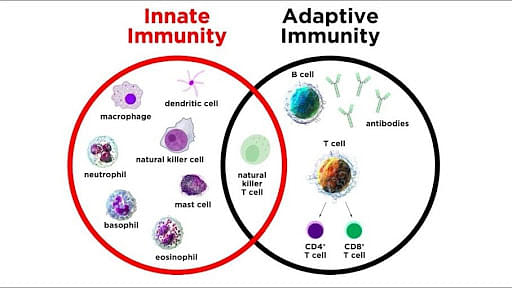
Fig. Innate Immunity vs. Adaptive Immunity
Things to Remember
- Multicellular organisms' ability to resist dangerous germs is known as immunity. There are both specific and generic components to immunity.
- The innate immune system is made up of anti-infection mechanisms that can be engaged very instantly when a pathogen assaults.
- The adaptive immune system, also known as the acquired immune system, is a subsystem of the immune system made up of specialized, systemic cells and mechanisms that kill or prevent infections from multiplying.
- Antibodies are the key components of adaptive immunity, while, antimicrobial peptides and proteins are the key components of innate immunity.
- Adaptive immunity has a high level of specificity and can distinguish between pathogen and non-pathogen structures, as well as minor changes in molecular structures, on the other hand, in innate immunity molecules and molecular patterns linked with generic infections or foreign particles are the only ones that are specific.
- Adaptive immunity is not inherited because it is not passed down from parents to children whereas, immunity that is inherited from parents and passed down to offspring is known as innate immunity.
- Adaptive immunity has the power to combat a certain infection but innate immunity defends the body against all infections and antigens.
Also Read:
Sample Questions
Ques. In the case of innate and adaptive immunity, what are the anatomical and physiological barriers? (2 marks)
Ans. The initial line of defense against infections is provided by anatomical and physiological barriers. Intact skin, active mucociliary clearance mechanisms, low stomach pH, and bacteriolytic lysozyme in tears, saliva, and other secretions are examples of these barriers.
Ques. What Is the main distinction between Innate Immunity and Adaptive Immunity? (2 marks)
Ans. Innate immunity is the type of immunity that all people have from birth. It is the body's natural defence system that protects us from dangerous antigens and is present from birth. Our bodies, on the other hand, develop the second type of immunity known as adaptive immunity as we grow older. Adaptive immunity, unlike innate immunity, is acquired by the body rather than being present at birth. As a result, it's also referred to as acquired immunity.
Also, read: Active and Passive Immunity
Ques. What are the adaptive immune system's cells? (2 marks)
Ans. White blood cells termed lymphocytes are responsible for adaptive immune responses. Antibody responses and cell-mediated immune responses are two types of such responses, and they are carried out by various types of lymphocytes, known as B cells and T cells, respectively.
Ques. What's the distinction between an antigen and an antibody? (2 marks)
Ans. An antigen is a molecule that produces an immunological response by triggering the creation of antibodies. Immunoglobulin (Ig) is another name for an antibody (Ab) (Ig). Plasma cells create these big, Y-shaped blood proteins. They attach to and infiltrate foreign particles. Antibody attacks these particles because they are alien bodies.
Explore more on: Difference Between Antigen and Antibody
Ques. What cells are involved in the innate immune mechanisms? (3 marks)
Ans. Different types of cells play a significant role in the innate immune system's functions. These are some of the cells:
- Mast Cells: These are vital for wound healing and infection defence.
- Natural Killer Cells: These cells inhibit infections from spreading by eliminating infected host cells.
- Eosinophils: These cells are white blood cells that contain highly poisonous proteins that destroy any bacteria or parasite that comes into contact with them.
- Basophils: Basophils are blood cells that kill parasitic multicellular organisms. These cells, like mast cells, emit histamine.
- Neutrophils: These blood cells carry poisonous granules that kill any pathogen that comes into contact with them.
- Phagocytes: These are cells that circulate throughout the body and search for foreign objects. They envelop and destroy it in order to protect the body from the disease.
- Macrophages: These cells have the ability to migrate across the circulatory system's walls. They use cytokines to send out signals that attract other cells to the infection location.
- Dendritic Cells: These are found in the tissues that serve as entry sites for pathogens. These cells detect infection and use antigen presentation to communicate with the rest of the immune system.
Ques. What are the differences between the two types of adaptive immune systems? (3 marks)
Ans. Within the adaptive immune system, there are two basic processes of immunity: humoral and cellular immunity. Antibody-mediated immunity is another name for humoral immunity. B cells will differentiate into plasma B cells, which can manufacture antibodies against a specific antigen, with the cooperation of helper T cells.
Ques. How do innate and adaptive immunity work together to keep our bodies safe from pathogens? (3 marks)
Ans. The adaptive immune responses are triggered by the innate responses, and the two work together to destroy infections. Adaptive immune responses, unlike innate immune responses, are extremely specific to the pathogen that triggered them. They can also provide long-term security. The primary goal of the innate immune response is to stop invading infections from spreading and moving throughout the body. Adaptive immune response is the second line of protection against non-self infections.



Comments