



Content Curator
Difference between lytic and lysogenic cycles is that lytic cycle destroys the host cell, whereas Lysogenic Cycle does not. Lytic and Lysogenic Cycles are two viral replication processes that can occur simultaneously. The viral DNA destroys DNA of the host cell, halting the cell's functioning in Lytic Cycle. The viral DNA may, however, fuse with the host DNA throughout Lysogenic Cycle. A virus is an infectious agent with a nucleic acid molecule enclosed within a protein coat.
Read Also: DNA Polymerases
| Table of Content |
What is Lytic Cycle?
Lytic cycle is a form of viral reproduction process that causes the infected cell to lyse. Adsorption, penetration, replication, maturation, and release are the five steps. Viruses can connect to the host cell's cell wall or plasma membrane. The virus attaches to a specific receptor on the cell membrane, causing the cell membrane to weaken.
Viral DNA is reproduced and viral proteins are produced inside the host cell if the virus enters a receptive host. The maturation of the proteins then produces new virus particles. The viral particle is released from the host cell when it is lysed. Lytic cycle's steps are shown in the diagram below.
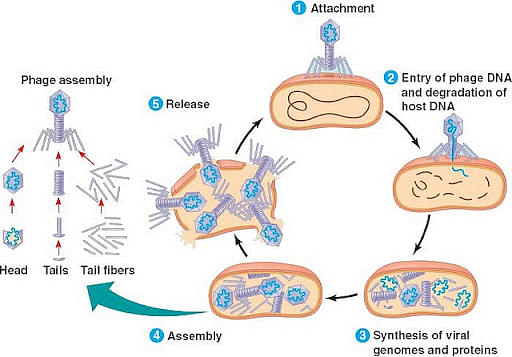
Flow Diagram of Lytic Cycle
Lytic cycle is the primary mechanism of viral replication because new viral offspring are released into the environment. Each cycle produces 100-200 virus particles. The enzyme produced by the virus causes the host to be lysed. As a result, lytic viruses hijack the infected cell's biological systems. The lysis of the cells causes the host to show signs of viral infection.
Also Read:
What is Lysogenic Cycle?
Lysogenic Cycle is a method of viral replication in which viral DNA is incorporated into the host genome. A prophage is a novel group of genes in the host genome. As a result, viral DNA is integrated into the host genome. When the host genome replicates, the viral genes multiply at the same time. The prophage stage is depicted in the diagram below.
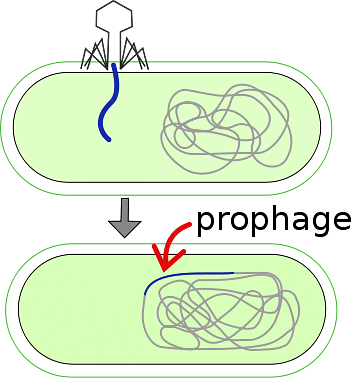
Lysogenic Cycle
The host cell does not lyse because Lysogenic Cycle produces no new progeny. As a result, the host shows no signs or symptoms of the viral infection. Some viruses go through Lysogenic Cycle before moving on to Lytic Cycle.
Also, read:
Difference Between Lytic and Lysogenic Cycle
Lytic and lysogenic cycles of bacteriophages differ in several ways. Some of these are tabulated below:
| Lytic Cycle | Lysogenic Cycle |
|---|---|
| It is a form of viral reproduction mechanism that causes the infected cell to lyse. | The viral DNA is incorporated into the host genome in this method of viral reproduction. |
| The DNA of the virus or phage does not integrate with the DNA of the host cell. | The phage DNA is integrated into the DNA of the host cell. |
| There is no prophage stage in the cycle. | There is a prophage stage in the cycle. |
| The DNA of the host is not hydrolyzed. | The DNA of the host is not hydrolyzed. |
| The host's DNA replication process is not involved in the replication of the DNA. | The viral DNA replicates at the same time as the host's DNA replicates. |
| Viral DNA has a high production. | Viral DNA has lower productivity. |
| The viral genome takes over the cellular machinery of the host. | The viral genome does not take over the biological functions of the host cell. |
| The virus (bacteriophage) is virulent. | The virus is avirulent. |
| As the viral particles are liberated, the host cell is lysed. | There is no lysis of the host cell. |
| Since the release of viral particles, it has been producing virus progeny. | Because viral particles are not freed, it does not form viral progenies. |
| The entire procedure takes only a few minutes to finish. | Time-consuming process. |
| Lysogenic Cycle is not followed. | Lytic Cycle can be followed by Lysogenic Cycle. |
| In the host bacterium, does not follow genetic recombination. | It enables the host bacterium's genetic recombination. |
Check Important Notes for Cloning Vector
Things to Remember
- In Lytic Cycle, viral particles are freed. As a result, Lytic Cycle produces a virus progeny.
- Virus particles are rarely freed during Lysogenic Cycle. As a result, no viral offspring is produced by Lysogenic Cycle.
- Lytic Cycle demonstrates the signs and symptoms of viral replication.
- Lysogenic Cycle shows no signs of viral replication.
- During Lytic Cycle, the host cell is lysed as the virus particles are released.
- Lysogenic Cycle does not lyse the host cell.
Also Check:
Sample Questions
Ques. Does Lytic Cycle kill the Viral Host Cell? (2 Marks)
Ans. Some bacteriophages can only proliferate by bursting and killing their host cells in a lytic cycle. Other pages, such as the lambda phage, can switch between lytic and lysogenic cycles, in which they don't harm the host cell but are instead replicated along with the host DNA every time the cell divides.
Ques. How is Lysogenic Cycle triggered? (2 Marks)
Ans. The bacteriophage DNA is incorporated into the host cell genome during Lysogenic Cycle and passed on to the following generations. The prophage may excise and enter Lytic Cycle as a result of several environmental stress factors such as hunger or exposure to hazardous substances.
Ques. How long does Lytic Cycle last? (2 Marks)
Ans. In wild-type lambda, lysis takes about 50 minutes, and roughly 100 completed virions are released. The holin and antiholin proteins control the timing of lysis, with the latter suppressing the former.
Ques. Do all viruses go through Lytic Cycle? (2 Marks)
Ans. Lytic Cycle and Lysogenic Cycle are the two replication processes used by viruses. Some viruses employ both routes of reproduction, whereas others solely use Lytic Cycle. The virus binds to the host cell and injects its DNA during Lytic Cycle.
Also Read More:
Ques. What is unique to Lysogenic Cycle? (2 Marks)
Ans. One of two viral reproduction cycles is lysogeny, or Lysogenic Cycle (Lytic Cycle being the other). The integration of bacteriophage nucleic acid into the host bacterium's genome or the creation of a circular replicon in the bacterial cytoplasm are both signs of lysogeny.
Ques. What happens during a lysogenic cycle? (2 Marks)
Ans. The phage DNA is incorporated into the host genome during Lysogenic Cycle, resulting in a prophage that is passed on to succeeding generations of cells. The prophage may be excised and enter Lytic Cycle as a result of environmental stressors like hunger or exposure to hazardous substances.
Ques. What are the Similarities Between Lytic Cycle and Lysogenic Cycle? (3 Marks)
Ans. Similarities between lytic and lysogenic cycles are as follows:
- Both are viral reproduction processes.
- They happen inside the host cell.
- Thousands of copies of the original virus are produced over the cycles.
- The host cell's DNA replication and protein production can be controlled by both lytic and lysogenic bacteria.
Ques. What is a Latent Virus? (3 Marks)
Ans. Lytic Cycle is not used by all animal viruses to replicate. In a process known as latency, some viruses can hide or remain latent inside the cell. These viruses are known as latent viruses, and they are capable of causing latent infections. Latency-capable viruses can induce an acute illness before going dormant.
Latent viruses can live as circular viral genome molecules outside of the host cell chromosome and hence remain dormant. Others integrate with the host DNA to become proviruses or prophages. Latent viruses do not create disease signs while dormant, making them difficult to identify. Unless a viral diagnostic test is performed, a patient may be unaware that he or she is infected.
Example: Varicella-zoster (the virus that causes chickenpox)
Biology Related Links:



Comments