



Content Curator
Bacterial Transformation is the process of the integration of foreign DNA with the host bacterium. This leads to formations of transformants that have different characteristics than the non-transformant bacterium. The DNA is linked with the single extrachromosomal plasmid DNA of the host bacterium. The extrachromosomal DNA strand should contain an origin of transformation.
The transformants are used for various purposes –
- Used for the formation of multiple copies of the gene of interest
- Formation of a large number of DNA
- To genetically modify a bacterium or other cell
| Table of Content |
Keyterms: Bacterial transformation, DNA, Host Bacterium, Non-transformant bacterium, Extrachromosomal DNA, Gene, Gene transfer, DNA cloning, DNA ligase, DNA polymerase enzyme
What is Bacterial Transformation?
[Click Here for Sample Questions]
The horizontal gene transfer process is in which a foreign DNA gets linked with the plasmid DNA of the host bacterium. It is the most crucial step in DNA cloning. This was first performed by Griffith in 1928 in streptococcus pneumonia. The linking up of foreign DNA is done with help of DNA ligase. The organism from which the foreign DNA and host bacterium should be closely related. The foreign DNA replicates using the new host’s DNA polymerase enzyme and makes multiple copies.
The foreign DNA doesn’t have to be from the living donor but the host bacterium should be persistent. The host bacterium should be competent and able to uptake extracellular DNA. The nature of competence is based on the genus of the organism. If the foreign DNA is similar to bacterial DNA, it may integrate into the chromosome.
Formation of Bacterial Transformants
[Click Here for Sample Questions]
- The foreign DNA is linked with the bacterium host with the help of DNA ligase. This process is called ligation.
- The bacteria are made to take up plasmid by giving heat shocks. These heat shocks make the bacterial membrane-permeable by forming pores which help in the easy uptake of DNA molecules.
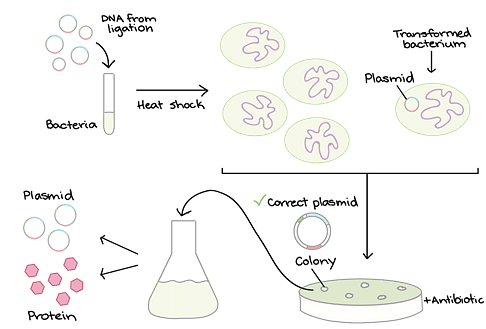
Formation of Bacterial Transformants
- Plasmids used in Cloning contain an antibiotic resistance gene. Thus, all of the bacteria are placed on an antibiotic plate to select for ones that took up a Bacteria without a plasmid die. Each bacterium with a plasmid gives rise to a cluster of identical, plasmid-containing bacterim called a colony.
- Several colonies are checked to identify one with the right plasmid (e.g., by PCR or restriction digest).
- A colony containing the right plasmid is grown in bulk and used for plasmid or proein production.

Formation of Bacterial Transformants
Selection Of Bacterial Transformants
[Click Here for Sample Questions]
Transformants can be selected from non-transformant by the property of antibiotic resistance.
For example, you can ligate a foreign DNA at the BamH I site of the tetracycline resistance gene in the vector pBR322. The recombinant plasmids will lose tetracycline resistance due to the insertion of foreign DNA but can still be selected out from non-transformants ones by plating the transformants on an ampicillin-containing medium. The transformants growing on an ampicillin-containing medium are then transferred on a medium containing tetracycline. The recombinants will grow in an ampicillin-containing medium but not on that containing tetracycline. But, nonrecombinants will grow on the medium containing both the antibiotics

Selection Of Bacterial Transformants
Things To Remember
- Integration of foreign DNA with the host bacterium is called the formation of transformant
- F.Griffith in 1928 formed the first transformant.
- The foreign DNA and host bacterium should be of a closely related genus.
- Transformation is the most crucial step in DNA cloning.
- It is the basis of biotechnology and the formation of GMOs (Genetically Modified Organisms)
- The bacterial cells are made to take foreign DNA by giving heat shocks.
- The transformants can be distinguished from non-transformant by using antibiotic resistance or based on chromogenic substances.
Also Read:
| Related Articles | ||
|---|---|---|
| Binary fission | Menstrual Cycle | Pollen Grains |
| Blastocyst | Infant Mortality Rate | Embryology |
Sample Questions
Question 1. Name the enzymes that are used for the isolation of DNA from bacterial and fungal cells for recombinant DNA technology. [All India 2014; Foreign 2014 ] (2 Marks)
Ans. The enzymes used for the isolation of DNA from bacterial cells is lysozyme and fungal cells are chitinase
Question 2. Any recombinant DNA with the desired gene is required in billion copies for commercial use. How is the amplification done? Explain. [Delhi 2010c](2 Marks)
Ans. Amplification of gene is done using Polymerase Chain Reaction (PCR). it is carried out in the following steps:
(i) Denaturation The double-stranded DNA is denatured by applying a high temperature of 95°C for 15 seconds. Each separated strand acts as a template.
(ii) Annealing Two sets of primers are added, which anneal to the 3′ end of each separated strand.
(iii) Extension DNA polymerase extends the primers by adding nucleotides complementary to the template provided in the reaction. Taq polymerase is used in the reaction, which can tolerate heat. All these steps are repeated many times to get several copies of the desired DNA.
Question 3. How can the following be made possible for biotechnology experiments? (2 Marks)
(I) Reintroduction of the recombinant DNA into a bacterial cell.
Ans. Reintroduction of the recombinant DNA into bacterial cells can be done by the following methods:
(a) The recipient bacterial cell is made ‘competent to take up the recombinant DNA by treatment with a specific increase in the concentration of calcium ions.
(b) the recombinant DNA is forced into the cells by heat shock treatment, i.e. by incubating the cells with rDNA followed by placing them at 42°C (heat shock) and then putting them back on ice. This enables bacteria to take up rDNA.
Question 4. I) Name the organism in which the vector shown is inserted to get the copies of the desired gene.
II) Mention the area labeled in the vector responsible for controlling the copy number of the inserted gene.
III) Name and explain the role of a selectable marker in the vector shown. (2 Marks)
Ans.
- Escherichia coli / E coli
- ori.
- ampR is the marker gene that helps in the identification and elimination of the non-transformant growing in ampicillin medium and selectively permitting the growth of the transformant resistant to ampicillin. tetR is the marker gene that helps in the identification and elimination of the non-transformant growing in tetracycline medium and selectively permitting the growth of the transformant resistant to tetracycline.
Questions 5. Name the soil bacterium which contains the gene for the production of endotoxins. (2 Marks)
Ans. Agrobacterium tumefaciens.
Question 6. While cloning vectors, which of the two will be preferred by biotechnologists, bacteriophages, or plasmids. Justify with reason. (2 Marks)
Ans. Biotechnologists prefer bacteriophages for cloning over plasmids because they have very high copy numbers of their genome within the bacterial cells whereas some plasmids may have only one or two copies per cell and others may have 15-100 copies per cell. Phage vectors are more efficient than plasmids for cloning large DNA fragments.
Question 7. What are recognition sequences or recognition sites? (2 Marks)
Ans. The sites recognized by restriction endonucleases are called recognition sites. The recognition sequences are different and specific for the different restriction endonucleases. These sequences are palindromic.
Question 8. What do you understand by the term selectable marker? (2 Marks)
Ans. Selectable marker:
- A marker is a gene that helps in selecting those host cells which contain the vector (transformant) and eliminating the non-transformants. It selectively permits the growth of transformants.
- Common selectable markers for E. coli include the genes encoding resistance to antibiotics such as ampicillin. chloramphenicol tetracycline and kanamycin or the gene for (i-galactosidase which can be identified by a color reaction. Normal E.Coli does not carry resistance against any of these antibodies.
Question 9. Why is it not possible for an alien DNA to become part of a chromosome anywhere along its length and replicate? (CBSE 2014)(2 Marks)
Ans. For the multiplication of any alien DNA, it needs to be a part of a chromosome that has a specific sequence known as the origin of replication.
For Latest Updates on Upcoming Board Exams, Click Here: https://t.me/class_10_12_board_updates
Check-Out:



Comments