



Content Curator
The endocrine and neurological(nervous) systems are the two systems that work together to coordinate the body's functioning. To keep the body in a state of homeostasis, both the endocrine and neurological systems transmit signals to the effector organs, tissues, and glands. Endocrine glands make up the endocrine system. The brain, spinal cord, and various peripheral nerves make up the nervous system.
| Table of Content |
Key Terms: Endocrine system, Nervous System, Peripheral Nervous System(PNS), Central Nervous System(CNS)
What is Endocrine System?
Endocrine system is made up of glands that make, store, and secrete hormones. Hormones are the molecules that carry the endocrine system's impulses. They control biological functions including growth and development, body system homeostasis, metabolism, reproduction, and stress or injury response.
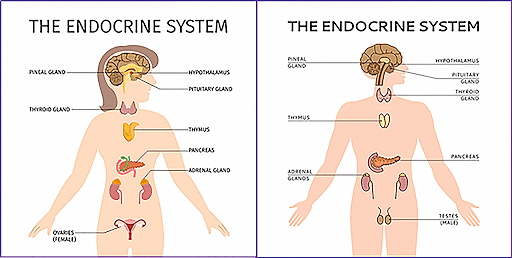
Endocrine System
Hormones are secreted by the endocrine glands into the bloodstream and then delivered to the effector organ. Hypothalamus, pineal gland, pituitary gland, thyroid, parathyroid, thymus, adrenal gland, pancreas, ovaries, and testes are some of the glands in the endocrine system.

Endocrine System
The hypothalamus and pituitary gland are the two major endocrine glands in the body that emit hormones to control the production and secretion of hormones in the rest of the body. Other significant endocrine glands include the pineal gland, thyroid, parathyroid, and adrenal gland. Age, stress, environmental factors, heredity, and illness conditions all influence the endocrine system's function.
What is Nervous System?
Nervous system is a network of nerve cells that coordinates the body's operations. The nerve cell is the nervous system's structural and functional unit. The neuroglia is the nervous system's supporting cells. The brain, spinal cord, nerves, ganglia, receptor organs, and effector organs are all part of it. The nervous system is divided into two parts: the central nervous system (CNS) and the peripheral nervous system (PNS).
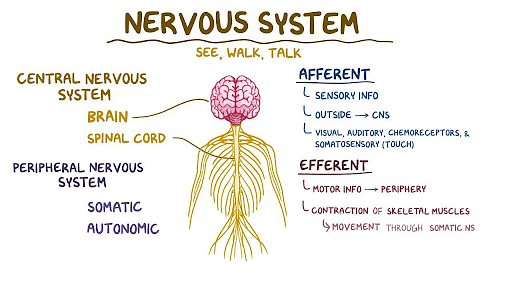
Nervous system
The CNS is made up of the brain and spinal cord. The PNS is made up of the remaining peripheral nerves, which receive stimuli via sensory neurons and send impulses to the effector organs via motor neurons. Peripheral nerves connect the body to the central nervous system. The PNS receives input from the body's internal and exterior environments.

Nervous System
The somatic nervous system and the autonomic nervous system are two parts of the PNS. The voluntary functions that a person can control are coordinated by the somatic nervous system. The autonomic nervous system, on the other hand, coordinates involuntary activities. Neurotransmitters aid in signal transmission between nerve cells.
Similarities between Endocrine Vs Nervous System
- The endocrine and neurological systems respond to stimuli to coordinate the body's functioning.
- The body's homeostasis is maintained by both the endocrine and neurological systems.
- The effector organ receives information from both the endocrine and neurological systems.
- Chemical substances are used by both the endocrine and neurological systems to deliver signals.
Difference between Endocrine Vs Nervous System
There are a number of differences between the endocrine system and the nervous system based on a number of different factors. Some of them are:
Difference based on Definition
Endocrine System: The endocrine system is a collection of glands that produce hormones to regulate the body's functioning.
Nervous System: The nervous system is a network of nerve cells that transfer nerve impulses to coordinate the body's operations.
Difference based on Composition
Endocrine System: Glands make up the endocrine system.
Nervous System: Nerve cells are grouped in the brain, spinal cord, and peripheral nerves to form the nervous system.
Difference based on Signal Types
Endocrine System: Hormones are used by the endocrine system to deliver signals to the effector organs.
Nervous system transmits signals to the effector organs through electric impulses and chemical molecules called neurotransmitters.
Difference based on Transmission of Signals:
Endocrine System: The signals in the endocrine system are conveyed through the blood.
Nervous System: Signals are transferred through nerve cells in the nervous system.
Difference based on Whole System
Endocrine System: The endocrine system as a whole is not physically connected.
Nervous System: The nervous system as a whole is physically connected.
Difference based on Transmission Time:
Endocrine System: Because the endocrine system's signals travel through the blood, it takes longer for them to reach the effector organ.
Nervous System: The nervous system's impulses are transmitted in a very short amount of time.
Difference based on Effect
Endocrine System: The endocrine system has a wide range of effects.
Nervous System: The nervous system has a localized influence.
Difference based on Functions
Endocrine System: Growth, hydration, glucose levels, heat productivity, sexual maturity, and gamete production are all controlled by the endocrine system.
Nervous System: Muscle movement, heartbeat, digestion, respiration, senses, speech, and memory are all controlled by the nervous system.
Difference based on Factors Affecting Both
Endocrine System: Age, stress, environmental factors, heredity, and illness conditions all influence the endocrine system's function.
Nervous System: Multiple sclerosis, meningitis, and malignancies can all damage the nervous system's ability to function.
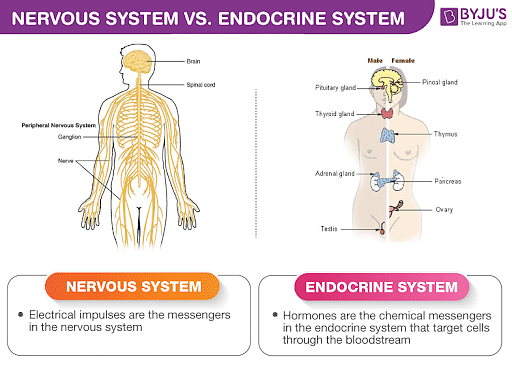
Difference between Nervous system and endocrine System
Tabular Distinction between Endocrine System and Nervous System
| Endocrine System | Nervous System |
|---|---|
| Hormones are endocrine system chemical messengers that go through the bloodstream to target cells. | Electrical impulses are the nervous system's messengers. |
| The endocrine system includes glands and organs such as the thyroid, pituitary glands, and reproductive organs (ovaries and testes). | The nervous system is made up of the brain and the spinal cord. |
| Hormones go through the bloodstream. | Neurons are responsible for transmitting nerve impulses. |
| Involuntary control of the endocrine system | Both voluntary and involuntary control is exercised over the neurological system. |
| Hormones enter target cells by diffusing through the plasma membrane or attaching to receptors on the cell surface. | Nerve impulses penetrate target cells via using neurotransmitters at synaptic clefts, as well as sodium and potassium channels. |
| There are a lot of reactions. | Localized responses are made. |
Things to Remember
- Endocrine system is a group of glands that produce hormones to regulate the body's functioning whereas the nervous system is a network of nerve cells that transfer nerve impulses to coordinate the body's operations.
- Hormones are used by the endocrine system to send signals to the effector organ.
- Muscle movement, heartbeat, digestion, respiration, senses, speech, and memory are all controlled by the nervous system.
- The nervous system's messages are transmitted in a very short amount of time.
Sample Questions
Ques. What happens if the nervous system doesn't function properly? (2 marks)
Ans. If the nervous system doesn't function properly then one or more symptoms, such as numbness, tingling, weakness, or inability to move a part or all of one side of the body, may appear suddenly (paralysis). Dimming in one or both eyes, blurring, double vision, or loss of vision, speech loss, difficulty speaking, or difficulty understanding speech may also be caused.
Ques. What are the most prevalent disorders of the neurological system? (3 marks)
Ans. The following are six common neurological illnesses:
- Headaches. Headaches are one of the most frequent neurological illnesses, afflicting people of all ages.
- Stroke
- Epilepsy and Seizures.
- Amyotrophic Lateral Sclerosis (ALS)
- Amyotrophic Lateral Sclerosis (ALS)
- Alzheimer's and Dementia
- Parkinson's Disease.
Ques. What 6 interesting facts about the neurological system can you share? (3 marks)
Ans. The 6 interesting facts about the nervous system are mentioned below:
- There are billions of nerve cells in the human body.
- There are three parts of a neuron.
- Neurons can have a multitude of appearances.
- Neurons are designed to undertake a variety of tasks.
- The nervous system is divided into two sections.
- Nervous systems are divided into two types.
Ques. Is it true that the neurological system is in charge of emotions? (2 marks)
Ans. The nervous system is the body's main communication system. Your autonomic nervous system controls all of the operations of your internal organs and glands that secrete hormones on a subconscious level. Your autonomic nervous system is responsible for your ability to experience emotions.
Ques. What are some interesting endocrine system facts? (3 marks)
Ans. Endocrine System facts that will surprise you are:
- The endocrine system is a system that regulates the production of hormones in the body.
- Endocrinology was first practiced by traditional Chinese healers over 2,000 years ago.
- Osteoporosis is sometimes caused by the endocrine system.
- It's just been a century since the name "hormone" was coined.
- The endocrine system does not produce all hormones.
Ques. What are the nervous system's four primary functions?
Ans. The nervous system's four primary roles are:
- Controlling the interior environment of the body in order to maintain 'homeostasis' The regulation of body temperature is an example of this.
- Reflexes in the spinal cord are programmed. The stretch reflex is an example of this.
- Learning and memory.
- Controlling one's movement voluntarily.
Ques. What would happen if the endocrine system didn't exist?
Ans. If a person doesn’t have an endocrine system then one can have trouble developing during puberty, becoming pregnant, or handling stress. Without an endocrine system, too much sugar lingers in your blood instead of going into your cells where it's needed for energy, you may gain weight easily, have weak bones, or lack energy.
Ques. What is the total number of endocrine glands? Which endocrine gland is the tiniest? (4 marks)
Ans. Despite the fact that there are eight primary endocrine glands spread throughout the body, they are nevertheless considered one system since they have comparable functions, influence mechanisms, and interrelationships.
The Pineal Gland is the tiniest endocrine gland located at the base of the brain.
The pineal gland is a sort of endocrine gland that is found in the third ventricle's roof. The pineal gland resembles a little pine cone in shape, and it is the smallest gland in the body.
Ques. What effect does massage have on the nervous system? How long does it take for injured nerves to heal? (3 marks)
Ans. By stimulating the autonomic nervous system, massage can trigger the release of endorphins like serotonin and dopamine. An increase in endorphin levels can result in a reduction in pain as well as an increase in relaxation and tranquillity. Massage might help you feel less stressed.
The length of time it takes for your nerve to regenerate is determined by the severity of the injury and the type of injury. If your nerve has been bruised or damaged but not cut, it will heal in 6 to 12 weeks. After a 4 week period of rest following your injury, a cut nerve will grow at a rate of 1 mm every day.
Ques. What is the total number of nerves in the human body? What is the body's largest nerve? (2 marks)
Ans. The human body has approximately 7 trillion nerves, believe it or not. All of these nerves are part of the neurological system of your body. Nerves are the electrical wiring of your body, transmitting messages between your brain, spinal cord, and the rest of your body.
The sciatic nerve, which originates at the base of the spine and runs down the back of each leg into the foot, is the largest and longest nerve in the human body.
Ques. How long does the nervous system last? Is it possible for nerve injury to result in paralysis? (3 marks)
Ans. Our body would be 965 kilometers long if all of our neurons were lined up in a straight line. The brain alone contains 100 billion neurons. During the first year of life, a newborn baby's brain almost triples in size.
When nerve signals to muscles are disrupted, you may have paralysis, or the inability to produce voluntary motions. Strokes, spinal cord injuries, and nerve illnesses like multiple sclerosis are all common causes of paralysis.
Ques. How do neurons communicate with one another? (2 marks)
Ans. Electrical impulses are known as 'action potentials' and chemical neurotransmitters are used by neurons to communicate with one another. An action potential leads neuron A to produce a chemical neurotransmitter at the synapses between two neurons.



Comments