



Education Journalist | Study Abroad Lead
Breathing is essential for all living organisms to survive. Lungs play a significant part in the human respiratory system along with other respiratory organs such as the larynx and trachea. These vascularized bags help in the transportation and diffusion of gases. The lungs are divided into left and right lungs. They weigh approximately 1.3 kilograms. They are conical in shape and have an apex at the upper end. The base of the lungs rests on the diaphragm. The diaphragm separates the lungs from other internal organs. The outer pleural membrane is in contact with the thoracic lining, and the inner pleural membrane is in contact with the surface of the lungs. In this article, we will understand the difference between the right lung and the left lung.
| Table of Content |
Keyterms: Breathing, Lungs, Respiratory system, Organs, Appex, Membrane, Pleura, Alveoli, Thoracic chamber
Lung - The Respiratory Organ
[Click Here for Sample Questions]
The lungs are located in an anatomically air-tight chamber called a thoracic chamber. These are organs covered by double-layered pleura, which contains pleural fluid between them. This fluid reduces the friction on the surface of the lung. They are composed of millions of alveoli. The lungs are divided into left and right lungs. They are further divided into fissures and lobes, which are in turn divided into bronchopulmonary segments.

Figure 1: Sectional view of the left lung
The primary function of the lungs is to inhale and exhale gases in and out of the body, respectively. They facilitate the exchange of O2 and CO2 between the atmosphere and blood. Apart from breathing, lungs also help maintain the body's acidity level, protect the heart from certain types of collision, and act as a blood reservoir.
The lungs are mainly comprised of bronchi, bronchioles, and alveoli. The lungs have three borders, namely anterior, posterior and inferior, and two surfaces, namely costal and medial. The pressure gradient between the lungs and atmosphere helps in air movement in and out of the lungs. A diagram of the human respiratory system is given below (Figure 2).

Read Also: Difference Between Respiration and Photosynthesis
Right lung
[Click Here for Sample Questions]
The right lung is wider and shorter compared to the left lung. It is located on the right side over the liver. Since it is shorter, it provides more space for the liver. It consists of three lobes: superior, middle, and inferior lobes.
Left lung
[Click Here for Sample Questions]
The left lung is narrower and longer, unlike the right lung. It is located on the left side and has a concave impression called cardiac notch, which helps accommodate the heart. It consists of two lobes: superior and inferior lobes.
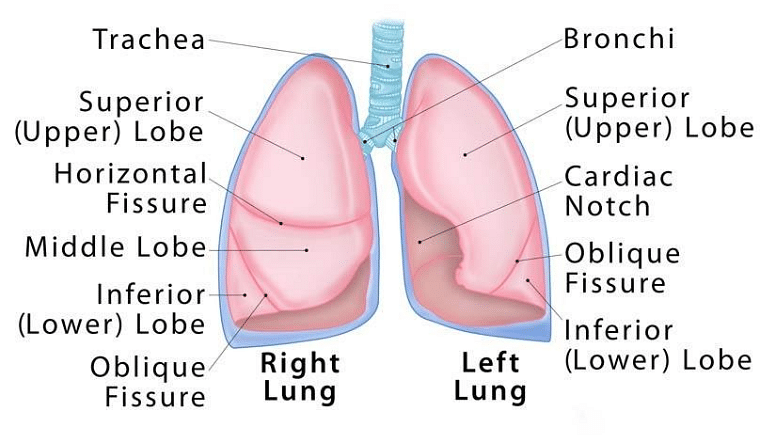
Lobes of lung
Read Also: Emphysema
Difference between right and left lung
[Click Here for Sample Questions]
Now let us tabulate the differences between the right and left lung:
| Criteria | Right lung | Left lung |
|---|---|---|
| Location | It is located on the right side of the liver. | It is located on the left side with a concave impression. |
| Structure | It is shorter and wider. | It is longer and narrower. |
| Shape | It is concave. | It is less concave compared to the right lung. |
| Weight | It is heavier and weighs approximately 700 g. | It is lighter compared to the right lung and weighs approximately 650 g. |
| Separation | The base is separated from the liver by the diaphragm. | The base is separated from the stomach and spleen by the diaphragm. |
| Lobes | It consists of three lobes: the superior lobe, middle lobe, and inferior lobe. | It consists of two lobes: the superior lobe and the inferior lobe. |
| Providing space | It provides space for the liver. | It provides space for the heart. |
| Fissures | It has two fissures: oblique and horizontal. The oblique and horizontal fissures separate the superior and middle lobes and middle and superior lobes, respectively. | It has only one oblique fissure. |
| Bronchus | It has two bronchi. | It has only one bronchus. |
| Bronchopulmonary segment | It has 10 segments. | It has 9–10 segments. |
Things to Remember
- The right lung is wider, shorter, and separated from the liver, whereas the left lung is narrower, longer, and separated from the stomach and spleen.
- The right lung consists of superior, middle, and inferior lobes. The left lung has superior and inferior lobes.
- Both the lungs have fissures to separate the lobes from each other. The right lung has two fissures. The oblique and horizontal fissures separate the superior and middle lobes and middle and superior lobes, respectively. On the other hand, the left lung has only one oblique fissure.
- The right lung provides space for the liver, whereas the left lung provides space for the heart. The bronchi and bronchopulmonary segments on the right lung are 2 and 10 and on the left lung are 1 and 9–10.
- Adding a fact, the lung is the only organ that can float on water due to the millions of balloon-like structured alveoli within it. Also, a person can lead a normal life with only one lung. But this may restrict a few physical abilities, such as exercising.
Sample Questions
Ques. List the differences between right and left lungs. (5 marks)
Ans. The differences are:
- The right lung is located on the right side above the liver, and the left lung is located on the left side.
- The right lung is shorter and wider, whereas the left lung is longer and narrower.
- The right lung is concave, whereas the left lung is less concave compared to the right lung.
- The right lung is heavier compared to the left lung and weighs approximately 700 g. The left lung is lighter and weighs approximately 650 g.
- The right lung provides space for the liver, whereas the left lung provides space for the heart
- The right lung has two bronchi, whereas the left lung has only one bronchus.
Ques. Why does the left lung have two lobes? (2 marks)
Ans. The left lung has two lobes because it has a concave impression called a cardiac notch. This impression provides space for the heart in the chest cavity.
Ques. Name the fluid present between the layers of the lung membrane and its function. (2 marks)
Ans. The pleural fluid is present between the double layers of the membranes. It reduces the friction or resistance on the surface of the lung.
Ques. Give reason for the following statement: Lung can float on water. (2 marks)
Ans. The millions of balloon-like structures called alveoli are the reasons for the lungs to float on water.
Ques. Lungs do not collapse between breaths and some air always remains in the lungs which can never be expelled. What is the reason behind that? (NEET–II 2016) (1 mark)
Ans. The negative intrapleural pressure pulling at the lung walls.
Ques. Does man require both the lungs for breathing? (2 marks)
Ans. No, a man can live a normal life even with one lung. One lung is enough to pump air in and out from the body. But there may restrict a few physical abilities, such as exercising and lead to breathlessness and fatigue. This can also lead to tiredness, pain, and cardiac disorders.
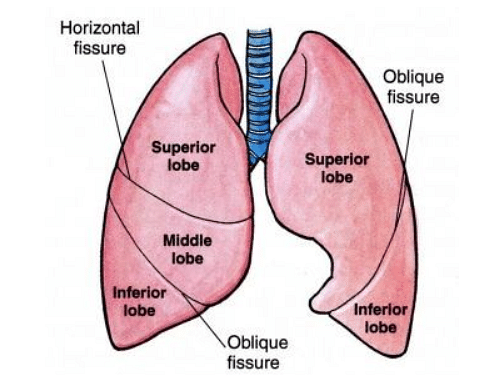
Ques. Explain the significance of lobes in the lungs with a neat diagram. (3 marks)
Ans. The lungs are divided into left and right lungs. They are further divided into fissures and lobes. These lobes are divided into bronchopulmonary segments. These lobes have the same function as the lungs. They help in bringing O2 into the blood and removing CO2.
Lobes in the lungs with a neat diagram
The right lung consists of three lobes, namely the superior lobe, middle lobe, and inferior lobe. The left lung consists of two lobes, namely the superior lobe and the inferior lobe. The left lung has two lobes because it has a concave impression called a cardiac notch. This impression provides space for the heart in the chest cavity.
Ques. Explain the process of respiration when a person goes up a hill? (2 marks)
Ans. The level of O2 in the mountainous region is low. Therefore, the breathing rate increases to supply adequate oxygen to the blood.



Comments