



Education Content Expert
Spiracles are small apertures or openings present on the surface of various species of fish, insects, and sharks for breathing.
- They help in the entry and exit of gases for respiration.
- Respiration in insects occurs through a tracheal system that connects with the external environment through spiracles.
- Air enters the tracheal chamber with the help of the spiracles.
- A pair of spiracles are present on each segment of the body.
Read More: NCERT Solutions for Class 7 Science Respiration in Organisms
Key Terms: Spiracles, Insects, Trachea, Fish, Tracheal System, Respiration, Cockroach, Gills, Species
What are Spiracles?
[Click Here for Sample Questions]
Spiracles are tiny holes present on the bodies of insects that allow them to breathe. Spiracles are typically found on the sides of the body in animals, although some, like snakes, have them on the bottom.
- Insects have a pair of spiracles on each side of their bodies.
- Spiracles allow air to enter, which then passes through the insect's body and into its lungs.
- Spiracles in aquatic animals allow water to enter and exit the body of the organism.
- They are typically found close to the gills on the sides of the body.
- The water balance and breathing are controlled by spiracles.
- Spiracles are frequently enclosed by the hair, which reduces the amount of airflow, thus, minimizing water loss.
- Different species have distinct pairings of spiracles.
- Cockroaches have 10 spiracles, of which two pairs are located in the thoracic region and 8 in the abdomen region.
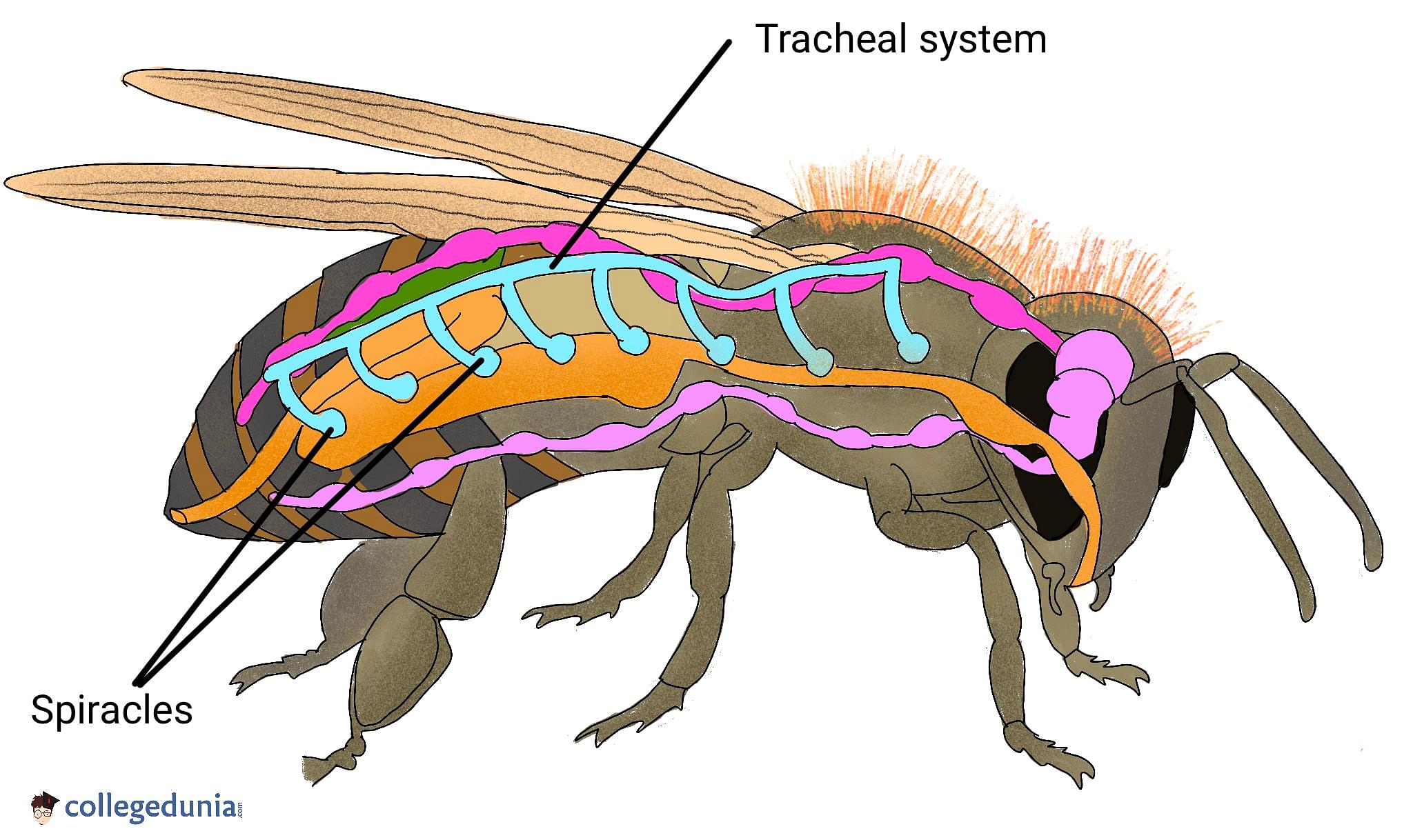
Spiracles
Types of Spiracles
[Click Here for Sample Questions]
Spiracles can be categorized into two main types namely Primary Spiracles and Secondary Spiracles.
- Primary Spiracles: The openings of the respiratory system on the head of a larva or adult bug are called primary spiracles. They help to breathe and expel waste.
- Secondary Spiracles: The openings of larvae or adult insect's reproductive systems are known as secondary spiracles. They are used for mating and egg-laying.
Numerous insects have valves with flaps and hairs to cover their spiracles, which are also encircled by ridges, folds, and spines. Spiracles are further controlled by muscles that contract when an organism requires oxygen. Spiracles can be modified in insects to enable them to survive in dry environments.
Read More:
Evolution of Spiracles
[Click Here for Sample Questions]
Spiracles were originally just the gill holes behind the mouth in jawless fish.
- The jaw gradually detached from the structure that was situated between this gill opening and the other gill openings.
- The stigma was mostly preserved as a tiny hole-like entrance in cartilaginous fish.
- The ability of the spiracles to breathe without the aid of exposed gills makes them more resistant to the kinds of rays found buried in the ocean floor.
- Therefore, it seems likely that the spiracle developed from the gill opening.
- The hearing organs of some frogs and other amphibians are also thought to be connected to spiracles.
Read More: Aerobic and Anaerobic Respiration
Examples of Spiracles
[Click Here for Sample Questions]
Spiracles are found in distinct types in different insects and fish, ranging from grasshoppers to sharks.
- Southern stingrays breathe through spiracles while submerged in the water.
- Angel sharks, on the other hand, have flat bodies and use their spiracles to bury themselves in the sand.
- Angel sharks don't need to swim like other sharks because they can take oxygen and expel carbon dioxide.
Tracheal System in Insects
[Click Here for Sample Questions]
Insects do not have a respiratory system. They have a tracheal system that transports oxygen throughout their body while exhaling carbon dioxide.
- Tracheoles are the distinct cells employed for gas exchange in insects.
- Air travels from the spiracle to the tracheal tube to reach the tracheoles.
- Large insects use their abdomen muscles to open and close their individual spiracles.
- They are able to move air more easily as a result.
- The nature of these tubes is one of the reasons why these insects aren't evolving.
Spiracles in Cockroaches
- According to the morphology and anatomy of cockroaches, cockroaches have ten spiracles.
- They have various locations for their spiracles, each with a different number.
- Some can be seen on the thorax and on the lower legs.
- Abdominal regions contain the rest of the spiracles.
- The first thoracic spiracle is the largest cockroach spiracle.

Spiracles in Cockroaches
Read More: Difference Between Breathing and Respiration
Spiracles in Insects
[Click Here for Sample Questions]
Numerous insect species, including cockroaches and grasshoppers, possess spiracles of various shapes.
- Spiracles enable insects to move their tracheal system with air.
- Insects use their tracheal system to breathe because they lack lungs.
- Insects also use muscle contraction to open and close their spiracles.
- The tracheal system of insects is used to transport oxygen molecules during this process.
Spiracles in Animals
[Click Here for Sample Questions]
Whales and sharks are some animals that use spiracles for breathing.
- Whales breathe on oxygen and exhale carbon dioxide through blowholes.
- Every living creature has a unique structure for respiration.
- The organs including the respiratory system, are also unique in living organisms.
- Lungs are the principal respiratory organ of both humans and other animals like cows, birds, snakes, lions, and elephants.
- Fish breathe with their gills, and earthworms breathe through their skin.
Check More:
Things to Remember
- Spiracles are the openings on the body surface of the organisms that help in breathing.
- Primary Spiracles and Secondary Spiracles are the two types of spiracles.
- Spiracles are found in various animal and insect species such as cockroaches, houseflies, fish, whales, etc.
- Animals typically have spiracles on each side of their bodies.
- It is also found in the abdomen of some insects.
- Cockroaches have 10 spiracles found on the thorax, parts of the legs, and abdominal areas.
Sample Questions
Ques. How is respiration possible in insects? (3 Marks)
Ans. Insects do not have lungs, thus, they use spiracles that open and close by the contraction of their muscles to exchange oxygen and carbon dioxide with the atmosphere outside. The oxygen molecules then move through the tracheal system of insects. Each tracheal tube ends in the trachea, where the oxygen dissolves in the tracheal fluid and diffuses into the cell.
Ques. What are the different breathing organs in organisms? (3 Marks)
Ans. Different animals and insects have different breathing organs that differ according to the intensity of the function performed by them. Animals such as cows, birds, and elephants have lungs as their main respiratory organs. Earthworms breathe through their skin. Spiracles are present in insects like a grasshopper or a cockroach for breathing.
Ques. What are Spiracles? (3 Marks)
Ans. Spiracles are openings to the tracheal system of an insect and are situated on the integument of the insects. They resemble the breathing holes that can be seen on the skin of many insects, including sharks and stingrays. Spiracles are present in a pair in a fish that open behind the eyes to let oxygenated water in without having to use the gills.
Many Apterygota and larval insects lack valves in their spiracles, resulting in the trachea that remains open while being coated with sieve-like plates.
Ques. How many pairs of spiracles are present in cockroaches? (3 Marks)
Ans. The respiratory system of a cockroach is made up of a network of the trachea that opens through ten pairs of tiny openings on its side known as spiracles. 2 pairs are present in the thorax and 8 pairs are there in the abdomen. All sections are supplied with oxygen from the air by thin, branching tubes. The spiracles are controlled by the sphincters. Diffusion is responsible for the gas exchange at the tracheoles.
Ques. How are Spiracles useful? (3 Marks)
Ans. Grasshoppers and other insects use their trachea to breathe. An insect's entire body is made up of a network of tubes. Spiracles, which are tiny openings where the trachea exits the body, are located on either side of a body component. Each spiral connects to a tracheal tube opening, where air enters the body through branches that emerge. All of the body's cells are directly supplied with oxygen by the trachea, a small branch of the trachea, which extends to each one of them.
Ques. Why do Spiracles exist? (3 Marks)
Ans. Openings or tiny holes known as spiracles can be seen in various parts of some animals. Spiracles are openings that cover an insect's body. As soon as oxygen enters these holes, it travels to the trachea and aids in blood circulation throughout the body. Carbon dioxide is transported by the trachea and released through spiracles during exhalation. Cockroaches and other microscopic insects breathe through spiracles that are distributed throughout their tiny bodies.
Ques. Do Wasps have spiracles? (3 Marks)
Ans. Wasps breathe by spiracles, which are pore openings on their bodies and are also used by houseflies and mosquitoes. The trachea is a network of tubes and pores that deliver oxygen straight to each cell. Your blood simply carries nutrients and waste; it does not carry oxygen. Insects have the ability to open and close spiracles, stop water flow, hold onto moisture, and return air.
Ques. Do white sharks possess spiracles? (2 Marks)
Ans. Yes, white sharks have spiracles behind their eyes that allow them to draw in the water while submerged in sand. White sharks must continue swimming in order to get enough oxygen for survival.
Ques. For breathing and respiration, which group of animals has spiracles and tracheae? (2 Marks)
Ans. Animals belonging to the insect family have tracheae and spiracles for breathing. The tracheal framework, which enables bugs to unwind, is a complex and extraordinarily potent gas exchange framework made up of tracheae, which are flexible air tubes that can stretch.
Ques. What is the size of a Spiracle? (1 Mark)
Ans. Spiracles are of different shapes and sizes. They can range tremendously from 27 μm2 in the area for the second spiracle of the giant Petrognatha beetle to only a few microns square.
Check-Out:



Comments