



Education Journalist | Study Abroad Lead
Distributive Property refers to the property that explains the operations performed on the numbers inside the brackets that results in the distribution of each of the numbers outside the brackets. The Distributive Property is one of the most commonly applicable properties in Mathematics. The distributive property involves the distribution of multiplication over addition or subtraction, thus, it is commonly known as the distributive property of multiplication over addition or subtraction. The Distributive property is applicable when we have to multiply the given number by the sum of the two numbers. In this case, according to the rule of order of operations, is to first add the numbers, and then multiply them by the given number.
| Table of Content |
Key Terms: Distributive Property, Multiplication, Division, Addition, Subtraction, Variables, Distributive Formula, Mathematical Operations, Polynomials
What is Distributive Property?
[Click Here for Sample Questions]
The expression which can be solved by multiplying each internal number within the brackets with the numbers remaining outside of the brackets is known as distributive property. This property can be more clearly understood with the following expression.
A ( B + C ) = A × (B + C) = AB + AC
The name of the property itself signifies that the operation of the property includes dividing or distributing something. The property is also applicable for other mathematical expressions such as addition, subtractions, multiplication etc. This property is also known as the distributive law of multiplication over addition and subtraction.

Read More: Multiplication and Division of Integers
Example: Calculate the sum of 4 ( 8 + 6 ) using the distributive property.
Solution: To find the sum of the expressions 4 ( 8 + 6 ) we first have to use the distributive property.
4 ( 8 + 6 ) = 4 × 8 + 4 × 6
= 32 + 24
= 56.
Read More
Distributive Property of Variables
[Click Here for Sample Questions]
The law distributive property can be applicable to the expression when we multiply or divide the algebraic expressions that may include either real numbers or variables is known as the distributive property of variables. The expression can be any type of binomial expression such as monomial, binomial or polynomial.
To multiply a polynomial expression with a monomial expression you may go through the following steps:
- Firstly you have to multiply the outside terms of the brackets with the first term in the parenthesis.
- Now multiply the outside of the terms with the second term in parenthesis.
- Lastly, carry out the given operations.
Example: Consider the expression x (2x + 8)
Solution: x (2x + 8)
= x×2x + x×8
= 2x² + 8x
Read More
Types of Distributive Property
[Click Here for Sample Questions]
The distributive property can be used to solve the expression of all the arithmetic equations such as addition, subtraction, multiplication and division. Depending upon its properties it can be divided into four types which are:
- Distributive Property of Addition
- Distributive Property of Subtraction
- Distributive Property of Multiplication
- Distributive Property of Division
Read More: Maths Formulas and Solved Examples
- Distributive Property of Addition
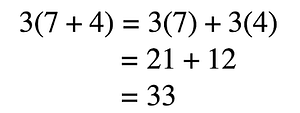
When we add two or more numbers to get the sum of their total. This property tells us that the sum of the two numbers multiplying with the third number is numerically equal to the sum of each addition of the number multiplying with the third number. It can be represented as
x × (y + z) = (x × y) + (x × z)
- Distributive Property of Subtraction
This is almost the same as the distributive property of subtraction, however, the sign of addition is replaced with the sign of subtraction. This can be expressed as
(x - y) × z = x × z - y × z

- Distributive Property of Multiplication
As in simple mathematics we know whenever we multiply a number with the sum of a number, generally we first add the numbers within the brackets and then multiplying it with the outside term of brackets. Like if we solve the expression 5 (2 + 3) = 5 (5) = 25.
But in the distributive property of multiplication, we first multiply the number with each of the numbers within the brackets and then solve the expression.
To be more clear let's take an example 5 (2 + 3) = 5 × 2 + 5 × 3 = 10 + 15 = 25.
Read More: Cross Multiplication Method of Solving Linear Equation
- Distributive Property of Division
The distributive property of division helps in dividing the larger numbers by breaking the larger numbers into the sum of smaller factors and then dividing them into the operations between them. Suppose we want to divide the number 96 by 8, then we can use the division distributive property for it.
Example: Solve 96 ÷ 8 using the distributive property of division.
Solution: The number 96 can be written as
(80 + 16)
Then, (80 + 16) ÷ 8
= (80 ÷ 8) + (16 ÷ 8)
= 10 + 2
= 12
Read More: Addition and Subtraction of Integers
Things to Remember
[Click Here for Sample Questions]
- The properties of a number can be divided into three types which are commutative property, associative property and the distributive property.
- The commutative property deals with the expression that can be achieved by addition and multiplication operations whereas the associative property is achieved by binary functions of a number.
- The distributive property is the only property that is applicable to all expressions such as addition, subtraction, multiplication and division. This is also known as the distributive law of multiplication over subtraction and addition.
- The distributive property of multiplication of numbers over addition is applied in the expression when we multiply a number with the sum of two numbers.
- The distributive property of multiplication of numbers over subtraction is applied in the expression when we multiply a number with the subtraction of the number inside the brackets.
Read More
Sample Questions
Ques. What are distributive properties in Maths? (3 Marks)
Ans. It is also known as the distributive law of multiplication, it's one of the most used properties in math. As per this property, multiplying the total of two addends by a number will give us precisely the same outcome as multiplying every number to be added exclusively by the number and then adding them together.
Ques. Verify the distributive property for the following expression: 3 × (4+8) = (3×4) + (3×8) (3 Marks)
Ans. Taking the LHS of the following expression we get
LHS: 3 × (4+8)
= 3 × (12)
= 36
Now we take the RHS of the expression, we get
RHS: (3×4) + (3×8)
=(12) + (24)
= 36
Here we see that the results of both sides are equal that's why LHS = RHS
Hence Proved.
Ques. Verify the distributive property for the following expression: 5 × (7−3) = (5×7) – (5×3) (3 Marks)
Ans. Taking the LHS of the following expression we get
LHS: 5 × (7-3)
= 5 × (4)
= 20
Now we take the RHS of the expression, we get
RHS: (5×7) − (5×3)
= (35)-(15)
= 20
Here we see that the results of both sides are equal that's why LHS = RHS
Hence Proved.
Ques. Verify the distributive property for the following expression: 7 × (6−3) = (7×6) – (7×3) (3 Marks)
Ans. Taking the LHS of the following expression we get
LHS: 7 × (6-3)
= 7 × (3)
= 21
Now we take the RHS of the expression, we get
RHS: (7×6) − (7×3)
= (42) - (21)
= 21
Here we see that the results of both sides are equal that's why LHS = RHS
Hence Proved.
Ques. Verify the distributive property for the following expression: 96÷8 = (80 + 16)÷8 (3 Marks)
Ans. Taking the LHS of the following expression we get
LHS: 96÷8
= 12
Now we take the RHS of the expression, we get
RHS: (80 + 16) ÷ 8
= (80 ÷ 8) + (16 ÷ 8)
= 10 + 2
= 12
Here we see that the results of both sides are equal that's why LHS = RHS
Hence Proved.
Ques. Solve the following equation with the use of distributive property (25) × 102 (5 Marks)
Ans. We have given the expression (25) x (102)
To solve the equation, we can use the law Distributive formula.
According to the Distributive Property, we have
P x (Q + R) = (P x Q) + (P x R)
Hence we can write the expression as
(25) x (102) = (25) x (100 + 2)
(25) x (102) = (25 x 100) + (25 x 2)
(25) x (102) = (2500) + (50)
(25) x (102) = 2550
Hence the answer of the expression (25) x (102) is equal to 2550.
Ques. Rewrite the expression 15 (10 + 15) using the distributive property formula and solve it. (3 Marks)
Ans. The distributive property formula can be expressed as,
x × (y + z) = (x × y) + (x × z)
Now, to solve it let's first multiply the outside term with both of the terms within the parenthesis,
15 (10 + 15)
= (15 × 10) + (15 × 15)
= 150 + 225
= 375
Hence, the value of 15 (10 + 15) = 375
Ques. Rewrite the expression 25 (15 + 10) using the distributive property formula and solve it. (5 Marks)
Ans. The distributive property formula can be expressed as,
x × (y + z) = (x × y) + (x × z)
Now, to solve it let's first multiply the outside term with both of the terms within the parenthesis,
25 (15 - 10) = (25 × 15)-(25 × 10)
= 375 - 250
= 125
Hence, the value of 25 (15 - 10) = 125
Ques. Solve the following equation with the use of distributive property (25) × (105) (5 Marks)
Ans. We have given the expression (25) x (105)
To solve the equation, we can use the law Distributive formula.
According to the Distributive Property, we have
P x (Q + R) = (P x Q) + (P x R)
Hence we can write the expression as
(25) x (105) = (25) x (100 + 5)
(25) x (105) = (25 x 100) + (25 x 5)
(25) x (105) = (2500) + (125)
(25) x (106) = 2625
Hence the answer of the expression (25) x (105) is equal to 2625.
Ques. Verify the distributive property for the following expression: 108 ÷ 12 = (96 + 12) ÷ 12 (5 Marks)
Ans. Taking the LHS of the following expression we get
LHS: 108 ÷ 12
= 9
Now we take the RHS of the expression, we get
RHS (96 + 12) ÷ 12
= (96÷12) + (12÷12)
= 8 + 1
= 9
Here we see that the results of both sides are equal that's why LHS = RHS
Hence Proved.
Read More



Comments