



Content Curator
A Dodecagon is defined as a polygon with 12 sides. Polygons are 2 dimensional shapes with a variety of line segments. There are several special types of dodecagons.
| Table of Content |
Polygon and its Classification
[Click Here for Sample Questions]
A polygon is a simple closed curve made up of only line segments. One can classify the polygons according to the following basis:
On the basis of number of sides or vertices:
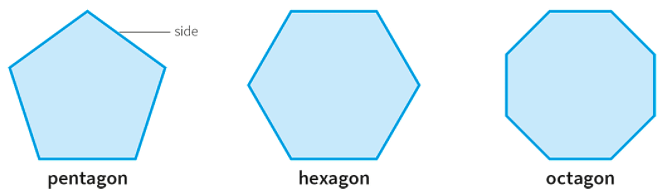
Triangle: A triangle is the most basic polygon, which has three sides.
Quadrilateral: A quadrilateral is a four-sided polygon.
We can make a six-sided polygon called a hexagon, a seven-sided polygon called a heptagon, and so on using this method.
On the basis of proportion of exterior diagonals:
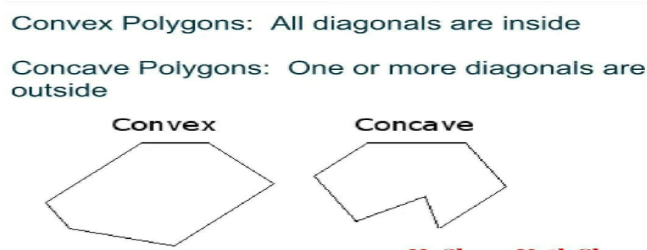
Convex polygons are those that do not have any of their diagonals on the outside. Polygons that have at least one section of their diagonals on the outside are called concave polygons. On the basis of size of the vertices and the angle between them:
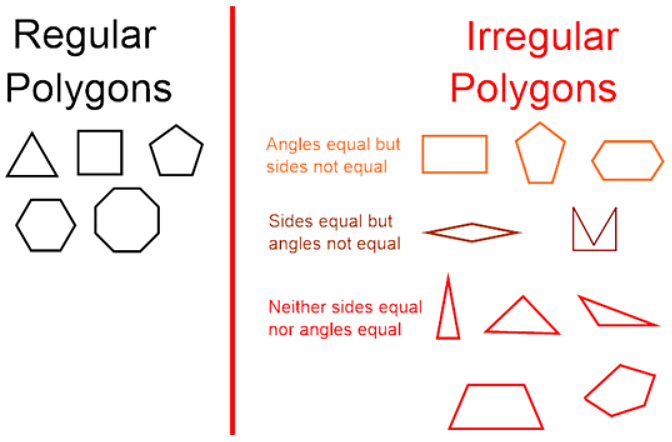
Regular Polygons: A regular polygon is one in which:
- The angle between any two vertices is the same and
- Length of each vertex is equal.
Irregular Polygons: An irregular polygon is one in which:
- The length of the sides are not equal to each other and
- The angles are not equal in measure to each other.
What is Dodecagon?
[Click Here for Sample Questions]
A dodecagon is a polygon which is 12-sided. Dodecagons can be regular in the sense that all of their inner angles and sides are the same size. They can also be irregular, with various angles and sides of varying lengths. Thus, dodecagons can be classified into several varieties based on the lengths of their sides, angles, and other characteristics.
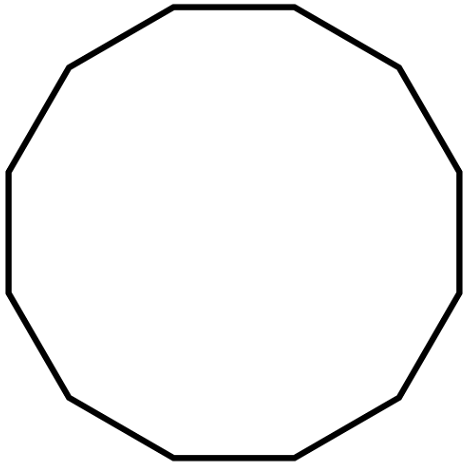
Types of Dodecagon
[Click Here for Sample Questions]
Regular Dodecagon
A regular dodecagon is a symmetrical polygon with 12 sides. The characteristics of a regular polygon are:
- All 12 sides of a regular dodecagon are the same length
- All angles of a dodecagon are equal
- The vertices are equidistant from the centre.
Irregular Dodecagon
Irregular dodecagons feature a variety of forms and angles on their sides. They all have various looks, yet they all have 12 sides.

Convex Dodecagon
A convex dodecagon is one, in which:
- there is no line segment between any two points on its boundary, which lies outside of the dodecagon.
- No interior angle is greater than 180°.

Concave Dodecagon
A concave dodecagon is one in which:
- At least one line segment can be traced between the points on the boundary that lies outside of the dodecagon.
- It has at least one interior angle that is more than 180 degrees.
Read More: Frequency Polygons
Properties of Dodecagon
[Click Here for Sample Questions]
Interior Angles of a Dodecagon
Each interior angle of a regular dodecagon is equal to 150°. The same can be represented by the following formula:
180n–360n
Where
n = the number of sides of the polygon.
In a dodecagon, n = 12. Now substituting this value in the formula, we get,
180 * (12)–360 * (12) =150°.
Note: The total of a dodecagon's interior angles can be determined using the formula .(n - 2 ) × 180° = (12 – 2) × 180° = 1800°.
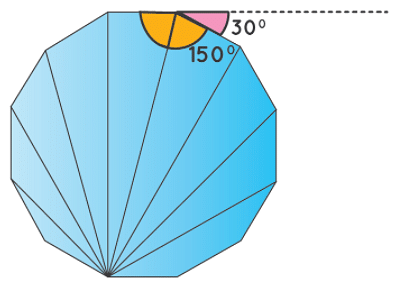
Exterior Angles of a Dodecagon
A typical dodecagon's exterior angles are all 30 degrees.
We can see that the external angle and the inner angle make a straight angle in the diagram above.
As a result, 180° - 150° = 30°.
As a result, each outside angle is 30 degrees. A normal dodecagon's external angles add up to 360°.
Diagonals of a Dodecagon
The formula for calculating the number of diagonals that can be drawn in a dodecagon from all of its vertices is:
1/2 × n × (n-3)
where
n = number of sides.
In this case, n = 12. Substituting the values in the formula:
1/2 × n × (n-3) = 1/2 × 12 × (12-3) = 54
As a result, a dodecagon has 54 diagonals.
Triangles in a Dodecagon
The diagonals drawn from the vertices of a dodecagon can be used to draw down a sequence of triangles in a dodecagon.
The formula for calculating the number of triangles formed by these diagonals is as follows:
(n - 2)
Where
n = the number of sides.
In this case, n = 12. So, 12 - 2 = 10. As a result, a dodecagon can be made out of ten triangles.
Also, read:
Perimeter of Dodecagon
[Click Here for Sample Questions]
The perimeter of a normal dodecagon can be calculated by adding all of its sides together, or by multiplying one side's length by the entire number of sides.
The following formula can be used to express this:
P = s × 12
where
s = length of the side.
Area of Dodecagon
[Click Here for Sample Questions]
The area of a regular dodecagon can be calculated using the following formula:
A = 3 × ( 2 + √3 ) × s2
where
A = the area of the dodecagon
s = the length of its side.
Things to Remember
- A polygon is any 2-dimensional shape formed with straight lines.
- Examples of polygons are square, triangle, rectangle, octagon, nonagon, dodecagon etc.
- A dodecagon is the classification of a polygon with 12 sides.
- The different types of dodecagon classified on the basis of its angles, sides and diagonals are: regular dodecagon, irregular dodecagon, concave dodecagon and convex dodecagon.
- The interior angle of a dodecagon is 150°.
- The exterior angle of a dodecagon is 30°.
- A dodecagon has 54 diagonals.
- A dodecagon can be made out of 10 triangles.
- Perimeter of a dodecagon is s x 12, where s is the length of its side.
Sample Questions
Ques. What is the measure of an interior angle of a dodecagon? [ 3 marks]
Ans. For dodecagon, the number of sides = 12
We know that the sum of all interior angles = ( 2n - 4 ) * 90
= 2 * 12 - 4 * 90
= 1800 degrees
Therefore, measure of interior angle od a regular dodecagon = sum of all interior angles / number of sides
= 1800 degree / 12
= 150 degrees.
Ques.In the given figure, ABCD is a parallelogram. Find x. [ 2 marks]

Ans. AB = DC [Opposite sides of a parallelogram]
3x + 5 = 5x – 1
⇒ 3x – 5x = -1 – 5
⇒ -2x = -6
⇒ x = 3
Ques. In the given figure, find x. [ 2 marks]

Ans. ∠A + ∠B + ∠C = 180° [Angle sum property]
(x + 10)° + (3x + 5)° + (2x + 15)° = 180°
⇒ x + 10 + 3x + 5 + 2x + 15 = 180
⇒ 6x + 30 = 180
⇒ 6x = 180 – 30
⇒ 6x = 150
⇒ x = 25
Ques, In the parallelogram given alongside if m∠Q = 110°, find all the other angles. [ 3 marks]

Ans. Given m∠Q = 110°
Then m∠S = 110° (Opposite angles are equal)
Since ∠P and ∠Q are supplementary.
Then m∠P + m∠Q = 180°
⇒ m∠P + 110° = 180°
⇒ m∠P = 180° – 110° = 70°
⇒ m∠P = m∠R = 70° (Opposite angles)
Hence m∠P = 70, m∠R = 70°
and m∠S = 110°
Ques. How many diagonals does each of the following have? [3 marks]
(a) A convex quadrilateral
(b) A regular hexagon
(c) A triangle
Ans.
(a) In Fig. (i) ABCD is a convex quadrilateral which has two diagonals AC and BD.

(b) In Fig. (ii) ABCDEF is a regular hexagon which has nine diagonals AE, AD, AC, BF, BE, BD, CF, CE and DF.

(c) In Fig. (iii) ABC is a triangle which has no diagonal.

Ques. What is a regular polygon? State the name of a regular polygon of [3 marks]
(i) 3 sides
(ii) 4 sides
(iii) 6 sides
Ans. A polygon with equal sides and equal angles is called a regular polygon.

Ques. Find the angle measure x in the following figures: [4 marks]
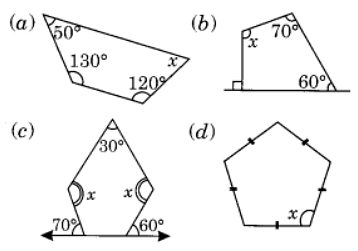
Ans. (a) Angle sum of a quadrilateral = 360°
⇒ 50° + 130° + 120° + x = 360°
⇒ 300° + x = 360°
⇒ x = 360° – 300° = 60°
(b) Angle sum of a quadrilateral = 360°
⇒ x + 70° + 60° + 90° = 360° [? 180° – 90° = 90°]
⇒ x + 220° = 360°
⇒ x = 360° – 220° = 140°
(c) Angle sum of a pentagon = 540°
⇒ 30° + x + 110° + 120° + x = 540° [? 180° – 70° = 110°; 180° – 60° = 120°]
⇒ 2x + 260° = 540°
⇒ 2x = 540° – 260°
⇒ 2x = 280°
⇒ x = 140°
(d) Angle sum of a regular pentagon = 540°
⇒ x + x + x + x + x = 540° [All angles of a regular pentagon are equal]
⇒ 5x = 540°
⇒ x = 108°
Also Read:



Comments