



Content Curator
Electron gain enthalpy is defined as the amount of energy that is released or absorbed when a neutral isolated gaseous atom accepts an electron to form a negatively charged anion. This reaction can either be exothermic or endothermic, meaning, energy can either be released or absorbed when the electron combines with the isolated gaseous atom. Greater the energy released during the combining process, higher is the electron gain enthalpy which is denoted by \(\triangle_{eg}H\). The reaction can be represented as follows.
X(g) + e- → X- (g)
Normally, exothermic reactions take place due to which electron gain enthalpy would be negative. Since halogens require only a single atom to acquire the noble gas configuration, they tend to have a highly negative electron gain enthalpy as opposed to noble gases which exhibit a highly positive electron gain enthalpy.
| Table of Content |
Key Takeaways: Electron Gain Enthalpy, Electron Configuration, Orbitals, Positive and Negative Electron Gain Enthalpy, Noble Gases, Halogens.
Electron Gain Enthalpy
[Click Here for Sample Questions]
Electron gain enthalpy is defined as the amount of energy released, when an electron is added to an isolated gaseous atom. The electron gain enthalpy is measured with the unit of KJ/ mol or electron volts per atom. Depending on the constituent elements, the reaction can either be exothermic or endothermic.
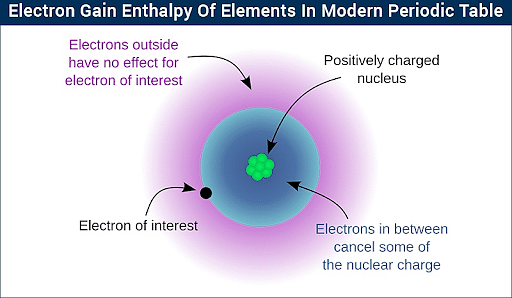
When an electron is added to a gaseous atom which has already gained an electron and achieved the stable noble gas configuration or when electrons are added to noble gases, a large amount of additional energy will be required to overcome the repulsive forces occurring due to the already present electrons in the orbitals. Thus, in this case, the electron gain enthalpy will become highly positive.
Electron Gain Enthalpy in detail
Some main group elements and their electron gain enthalpies (KJ/ mol)
| Group 1 | ΔegH | Group 16 | ΔegH | Group 17 | ΔegH | Group 0 | ΔegH |
|---|---|---|---|---|---|---|---|
| H | - 73 | - | - | - | - | He | + 48 |
| Li | - 60 | O | - 141 | F | - 328 | Ne | + 116 |
| Na | - 53 | S | - 200 | Cl | - 349 | Ar | + 96 |
| K | - 48 | Se | - 195 | Br | - 325 | Kr | + 96 |
| Rb | - 47 | Te | - 190 | I | - 295 | Xe | + 77 |
| Cs | - 46 | Po | - 174 | At | - 270 | Rn | + 68 |
The halogens (group 17 elements) have highly negative electron gain enthalpies as they can reach the stable noble gas electronic configuration by taking an electron.
The noble gases have large positive electron gain enthalpies as an electron has to move to the next higher shell which leads to the unstable electronic configuration.
These two examples indicate that there will be large negative values to the upper right of the periodic table till the noble gases.
Types of Electron Gain Enthalpy
[Click Here for Sample Questions]
The different types of Electron gain enthalpy are listed below.
Negative Electron Gain Enthalpy:
Negative electron gain enthalpy indicates negative values when the energy gets released. When halogens gain electrons, it gains stability. Halogens have a highly negative electron gain enthalpy because they show a strong affinity to reach stable noble gas configuration.
Positive Electron Gain Enthalpy:
In positive electron gain enthalpy, the element is reluctant to accept the other atom. The noble gases place the extra gained electron into the higher energy level as they have a high positive electron gain enthalpy which leads to highly reactive and unstable electronic configuration. It indicates that it has large negative values to the upper right of the periodic table foregoing the noble gases.
Factors Affecting Electron Gain Enthalpy
[Click Here for Sample Questions]
There are three factors that are affecting electron gain enthalpies:
- Nuclear charge
- Atomic size
- Electronic configuration
Nuclear charge
The force of attraction increases with the new electron when the increase in total negative charge. Also, the enthalpy turns more negative when the size of the nucleus increases.
Atomic size
The distance between the last cell and the nucleus increases when the atomic size increases. Due to this, there is a decrease in the force of attraction between the new electron and the core. Hence, it becomes less negative.
Electronic configuration
Only the elements that have half-filled or fully filled orbitals are relatively more stable. These elements undergo the addition of electrons when energy is provided to them. So, they have a higher value of electron gain enthalpy.
Electron Gain Enthalpy In Group & Period
[Click Here for Sample Questions]
Variation of electron gain enthalpy in the period: On moving from left to right across a period, the atomic size of elements decreases and the effective nuclear charge increases. Due to this the force of attraction between the nucleus and the added electron increases. Therefore, the electron gain enthalpy becomes more negative while moving left to right across a period.
Variation of electron gain enthalpy in a group: On moving down in a group, the electron becomes less negative. This is because both the atomic size and nuclear charge increases, but the effect of atomic size is more than that of nuclear charge. As a result, the attraction between the nucleus and the added electron decreases and therefore the enthalpy becomes less negative.
Exceptions in Electron Gain Enthalpy
[Click Here for Sample Questions]
Some of the exceptions in Electron Gain Enthalpy are seen in two cases as explained below.
| Case 1: The Electron Gain Enthalpy of Fluorine is Less Negative than that of Chlorine The electron gain enthalpy of fluorine is less negative than chlorine due to its small size. The electron-electron repulsion in the 2p subshell of fluorine is comparatively large. Hence the electron is not accepted easily as is the case with chlorine. Case 2: The Electron Gain Enthalpy of Noble Gases is Positive The atoms of these elements have a completely filled subshell. As a result, there is no space in their valence orbitals and the additional electron has to be placed in the next higher shell. As a result, energy has to be supplied to add on additional electrons. Case 3: Electron affinity of Sulphur is greater than Oxygen Oxygen has a small atomic size with large electron density in its atoms due to which the affinity towards electrons becomes less whereas, Suphur atoms possess a larger atomic size with less electron density and thus has more electron affinity than oxygen. |
Things to Remember
- Electron gain enthalpy is the amount of energy released when an electron is added to an isolated gaseous atom. The unit of electron gain enthalpy is KJ/ mol or KJ per Mole.
- The electron gain enthalpy of an element depends on the nuclear charge, atomic radius and electronic configuration.
- The electron gain enthalpy becomes less negative on moving down in a group.
- On moving from left to right across a period, the electron gain enthalpy becomes more negative.
- Halogens have highly negative electron gain enthalpy as they can attain the electronic configuration of noble gases by accepting an electron.
- The Electron Gain Enthalpy of Noble Gases is Positive.
Sample Questions
Ques: Identify and explain the least negative electron gain enthalpy and most negative electron gain enthalpy of the following compounds- “S, P, F, Cl”. (3 Marks)
Ans: When we move from left to right across a period, the electron gain enthalpy becomes more negative. Also, it becomes less negative when moving down in a group. There will be a greater repulsion when the electron is added to the 2p orbital than 3p orbital.
So, the Phosphorus has the least negative electron gain enthalpy and the Chlorine has the most negative electron gain enthalpy.
Ques: Which element has the highest electron gain enthalpy?. (1 Mark)
Ans: Chlorine (Cl) has the highest electron gain enthalpy.
Ques: Which element has the lowest electron gain enthalpy?. (1 Mark)
Ans: Mercury (Hg) has the lowest electron gain enthalpy.
Ques: What is the difference between electron gain enthalpy and electron affinity?. (2 Mark)
Ans: The main difference between electron gain enthalpy and electron affinity is that electron gain enthalpy is the amount of energy released when an isolated gaseous atom accepts an electron whereas electron affinity is the tendency for the isolated gaseous atom to accept the electron.
Ques: State the difference between electronegativity and electron gain enthalpy. (2 Marks)
Ans: The main difference between electronegativity and electron gain enthalpy is that Electronegativity is the tendency of an atom to attract electrons of shared pair in a chemical compound to form a covalent bond whereas when an electron is added to an isolated gaseous atom, then the amount of energy released is electron gain enthalpy. Also, electron gain enthalpy can be measured in quantitative terms but electronegativity cannot be measured in quantitative terms as it is qualitative in aspects.
Ques: Which of the following have more negative electron gain enthalpy?
(i) Cl or F
(ii) F or O (2 Marks)
Ans:
(i) Cl or F
The chlorine is more negative than fluorine because on moving down in a group, the electron gain enthalpy becomes less negative. Due to this, there will be a greater repulsion when the electron is added to the 2p- orbital than 3p- orbital.
(ii) F or O
Fluorine is more electronegative than oxygen. The nuclear charge increases and atomic size decreases as we move from oxygen to fluorine. Due to this , the force of attraction between nucleus and the received electron increases. That's why electron gain enthalpy of fluorine (F) is higher than oxygen (O).
Ques: Define ionization enthalpy and electron gain enthalpy? (2 Marks)
Ans: Ionization enthalpy- Ionization enthalpy is the energy required to remove an electron from an isolated gaseous atom (x) in ground state. It also results in the formation of a positive ion.
x(g) + Energy → x+ (g) + e-
Electron gain enthalpy- Electron gain enthalpy is the amount of energy released when an electron is added to a neutral gaseous atom (x) and results in the conversion of electron into a negative ion.
x(g) + e- → x- (g) + Energy
Ques: Define electron gain enthalpy. What are its units? (2 Marks)
Ans: The energy released by an atom when it gains an electron from outside an atom or ion to form a negative ion (or anion) is called electron gain enthalpy (?egH).
Unit of electron gain enthalpy is kJ/ mol.
In some cases, like in noble gas, atoms do not have any attraction to gain an electron. In that case energy has to be supplied.
For example,
Ne (g) + e– → Ne– (g)
\(\triangle_{eg}H\)= + 116 kJ mol -1
Ques: The electron gain enthalpy of chlorine is – 349 kJ mol-1 How much energy in kJ is released when 3.55 g of chlorine is converted completely into Cl– ion in the gaseous state. (3 Marks)
Ans: According to the definition of electron gain enthalpy, the energy released when an electron is added to an isolated gaseous atom is called the electron gain enthalpy.
Cl(g) + e– (g) → Cl– (g) + 349 kJ mol-1
So, the energy released when 1 mole (= 35.5 g) of chlorine atoms change completely with Cl– (g) = 349 kJ
Ques: The amount of energy released when 1 × 10¹⁰ atoms of chlorine in vapor state are converted to Cl– ions according to the equation. Cl (g) + e– → Cl– (g) is 57.86 × 10⁻¹⁰ J. Calculate the electron gain enthalpy of the chlorine atom in terms of kJ mol-1 and eV pet atom. (3 Marks)
Ans: The electron gain enthalpy of chlorine can be calculated as-

Ques: Although F is more electronegative than chlorine whereas the electron gain enthalpy of Cl is more negative than that of F. Why? (3 Marks)
Ans: Electronegativity decreases on moving from top to bottom in a group and therefore Cl is less electronegative than F. Electron gain enthalpy of F is less negative than Cl because of the compact size of fluorine atom (2 orbits) as compared to Chlorine atom (3 orbits). Due to this, the mutual electronic repulsion in F is more than that of Cl.
Ques: Define electron gain enthalpy. What are its units? Discuss the factors which influence the electron gain enthalpy. (5 Marks)
Ans: Electron gain enthalpy is described as the amount of energy released when an electron is added to an isolated gaseous atom.
Electron gain enthalpy is denoted by the sign \(\triangle_{eg}H\). The unit of electron gain enthalpy is KJ/ mol or KJ per Mole.
The positivity and negativity of electron gain enthalpy depends upon the nature of the element. For example, for halogens it is highly negative, because they can acquire the noble gas configuration by accepting an extra electron whereas noble gases have positive electron gain enthalpy because energy has to be supplied to the element.
Factors on which electron gain enthalpy depends:
- Atomic size- As the size of an atom increases, the distance between its nucleus and the incoming electron also increases. Therefore, the force of attraction between the nucleus and the incoming electron decreases and hence the electron gain enthalpy becomes less negative.
- Nuclear charge- As the nuclear charge increases, the force of attraction for the incoming electron increases and thus electron gain enthalpy becomes more negative.
- Symmetry of electronic configuration- Elements having symmetrical configuration have no attraction for electrons because by accepting electrons their configuration becomes less stable. In that case energy has to be supplied to accept electrons. Thus electron gain enthalpy will be positive.
Also Read:



Comments