



Content Writer
A Carboxyl group, in Chemistry, is an organic, functional group or a compound formed when the carbonyl and the hydroxyl group are bonded together by a single bond. The Carbon atom is double-bonded to the oxygen atom and single bonded with the hydroxyl atom. Carboxyl group is at times referred to as the carboxy group, carboxyl functional group, or carboxyl radical. Here we will discuss the concept in depth along with some examples and important questions. The carboxyl group is commonly written as -C(=O)OH or -COOH. Carboxyl groups ionize by releasing the hydrogen atom from the -OH group. During this process, the H+ which is a free proton is released. Therefore, the carboxyl groups make good acids. When hydrogen leaves, the oxygen atom possesses a negative charge which it shares with the second oxygen atom in the group and allows the carboxyl to remain stable even when oxidised.
| Table of Content |
Keyterms: Carboxyl group, oxygen, atom, hydrogen, acids, proton, organic compounds, butyric acid, glycerol esters
Carboxyl Group: Formula and Carboxylic Acids
[Click Here for Sample Questions]
It is one of the most important organic chemical classes. The class's general formula is R-C(O)OH. The alkyl or aryl group is represented by R in this formula. Carboxylic acids can be found in abundance in nature.
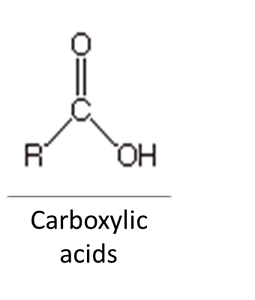
Carboxylic Acids
Carboxylic acids are compounds that have a carbon compound connected to the functional group –COOH (carboxyl group). The synthesis of a carboxyl group, on the other hand, is conceivable by attaching a hydroxyl group to a carbonyl group, hence the name "carboxyl group." Based on the group present, carboxylic acids can be classified as either aliphatic or aromatic.
Fatty acids are the upper members of the aliphatic carboxylic acids, ranging from C12 to C18. They exist in nature as natural fats or glycerol esters. Furthermore, this group serves as the precursor of a variety of important organic compounds such as esters, acid chlorides, anhydrides, and amides.
Carboxylic acid is found in a variety of natural substances. For example, formic acid can be found in insect stings, butyric acid can be found in butter, carbonic acid can be found in the bicarbonate system of blood and tissues, lauric acid can be found in coconut oil, palmitic acid in palm oil, arachidic acid in peanut oil, and stearic acid can be found in chocolate, waxes, soaps, and oils.
Also Read:
Nomenclature of Carboxylic Acids
[Click Here for Sample Questions]
This is one of the earliest classes of organic compounds to be isolated from nature. This is why many of the compounds in this class are more often known by their common names.
Common Name
- Many of the carboxylic acids' common names come from the Latin or Greek names of their natural sources. The suffix –ic acid is usually seen at the end of the common names.
- HCOOH, for example, is formic acid. The name is derived from the Latin word "Formica," which means "ant." Red ants are the source of formic acid.
- Acetic acid (CH3COOH) is found in vinegar, and the Latin name for vinegar is "acetum."
- Similarly, butyric acid, also known as butyrum in Latin, is found in rancid butter.
IUPAC Name
The IUPAC approach makes naming aliphatic carboxylic acids simple by replacing the “e” of the appropriate alkane with –oic acid. In a carboxylic acid, the carbon atom chain is numbered beginning with the carboxylic carbon. This means that the first carbon in the parent chain will always be carboxylic.
- If a product has more than one carboxyl group, the alkyl chain must be numbered.
- By adding the multiplicative prefix to the name of the parent alkyl chain, such as dicarboxylic acid, tricarboxylic acid, and so on, you can indicate the number of carboxylic acids present in the product.
- To identify the position of the Carboxyl groups (–COOH) groups in a certain compound, Arabic numerals must be written before the multiplicative prefix.
Methanoic acid is the most basic member of this type of substance, followed by ethanoic acid, propanoic acid, butanoic acid, and so on. The nomenclature of aromatic carboxylic acids, on the other hand, is not always in the conventional form. They have IUPAC-approved special names like benzoic acid.

Nomenclature of Carboxylic Acids
We can alternatively identify the compounds based on their positions and alphabetical order.

Nomenclature of Carboxylic Acids
Properties of Carboxyl Group
[Click Here for Sample Questions]
- The carboxyl group is made up of an electronegative oxygen double bond to a carbon atom. As a result, the polarity of a bond will be increased.
- A molecule with a carboxyl group has a high melting point and boiling point.
- The creation of a hydrogen bond in the solid and liquid states dissipates the rationale for high melting and boiling points. Fatty acids are a well-known example.
Applications of Carboxylic Acids
[Click Here for Sample Questions]
- Methanoic acid is a type of acid that is utilized in the rubber, textile, dyeing, leather, and electroplating industries.
- In the food sector, acetic acid is employed as a solvent as well as vinegar.
- Hexanedioic acid is utilized in the production of nylon-6, a commercially important polymer.
- In the perfume industry, benzoic acid esters are employed.
- As a preservative, sodium benzoate is also utilized.
- Higher fatty acid levels are employed in the production of detergents and soaps.
Things to Remember
- The carboxyl group has the formula R-COOH, where R is the organic compound chain.
- While naming the compounds having the Carboxyl group, if there is more than 1 atom of the carboxyl group, then the Carboxyl groups are to be numbered and the nomenclature is done based on the number of the position.
- Compounds having a Carboxyl group will have a high melting and boiling point.
- Many of the compounds formed from the Carboxyl groups are used in day-to-day life, such as Acetic acids used as Vinegar, esters of the benzoic acid used in the perfumes industry, and Sodium Benzoate used as a preservative.
Also Read:
Sample Questions
Ques. Tell the common and IUPAC name of the following structure? (5 marks)
(a) HCO2H
(b) CH3CO2H
(c) CH3CH2CO2H
(d) CH3(CH2)2CO2H
(e) CH3(CH2)3CO2H
Ans:
| Sr No. | Common Name | IUPAC Name |
|---|---|---|
| 1 | formic acid | Methanoic Acid |
| 2 | acetic acid | Ethanoic acid |
| 3 | propionic acid | Propanoic acid |
| 4 | butyric acid | Butanoic acid |
| 5 | valeric acid | Pentanoic acid |
Ques. Give three test for carboxylic acid. (3 marks)
Ans:
- In aqueous solution, the carboxyl acid turn blue litmus red.
- Carboxyl acids give a brisk effervescence with sodium bicarbonate because of the evolution of carbon-di-oxide.
- When carboxyl acid is warmed with alcohol and concentrated H2SO4, it becomes an ester, which is detected by its fruity ordour.
Ques. Why carboxylic acid does not give the characteristic reactions of a carbonyl group? (2 marks)
Ans: Carboxylic acid does not give the characteristic reactions of a carbonyl group because of the reasonance effect by the virtue of which it does not have free carbonyl group.

Ques. An organic compound (A) (molecular formula C8H16O2) is hydrolysed with dilute sulphuric acid to give a carboxyl acid (B) and alcohol (C). Oxidation of (C) with chromic acid produce (B). (C) on dehydration gives but-1-ene. Write the equations for the given reactions involved. (3 marks)
Ans: The relevant equations for the given reactions that are involved may be explained as follows:

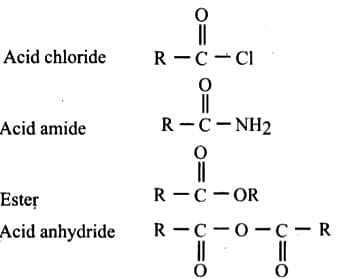
Ques. What do you mean by carboxylic acid derivatives? Give four examples. (3 marks)
Ans: Carboxylic acid derivatives are defined as the compounds in which carboxylic acid – OH group is replaced by the atom or the group.
Carboxylic acid examples:
Ques. Carboxylic acids do not give characteristic reactions to the carbonyl group. Explain why? (3 marks)
Ans: Because of the potential resonance structure, carboxylic carbon is less electrophilic than carbonyl carbon.

Ques. Give a chemical test to distinguish between benzoic acid and phenol. (3 marks)
Ans:

When NaHCO3 is added to both solutions, carbon dioxide gas is produced by benzoic acid, however, phenol does not produce CO2.
Ques. Write the structure of 2-hydroxybenzoic acid. (3 marks)
Ans:

Ques. Write the reagents required in the following reactions CH3-COOH→CH3-CONH2 (3 marks)
Ans:

Ques. Write the reactions involved in the following: (3 marks)
(i) Hell-Volhard Zelinsky reaction
(ii) Decarboxylation reaction
Ans:

For Latest Updates on Upcoming Board Exams, Click Here: https://t.me/class_10_12_board_updates
Do Check Out:



Comments