



Education Journalist | Study Abroad Lead
Energy is required for the normal functioning of cells, tissues, and other organ systems in all living things, including plants, animals, birds, insects, and people. Green plants acquire their energy from sunshine, and animals get their energy by eating these plants, as we all know. Energy is used as a fuel source. We receive energy from the food we eat as humans, but how is this energy produced and stored in our bodies? In this article, we will understand ATP, its structure, production, and functions.
What is ATP - Adenosine Triphosphate?
The cell's energy currency is known as ATP or Adenosine Triphosphate. ATP is a chemical molecule composed of phosphate groups, adenine, and sugar ribose. These molecules are in charge of providing energy to the body's different metabolic operations. ATP molecules can be found in all living species' cells. They get chemical energy from digested food and use it to power various chemical activities throughout the body. The mitochondria, known as the cell's powerhouse, is the site where ATP molecules are created.
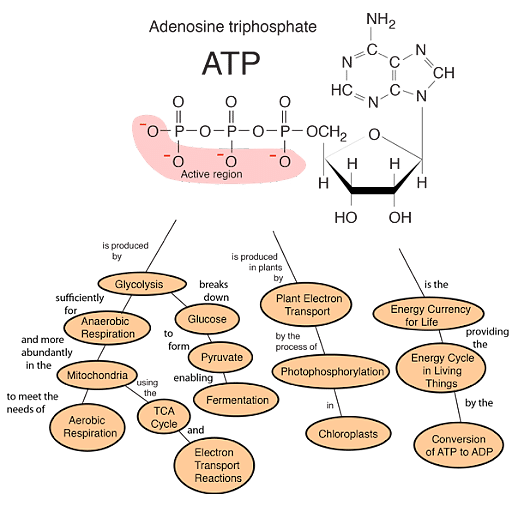
Karl Lohmann, a German chemist, was the first to discover the ATP molecule. Alexander Todd, a Scottish biochemist, created the first ATP molecule biochemically in 1948.
Structure of ATP
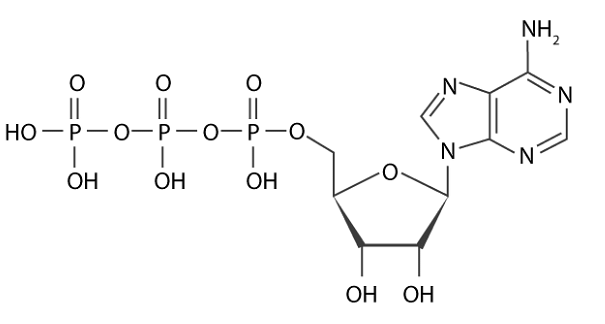
ATP Molecule
Adenosine triphosphate (ATP) is a nucleotide composed of an adenosine molecule linked to three other phosphate groups via phosphoanhydride bonds. The ATP structure is made up of three major components: sugar, adenine, and triphosphate. Condensation reactions combine all of these parts to form a single molecule. `
One of the phosphates is removed and used to release energy from ATP. When there are two phosphates left, it is referred to as ADP or Adenosine Diphosphate, and when there is only one phosphate left, it is referred to as AMP or Adenosine Monophosphate. Phosphates join via phosphoanhydride bonds in these molecules, just like ATP. The phosphoanhydride bond is broken whenever phosphate is removed.
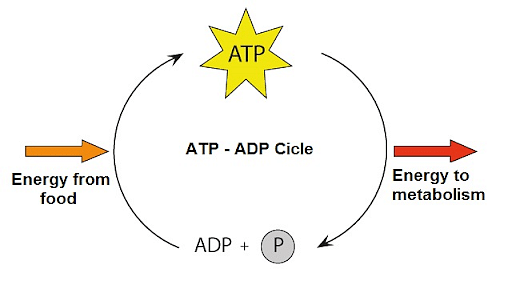
However, by forming new bonds, AMP or ADP can be converted back into ATP. As a result, there is constant energy interconversion in any living organism to regenerate and reuse ATP.

ATP Biology
ATP molecules are mostly made up of three key components.
- Ribose sugar is a pentose sugar molecule.
- Adenine, a nitrogen base, is bonded to the sugar molecule's initial carbon.
- The three phosphate groups are linked to the pentose sugar's fifth carbon in a chain.
The phosphoryl groups are referred to as alpha, beta, and gamma phosphates, starting with the group nearest to the ribose sugar. These phosphates are essential for the function of ATP.
ATP Energy
The three phosphate groups in the ATP molecule form a high-energy connection, allowing massive amounts of energy to be released when the molecule is split. Life would not be possible without the energy provided by ATP. Various enzymes and structural proteins utilize it in biosynthetic reactions, cell divisions, and other cellular processes. During cellular respiration, a digested simple molecule of food is used to create this "energy currency of the cell." After the energy is produced by the ATP molecules, it is stored in its bonds, which are then used by the cells by breaking the bonds as needed.
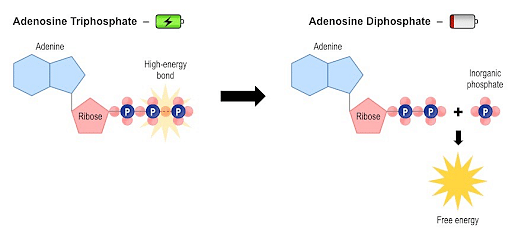
How Do ATP Molecules Produce Energy?
The three phosphate groups in this ATP molecule are referred to as high-energy bonds because they release a considerable amount of energy when broken. This molecule supplies energy for a variety of biological processes, without which life would be unable to exist.
Various enzymes and structural proteins utilize it in biosynthetic reactions, cell divisions, and other cellular processes.
Production of ATP
During cellular respiration, ATP is produced in the mitochondria and cytosol of a cell.
- The initial step in the process is glycolysis.
- It is followed by the electron transport chain.
- Then aerobic respiration occurs(which includes Kreb's cycle).
So, in total, these three procedures are required to meet the ATP generation demands. These procedures combine to form 36 ATP molecules. Each glycolysis and aerobic respiration generates two molecules of ATP. The remaining 32 ATP molecules and Kreb's cycle are produced by the electron chain transport system.
Photosynthesis in plants also results in the production of ATP. The sun's light energy is converted into chemical energy, or ATP, during photosynthesis. During the Calvin cycle, the same ATP consumption results in the formation of glucose for plant sustenance.
Functions of ATP
Energy Source
ATP is the primary energy carrier for all cellular activities. When ATP is hydrolyzed and transformed to adenosine diphosphate (ADP), energy is released. The removal of one phosphate group yields 7.3 kilocalories per mole or 30.6 kilojoules per mole under normal circumstances. This energy drives all of the reactions that occur within the cell. ADP can also be converted back into ATP, freeing up energy for other cellular reactions.
ATP can be produced in a variety of ways. Photophosphorylation is a process that is unique to plants and cyanobacteria. It is the process by which ATP is synthesized from ADP using sunlight energy. It occurs during photosynthesis. ATP is also produced during the process of cellular respiration in a cell's mitochondria. This can be accomplished through either aerobic respiration, which requires oxygen, or anaerobic respiration, which does not.

Aerobic respiration produces ATP from glucose and oxygen (along with water & carbon dioxide). Anaerobic respiration is a mechanism in which archaea and bacteria that survive in anaerobic conditions use substances other than oxygen to breathe. Fermentation is a non-oxygen-requiring method of producing ATP; it differs from anaerobic respiration in that it does not use an electron transport chain. Yeast and bacteria are two organisms that use fermentation to produce ATP.
Signal Transduction
ATP is a signaling molecule that is involved in cell communication. Kinases, which are enzymes that phosphorylate molecules, obtain phosphate groups from ATP. Kinases play an important role in signal transduction, which is the process by which a physical or chemical signal is transmitted from receptors on the cell's surface to receptors on the cell's interior. Once the signal has entered the cell, it can respond appropriately. Signals can be sent to cells to cause them to grow, metabolize, differentiate into specific types, or even die.

DNA Synthesis
Adenine is a nucleobase that is found in adenosine, a molecule made from ATP and directly inserted into RNA. GTP, CTP, and UTP. It is used to make the other nucleobases in RNA, cytosine, guanine, and uracil. Adenine is also contained in DNA, and its incorporation is remarkably similar to that of ATP, with the exception that ATP is transformed into deoxyadenosine triphosphate (dATP) before forming a DNA strand.
Importance of the ATP Molecule in Metabolism
- After each process, these ATP molecules can be recycled.
- Exergonic and endergonic processes both require energy from the ATP molecule.
- In both the central and peripheral neurological systems, ATP functions as an extracellular signaling molecule and a neurotransmitter.
- It is the only source of energy that can be used directly in a variety of metabolic processes. Before they can be used, other types of chemical energy must be transformed into ATP.
- Exocytosis, endocytosis, and motility are all part of metabolism, which also includes cellular division, fermentation, photosynthesis, photophosphorylation, aerobic respiration, protein synthesis, and exocytosis.
Related Biology Terms
- Cellular respiration: Nutrient energy is transformed into ATP.
- Signal transduction: Signal transfer from the outside to the inside of a cell.
- Hydrolysis: A reaction with water breaks a molecule's connection, allowing it to be split into smaller molecules.
- Kinase: A phosphate transfer enzyme that takes a phosphate group from ATP and transfers it to another molecule.
Things to Remember
- The cell's energy currency is known as ATP or Adenosine Triphosphate.
- ATP is a chemical molecule composed of phosphate groups, adenine, and sugar ribose.
- Adenosine triphosphate (ATP) is a nucleotide composed of an adenosine molecule linked to three other phosphate groups via phosphoanhydride bonds.
- During cellular respiration, ATP is produced in the mitochondria and cytosol of a cell.
- ATP is the primary energy carrier for all cellular activities.
- ATP is a signaling molecule that is involved in cell communication.
- It is used to make the other nucleobases in RNA, cytosine, guanine, and uracil.
- In both the central and peripheral neurological systems, ATP functions as an extracellular signaling molecule and a neurotransmitter.
Sample Questions
Ques. How much ATP do humans utilize daily? 1 mark
Ans. Humans consume between 100 and 150 mol/L of ATP daily.
Ques. Which foods have a lot of ATP energy in them? 1 mark
Ans. Eggs, bananas, brown rice, fatty salmon, seeds, and other nutrient supplements all supply a lot of ATP energy to the body.
Ques. What does the word "energy currency" mean? In plants and animals, what substance serves as an energy currency? 5 marks
Ans. The chemical that delivers energy for cellular processes whenever it is needed is referred to as energy currency. Because the energy is available in the form of high energy bonds in ATR, ATP is referred to as an energy currency. CTP, GTP, UTR, and other energy-producing molecules are examples.
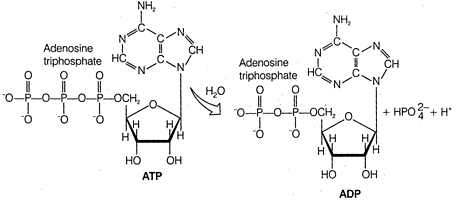
The energy yielded by converting ATP to ADP is approximately 7.3 kcal/mol. This is the source of energy for a wide range of biological processes in both plants and animals. The phrase 'energy currency' for ATP can be justified as follows:
- Minimize energy waste by storing little packets of energy as soon as they become available.
- Energy can be made available to a spot in the cell that is far away from where it is produced.
- Can perform significant work/activities by accumulating a large amount of energy and providing it continuously.
Ques. What is ATP? 2 marks
Ans. ATP is the cell's energy currency (Adenosine triphosphate). During a biological process, some of the energy is kept in ATP as chemical energy rather than being liberated as free energy. When a cell requires energy, the phosphate bonds in ATP are broken. It is used in a variety of energy-intensive cell processes.
Ques. In a plant system, how many ATP molecules are produced during the complete oxidation of 40 moles of glucose? 2 marks
Ans. The oxidation of a glucose molecule results in the production of over 38 molecules of ATP. So 40 glucose molecules provide 40*38= 1520 ATP molecules.
Ques. What is the amount of energy required to convert ADP to ATP? 2 marks
Ans. An adenine ring, a ribose sugar, and three phosphate groups make up adenosine-5'-triphosphate (ATP). In the cell, ATP is frequently employed for energy transmission. ADP or AMP + Pi are converted to ATP by ATP synthase. 7300 cal/mole of energy is spent during the conversion of ADP to ATP.
Ques. What is ATP's Function? 5 marks
Ans. The functions of ATP are:
- After each reaction, the ATP molecules can be reprocessed.
- Both exergonic and endergonic processes rely on the ATP molecule for energy.
- Adenosine triphosphate (ATP) is a signaling molecule found outside of cells.
- In both the central and peripheral neural systems, it functions as a neurotransmitter.
- It is the only source of energy that can be used directly in a variety of metabolic processes. Before they can be used, other types of chemical energy must be transformed into ATP.
- Metabolism – A life-sustaining chemical reaction that includes cellular division, fermentation, photophosphorylation, photosynthesis, protein synthesis, aerobic respiration, endocytosis, exocytosis, and motility – plays a crucial role.
The basic purpose of ATP is to store and distribute energy to body cells continuously.



Comments