



Content Curator
Factors of 100 can be formed when two numbers are multiplied in pairs, resulting in 100. To know what the factors of 100 are, the following can be said:
- A factor "y" of a number "x" is only called a factor when "y" is a natural number and can completely divide the number "x" without leaving a remainder.
- If we look at one of the basic factors of 100, it is 1 × 100.
- Hence we can say 1 and 100 are two factors 100.
Thus, the factors of 100 are 1, 2, 4, 5, 10, 20, 25, 50 and 100.
| Table of Content |
Key Terms: Prime Factorization, Factor Pairs, Prime Number, Prime Factors, Pair Factors
Factors of 100
[Click Here for Sample Questions]
When two numbers are multiplied and they result in 100, then those two numbers will be called factors of 100.
- Thus, the factors of 100 are: 1, 2, 4, 5, 10, 20, 25, 50 and 100.
- This method of factor calculation is called the pairing method.
- The factors of 100 are simply those numbers which divide 100 without leaving a remainder.
- The factorization method is used in order to determine the factors of 100. Here, the numbers 1 to 100 are taken as factors of 100.
- Then, the other pair multiples of 100 are determined, giving the result in form of an original number.
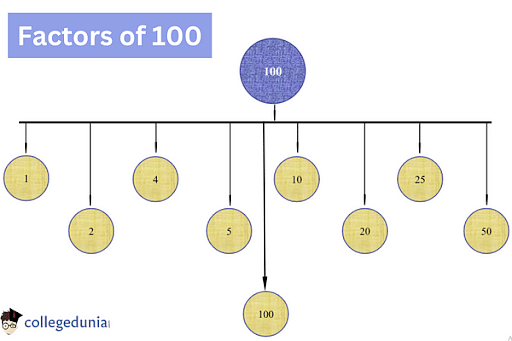
Factors of 100
Read Also:
| Topic Related Concepts | ||
|---|---|---|
| Factors of 25 | Factors of 16 | Factors of 48 |
| Factors of 21 | Co-Prime Numbers | Quotient |
Factors of 100 in Pairs
[Click Here for Sample Questions]
Pair factors refer to the pair of number multiplication, which will result in 100.
- The pair factor can not only be in positive form but also can be in negative form.
- This is because the multiplication of two negative numbers results in a positive number.
- To calculate the negative factors of 100, a negative sign is put in front of the already paired positive factors.
The factor of 100 can be shown as:
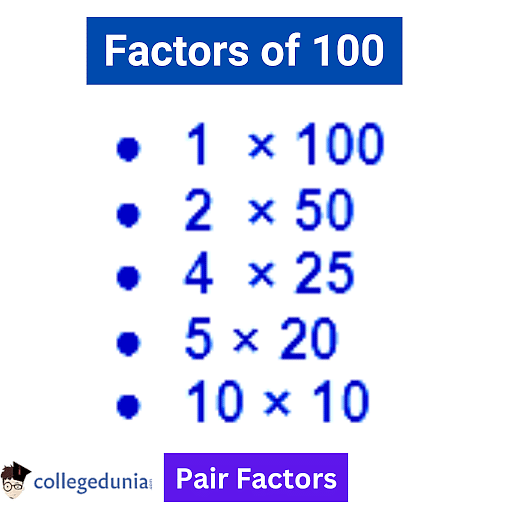
Pair Factors of 100
Note: It is important that both the factors have a negative sign; otherwise, the multiplication will result in a negative number.
| Positive Pair factors of 100 | Negative Pair factors of 100 |
|---|---|
| 1 × 100 = 100; [1,100] | -1 × -100 = 100; [-1, -100] |
| 2 × 50 = 100; [2,50] | -2 × -50 = 100; [-2,-50] |
| 4 × 25 = 100; [4,25] | -4 × -25 = 100; [-4,-25] |
| 5 × 20 = 100; [5,20] | -5 × -20 = 100; [-5,-20] |
| 10 × 10 = 100; [10,10] | -10 × -10 = 100; [-10,-10] |
Prime Factorization of 100
[Click Here for Sample Questions]
Prime factorization refers to expressing a number, i.e. 100, with respect to only its prime factors. It can be done in the way shown below.
Step 1: Divide the number using the smallest prime number, which can divide the number without leaving a remainder.
100 ÷ 2 = 50
Step 2: Then again, divide the result, i.e. 50, by the smallest prime number possible.
50 ÷ 2 = 25
Thus, the LCM of the number is calculated. So in this way, the prime factors of 100 are obtained. Thus, 2 × 2 × 5 × 5 = 100. Hence, the prime factors of 100 are 2 and 5.
Also Read:
| Chapter-Related Topics | ||
|---|---|---|
| HCF | Relation Between HCF and LCM | Properties of LCM and HCF |
| LCM of Two Numbers | Addition and Subtraction of Integers | LCM Formula |
Factor Tree of 100
[Click Here for Sample Questions]
The factor tree of 100 can be shown as:

Factor tree of 100
Factors of 100 by Division Method
[Click Here for Sample Questions]
Another method to find factors of 100 is by the division method. If any integer divides 100 with a remainder as 0, then the number can be called a factor of 100.
- 100 ÷ 1 = 100
- 100 ÷ 2 = 50
- 100 ÷ 4 = 25
- 100 ÷ 5 = 20
- 100 ÷ 10 = 10
- 100 ÷ 20 = 5
- 100 ÷ 25 = 4
- 100 ÷ 50 = 2
- 100 ÷ 100 = 1
Thus we get the factors of 100 as 1, 2, 4, 5, 10, 20, 25, 50 and 100.
Factorizing 100 Using Divisibility Rule
By using the Divisibility rule:
- 100 is completely divided by 2, so 2 is a factor of 100.
- It is not a factor of 3 because 100/3 leaves a remainder of 1.
- The divisibility rule of 4 says that if the last two digits of a number can be divided by 4, then the whole number can also be divided by 4. Thus, 4 is one of the 100 factors.
- If a number ends in 0 or 5, it can be divided by 5. This means that 5 is a factor of 100.
- To figure out if 100 is divisible by 6, it needs to be divisible by both 2 and 3. As we've already seen, 100 is not divisible bysix3, so 6 can't be a factor.
- Here, it is easier to try to divide 100 by 7 than to see if 7 is divisible by 2. This serves as a remainder that 100 is not divided by 7.
- The 8-test tells us to check if the last three digits of a number are divisible by 8. So, we have to divide 100 by 8 to see if 8 is a factor, and when we do that, we get a remainder. So, 8 can't be a factor of 100.
- Since 3 is a factor of 9, and 3 is not a factor of 100, neither is 9.
- 100 ends in 0, hence 10 is a factor of 100.
Factor Group
[Click Here for Sample Questions]
A factor group is a mathematical group made up of parts of a larger group related to each other. Using a relation of equality can help keep the group's structure.
- For instance, the cyclic group of addition mod n may be constructed from the group of numbers.
- Also, by finding elements which vary by a multiple of n and thus making a group structure.
- Each of these classes is treated as a separate unit.
- It is made up of a branch of mathematics called "group theory."
- When a group is divided by itself, the input's equivalence class is a normal subset of that group.
- The term "quotient group" for A/B comes from dividing integers.
- When you divide 15 by 3, you get the number 5 because 15 elements are divided into five groups of 3 things each.
- The same method is used for the quotient group, but instead of an integer as the final answer; we get a set because groups are more organized than a random collection of items.
- The group framework is used to create a natural "regrouping" when looking at A/B, where B is a normal subgroup of A.
- But since we started with a group and a normal subgroup, the final quotient is more than just the number of co-sets.
- Thus it also has the structure of a group.
Things to remember
- The factors of 100 are 1, 2, 4, 5, 10, 20, 25, 50 and 100
- The pair factors of 100 give the value 100 on multiplication with each other.
- The prime factorization of 100 is 2 x 2 × 5 x 5 = 100
- There are two prime factors of 100, which is 2 and 5.
- The sum of all factors of 100 is 217.
Sample Questions
Ques. Is six a factor of 100 or not? Give reasons. (1 Mark)
Ans. To find out whether 6 is a factor of 100 or not, we need to divide 100 by 6.
100 ÷ 6 = 16.67
Thus, 6 is not a factor of 100 as it leaves a remainder.
Ques. How many prime factors does 100 have? (1 Mark)
Ans. 100 has two prime factors, which are 2 and 5.
Ques. What are the factors of 100? (2 Marks)
Ans. The factors of 100 are as follows:
- 100 ÷ 1 = 21
- 100 ÷ 2 = 50
- 100 ÷ 4 = 25
- 100 ÷ 5 = 20
- 100 ÷ 10 = 10
Thus, the factors of 100 are 1, 2, 4, 5, 10, 20, 25, 50 and 100.
Ques. Find out the Greatest Common Factor between 100 and 25. (2 Marks)
Ans. First, we will write down all the factors of 100 and 25:
- Factors of 100: 1, 2, 4, 5, 10, 20, 25, 50 and 100.
- Factors of 25: 1, 5 and 25
Thus, the common factors of 100 and 25 are 1, 5 and 25. Therefore, the Greatest Common Factor of 100 and 25 is 25.
Ques. What are the common factors of 100 and 80? (2 Marks)
Ans. First, we will write down all the factors of 100 and 25:
- Factors of 100: 1, 2, 4, 5, 10, 20, 25, 50 and 100.
- Factors of 80: 1, 2, 4, 5, 8, 10, 16, 20, 40 and 80.
Thus, the common factors of 100 and 80 are 1, 2, 4, 5, 10, and 20.
Ques. Five girls bought 100 chocolates from a shop and distributed them among themselves equally. How many chocolates will each one of them get? (2 Marks)
Ans. There is a total of 100 chocolates that are to be divided among five girls equally.
It means that we need to divide 100 by 5
100 ÷ 5 = 20
Thus, each of the girls will get 20 candies.
Ques. What is the sum of all prime factors of 100? (2 Marks)
Ans. We know that the factors of 100 are 1, 2, 4, 5, 10, 20, 25, 50 and 100.
Adding up the factors, we get
1+2+4+5+10+20+25+50+100 = 217
Thus, the sum of the factors of 100 is 217.
Ques. List the pair factors of 100. (2 Marks)
Ans. The pair factors of 100 are as follows:
- Positive pair factors of 100: (1, 100); (2,50); (4,25); (5,20) and (10,10)
- Negative factors of 100: (-1,-100); (-2,-50); (-4,-25); (-5,-25) and (-10,-10)
Ques. Here are a few numbers- 1, 5, 6, 8, 9, 25. Find the number which is not included in the factors of 100. (2 Marks)
Ans. The numbers that divide 100 completely are the factors of 100, so
1, 2, 4, 5, 10, 20, 25, 50 and 100 are the factors of 100, but when we divide 100 by 6, 8, and 9, it leaves a remainder.
As a result,1, 5, and 25 are factors of 100, but 6, 8, and 9 are not factors of 100.
Ques. Rahil throws his birthday party at his house. He invited 100 friends from his class to the party. He wants to divide them into groups for a game. How will he arrange it so that no child is left out? (3 Marks)
Ans. Here, we will use the concept of factors of 100 as there is a total of 100 children.
The factors of 100 are 1, 2, 4, 5, 10, 20, 25, 50 and 100.
Thus, the children can be arranged only in one way, which is by dividing 100 by its factor 10.
100 ÷ 10 = 10
Thus, there would be ten groups with ten children each.
Check-More:



Comments