



Content Curator
Filtration is a chemical process that is used to separate solids from liquids or gases with the use of a filter paper or filtering device. The filter is essential for allowing the easy passage of the liquid but not the solid particles that are present in the liquid. The fluid that we get after the filtration is known as Filtrate. The solid particles are larger in size than the pores in the filter and will not pass through it and can be discarded as the extra remains of the filtration process. The most common form of filtration is known as Gravity Filtration. The suspension to be filtered is called Slurry and the porous medium used to retain the solids is known as the filter medium.
| Table of Content |
Read Also: Three States of Matter
Filtration Definition and Explanation
Filtration is a form of physical separation technique that is used to separate mixtures but can not be used to separate chemical compounds. It is considered one of the simplest separation processes used to separate an insoluble solid from a liquid. In order to do so, we required a filtering medium where the solids are deposited and liquids get deposited as the end product. The filter acts as a medium that is permeable only to the liquid, it retains all the solid particles and allows only the solid to pass through it. If we do more filtration using the same filtering medium, the solid particles that are collected on the filter form a packed bed of solid molecules known as a filter cake. The thickness of this filter cake is directly proportional to the resistance of the flow of filtrate and inversely proportional to the rate of filtration.

Filtration Procedure
Process of Filtration
Filtration takes place when the pores of the filter medium are smaller than the size of particles to be separated. Therefore, the filter medium resists the solid particles and allows the fluid to pass. The filter cakes also resist some slurry and act as a secondary filter.
- Step 1: Put soil and water mixture in a glass beaker.
- Step 2: Take a small piece of filter paper and shape it like a cone and place it at the bottom of the funnel.
- Step 3: Now pour the mixture through the filter funnel.
- Step 4: It'll be observed that the soil particles remain on the filter paper and the rest of the liquid has been filtered down.
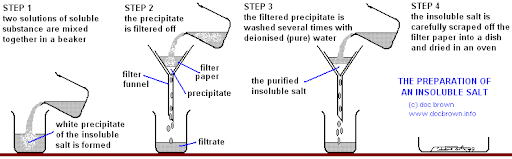
Steps of Filtration
Read More: Intermolecular Forces
Types of Filtration
- Sedimentation: It is the process of separating the insoluble solid from the liquid. Heavier solid particles in the liquid settle down in the beaker after some time.
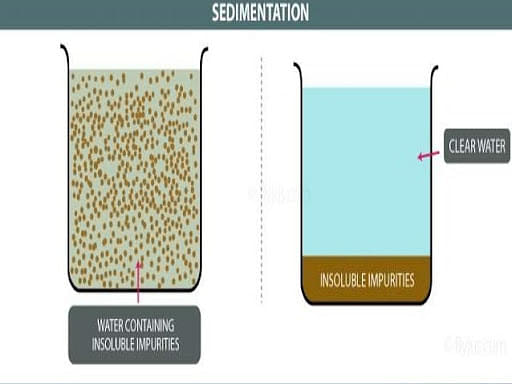
Sedimentation
- Distillation: This method is used when mixtures consist of two or more pure liquids. The round bottom flask contains the liquid mixture which is heated at very high temperatures. When the water starts boiling, components with lower boiling points get vaporized and will move through the condenser and get collected as a distillate, which is the pure liquid.
Read Also: Melting and Boiling Point

Distillation
- Evaporation: This method involves evaporating the solvent in the mixture. The solution is heated until the organic solvent evaporates as gas and leaves behind the solid residue.

Evaporation
- Decantation: It is the process by which a clear liquid obtained after sedimentation is transferred into another container without disturbing the settled particles.
Read More: Vapour Pressure

Decantation
Uses of Filtration
- The filtration process is used during the production of sterile products by passing air through HEPA to obtain sterile air and production of bulk drugs.
- It is an important step in the production of oral liquids, dewaxing of oils, and removal of suspended oils.
- In our daily lives, filtration is done through coffee filters, tea bags, water filters, automotive filters, and belt filters used in industrial machines.
- Air conditioning units use HEPA filters to remove dust particles from the outside air.
- Wastewater management - Waste and harmful solids are separated from the liquid prior to its disposal.
Drawbacks of Filtration
The most well-known disadvantage of filtration is that it removes useful minerals that are present in the liquid. On the contrary, it doesn't remove all the harmful particles present in the liquid. The filters can't be reused again and have to be discarded after the filtration process. Since the particles filtered out can be harmful, openly disposing of the filters can be further harmful to the environment and the surroundings.
Points to Remember
- Filtration is the process to separate mixtures present in liquids.
- It can not be used to separate chemical compounds.
- It required an additional component that served as the filtering medium.
- The thickness of the filter cake increases with the rate of filtration.
- The filtrate is a pure liquid.
Sample Questions
Ques 1: Out of the following options, which can be separated by the process of filtration? (1 Mark)
- Salt in water
- Pulses in water
- Oil in water
- Sugar in water
Ans. Filtration is used to separate solids from liquids. Since salt and sugar have the tendency to dissolve in water and oil partially dissolve, they can't be separated. Pulses are hard insoluble substances and thus could be separated by filtration.
Read More: Dispersion Forces
Ques 2: If a small amount of chemical compound is dissolved in a half-filled tumbler of water. Which method would be used to get back the solid from the chemical solution? (1 Mark)
- Boiling and Evaporation
- Evaporation and saturation
- Evaporation and condensation
- Condensation and saturation
Ans. The water droplets on the inner surface of the tumbler were formed as a result of evaporation and condensation.
Ques 3: If person X asked for a glass of water from Y. X gave Y a glass of icy cold water but Y observed some water droplets on the outer surface of the glass and inquired about it. Which of the following would be X's answer? (2 Marks)
- Evaporation of water from the glass
- Water that overflowed from the glass
- Evaporation of atmospheric water vapor
- Condensation of atmospheric water vapor
Ans. Due to the condensation of atmospheric water vapor water droplets are formed on the glass. The warm water vapors in the air coming in contact with the cold water vapor lose energy and are converted to a liquid state.
Ques 4: Which of the following options is False? (1 Mark)
- Water can be separated from salt by evaporation.
- A mixture of iron fillings can be separated by a magnet.
- A mixture of oil and water can be separated by filtration.
- A mixture of tea leaves and milk can be separated by decantation.
Ans. A mixture of oil and water can be separated by filtration.
Ques 5: Differentiate between sedimentation and decantation. (2 Marks)
Ans. Sedimentation is the process by which insoluble solids suspended in a liquid are separated by allowing them to settle. Whereas, Decantation is the process of pouring out the clear upper liquid from a solution without disturbing the sediments.
Ques 6: What is filtration? Give two common examples of filtration. (2 Marks)
Ans. Filtration is the process of separating insoluble solid impurities from a liquid by passing it through a filtering device. Insoluble solid particles are retained in the filtering device but the liquid passes through it. For example- Filtration of tea leaves after preparation of tea using a strainer, and filtration of water to remove solid impurities.
Ques 7: Condensation takes place only when (1 Mark)
- water vapour hits a cold surface
- water vapour hits a hot surface
- a hot surface hits a warm surface
- water is heated
Ans. (a) water vapour hits a cold surface
Condensation is the process by which water vapour condenses to form a liquid, and this happens when water vapour hits a cold surface.
Ques 8: Name the process of separating two immiscible liquids. (1 Mark)
Ans. The process of separating two immiscible liquids is known as Decantation.
Check out the Relatable Links:



Comments