



Exams Prep Master
Silk is made from the fibres of the silkworm, and is therefore a natural protein fibre. It is strong and durable, yet soft and lustrous. Silk is also hypoallergenic, making it a good choice for people with sensitive skin. This is a temperature regulator, so it keeps you cool in summer and warm in winter. It is also absorbent, so it can wick away sweat and moisture. And silk is a great insulator, so it can help you save on energy costs. Silk is also a low-maintenance fabric. It is easy to care for, and doesn't require special treatment. You can machine-wash silk on a gentle cycle, and it will air-dry quickly.
| Table of Contents |
Key takeaways: silk, silkworm, silk structure, silk fibres,cocoon, mulberry silk, tasar silk, eri silk.
How is Silk Made?
[Click Here for Sample Questions]
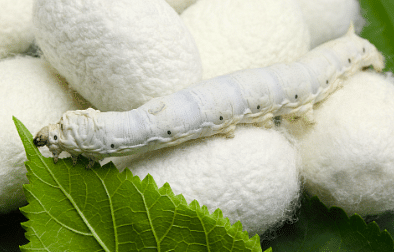
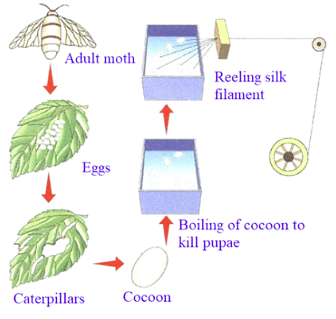
- The process of making silk is long and complicated, but it all starts with the silkworm. The silkworm is a caterpillar that feeds on mulberry leaves. Once it has reached a certain size, it spins a cocoon around itself and inside of this cocoon, the silkworm goes through metamorphosis and becomes a moth.
- To harvest the silk, the cocoons are boiled, which kills the moth inside. The cocoons are then unwound to reveal long, continuous silk fibres. These fibres are then woven or knitted into fabric.
- There are many different types of silk with varying degrees of quality. The most common type of silk is called mulberry silk, which is what the silkworm feeds on. There is also tussah silk, which is made from silkworms that feed on oak leaves, and bombyx silk, which is made from domesticated silkworms.
- The quality of the silk also depends on how many silkworms are used to make one cocoon. If only one silkworm is used, the resulting silk is called gansey silk. This silk is the highest quality because it is the strongest and most lustrous. If two or more silkworms are used.
Also read: Variety in Fabrics
How is Silk Obtained from the Cocoon?
[Click Here for Sample Questions]
- Silkworms produce silk fibres at their larva stage. The larvae weave a cocoon in two or three days to protect themselves as they develop into pupae.
- Silk is obtained before the adult moth matures and is extracted from the cocoons while they are in its pupa stage.
- The farmer submerges these cocoons in boiling water to soften up all of the layers of this protective layer around them and process secures loose silk strands inside it that are then brushed by workers so that there are no knots left and can be spun together with other threads for use as yarns for future uses like clothing fabrics or even medical suturing devices.
- At the larva stage silkworms produce strands of a material called silk. The larvae spin cocoons to protect themselves for the development into pupae. Silk is obtained from these worms before they become adult moths.
- Furthermore the only fibres in its pupa stage, they submerge its cocoons in boiling water to soften the layers of it’s cocoon and brush them away with brushes that are used by workers who reel those strands into a continuous string that has been twisted together and wrapped around spools after each other until it becomes yarn of threads which are then dyed or woven as desired for specific purposes.
Also read: Extraction of wool
What is the Silk Structure?
[Click Here for Sample Questions]
Silk is made up of protein fibres namely, 70% of fibroin and 30% sericin. These two proteins are produced by the mulberry silkworms who spin them in their cocoon. Fibroin consists mainly of long chain amino acids, Gly-Ser-Gly-Ala-Gly-Ala which form beta keratin chains. The coating on these chains from sericin results in high tensile strength within the strands as well as between strands through hydrogen bonding between groups that creates large forces with a strong structure for holding together different parts to make silk resistant against twisting or breaking under tension loads.
The relationship between structure and property is one of the most intriguing ‘mysteries’ about silk fibres. Various studies have suggested that there is a very strong connection between the structures of silk fibres and their mechanical properties, for example. And to understand this relationship requires knowledge on local structure including components and composition conformation or orientation with respect to fibres type – as well as other factors.
Read more: Spinning of cotton yarn
Types of Silk Fibres
[Click Here for Sample Questions]
Different types of silkworms produce different types of silk. Quality differs based on the chemical composition, and there are two main varieties – natural which is obtained from cocoons; or artificial (from wood pulp), such as rayon. Here are some examples:
- Mulberry Silk – It is the most substantial textile and very soft and durable fibres.
- Eri Silk- Another name for Eri Silk is peace-silk because its production does not include killing any silkworm at all. This variety of silks are heavier than mulberries ones but more enduring in comparison to them as well.
- Tasar Silk- Indian natives produce this type located near India’s north-east region, specifically Assam in Eastern India where it’s grown by Green Silk moths known locally as Tasar Silk.
- Spider Silk- This is an expensive variety that manufacturers used to make microscopes etcetera. with other things like bulletproof vests too.
- Muga Silk- This variety of fabric is made from semi-domesticated silkworms, which are found in Assam.
- Sea Silk- Another name for sea silk is mussel silk because it is made by Mediterranean mussels.
- Coan Silk- The coan kind of cloth consists of the raw fibres with protective coating that has been dissolved off and spun into yarn through a process called degumming. We can find this type in Greece, Turkey and Italy as well.

Also read: Cotton cultivation
Advantages of Silk Fibres
[Click Here for Sample Questions]
Silk is a natural material that is both breathable and durable.
Here are some more benefits of silk:
- Silk is an antibacterial material, resisting bacteria found in sweat or water.
- Silk helps with personal hygiene by wicking away dirt and sweat from the skin.
- Silk can improve the body's circulation, helping with discomfort from conditions like arthritis.
- Silk is an elegant fabric that has been used for centuries to make clothing and other items. It is made from the cocoons of silkworms and is prized for its softness, strength, and shine.
- Silk is also a natural fabric, which means it is very breathable and helps regulate body temperature. Additionally, silk is a durable fabric that resists wrinkles and fading.
- Silk is a natural fabric that is very breathable, helping to regulate body temperature.
- Silk is a strong and durable fabric that resists wrinkles and fading.
- Silk is a luxurious fabric that has a softness and shine that is unmatched by other fabrics.
Disadvantages of Silk Fibres
[Click Here for Sample Questions]
- The development of silk requires the existence of thousands of silkworms.
- It requires more land to create silk than cotton, which is more costly.
- They are more costly and can get costly contingent upon the grade.
- They are more challenging to dye. Silk needs more work concentrated work to deliver yet can endure up to multiple times how much season of other dress materials.
- Silk is one of the most costly textures available. Contrasted with cotton or nylon, silk is expensive.
- Silk ties or silk sheets cost altogether more than cotton partners as a result of the texture's rich appearance and the trouble in its assembling. Silk is viewed as an extravagance item; hope to pay something else for it.
- Silk is more hard to really focus on than different textures. Cleaning is by and large the favoured technique for cleaning silk.
- Silk can't be dyed or absorbed prewash items. All silk things should be air dried and steam pressed on a low setting. Wringing or contorting silk pieces of clothing can demolish and for all time harm the apparel.
Things to remember
- Silk is incredibly strong, yet also incredibly light and delicate. It’s been used for everything from clothing and accessories to parachutes and tires.
- Silk is also hypoallergenic, making it a good choice for people with sensitive skin. This is a temperature regulator, so it keeps you cool in summer and warm in winter. It is also absorbent, so it can wick away sweat and moisture.
- The silkworm is a caterpillar that spins a cocoon around itself in order to transform into a moth. The cocoon is made of a single continuous thread of silk fibre, which can be up to a kilometre in length.
- Silk is also a low-maintenance fabric. It is easy to care for, and doesn't require special treatment. You can machine-wash silk on a gentle cycle, and it will air-dry quickly.
- The threads are collected by sticky hairs on its head and then wrapped around itself to form its cocoon, an amazing feat for such a small creature.
- Moths emerge from their cocoons after shedding their final layer- useless insect skin as they turn into beautiful flying creatures ready to explore the world without any limitations.
- The worm has a series of tubes that carry silk fluid. It also has some spigots with which it can release the right amount of silk.
Sample Questions
Ques: How much time does the production of silk take? (3 marks)
Ans: The course of silk creation is known as sericulture. The whole presentation cycle of silk can be separated into a few stages which are commonly dealt with by various entities.[clarification needed] Extracting crude silk begins by developing the silkworms on mulberry leaves. When the worms begin pupating in their covers, these are broken down in bubbling water for individual long filaments to be separated and taken care of into the turning reel.
To create 1 kg of silk, 104 kg of mulberry leaves should be eaten by 3000 silkworms. It takes around 5000 silkworms to make an unadulterated silk kimono.
Ques: How would you explain the chemical composition of silk? (4 marks)
Ans: During the time spent winding around a cover, the silkworm insider facts Silk which is composed of two critical regular proteins, in particular, sericin and fibroin. Silk structure mostly comprises fibroin, which is an insoluble protein. Sericin and Fibroin are in the proportion of 30:70 by mass. During the arrangement of silk, the discharged Fibroin is covered with a layer of Sericin. Fibroin protein structure has layers of against equal long-chain amino acids with its rehashing unit as (Gly-Ser-Gly-Ala-Gly-Ala) . Sericin structure has different kinds of amino acids with serine having the greatest rate. The covering of sericin brings about intramolecular and intermolecular hydrogen holding between the amino corrosive gatherings, which gives huge powers of fascination. It brings about high rigidity and paste like construction of the silk fibres.
Ques: What are the alternatives fibres to silk? (2 marks)
Ans: Elective filaments to silk are cotton, rayon, thick, and fleece. Which are likewise perfect because of multiple factors, like cotton for permeable ness, or rayon for its intensity and receptiveness. gooey for its solace, and fleece for its solidness.
Ques: How much silk clothing is important for the people in India and how? (2 marks)
Ans: A decent agent of the significance India has on the creation of silk is that there is a particular celebration in India that is called Pongal. A period where they express appreciation for the reap and perceive bullocks, the creatures that were the foundation of the farming practice in India and are not utilized in this way any longer.
Ques: Does silk give rise to allergies? (3 marks)
Ans: This very delicate material not just wards off allergens, it likewise alleviates touchy skin. Silk is a strong decision for individuals with sensitivities. Since a silkworm turns silk strands in a case, the silk is normally intended to protect the worm from hunters — like residue mites.2 However, silk sheets can be difficult to really focus on and ordinarily are the most extravagant hypoallergenic choice. Silk is normally sensitivity free. Be that as it may, certain individuals might have a hypersensitive response to the colour utilized.
Ques: How is silk obtained from the rearing of silkworms in the process of sericulture? (4 marks)
Ans: A rancher produces silk through the course of sericulture. The silk fibre is obtained from the raising of silkworms. A female silk moth lays numerous eggs all at once. The gatherer keeps these eggs at a warm temperature of 75 to 85 degrees Fahrenheit as long as fourteen days. The rancher needs to take great consideration of these sensitive hatchlings and feed them mulberry leaves. Whenever they are a month old, they start to turn casings of silk strands by their skin organ. The rancher doesn't upset them during their fourteen days of transformation stage. If not, advancement may not happen. The cases are presented to high intensity so the upper layers of the covers mellow. The high-temperature empowers the rancher to isolate the silk filaments from the case. The most common way of separating silk strings from the case is known as reeling of silk.
Ques: What is the difference between natural silk and artificial silk? (4 marks)
Ans: The natural silk is the silk that is delivered normally by the silkworm, in any case, artificial silk is created for certain fake strategies where the worm is singed in the cover as it were.
Artificial silk, or rayon, is produced using cellulose, acquired from cotton or wood mash. The cellulose is broken down in a substance called antacid carbon disulphide to make a thick fluid. This is spurted through little openings into a shower of corrosive. It changes as filaments, which can be turned into yarn.
Recognize fake silk and normal silk.
- Take a piece of regular silk texture and one more piece of counterfeit silk texture.
- Consume both the textures independently and notice the smell delivered.
Conclusion:
- The texture which consumes giving a smell of consuming hair will be regular silk or unadulterated silk.
- The texture which consumes giving a smell of consuming paper will be fake silk.
Ques: Define the term “ Selective breeding”. (3 marks)
Ans: Selective breeding (additionally called counterfeit determination) is the interaction by which people utilize creature reproducing and plant rearing to specifically foster specific phenotypic qualities (attributes) by picking which commonly creature or plant guys and females will physically repeat and have posterity together. Tamed creatures are known as breeds, regularly reproduced by an expert raiser, while trained plants are known as assortments, cultigens, cultivars, or breeds. Two thoroughbred creatures of various varieties produce a crossbreed, and crossbred plants are called crossovers.
Ques: Cocoon is used to obtain silk threads. How? (2 marks)
Ans: Cocoons are gathered and held under the sun, or bubbled, or presented to steam. This aids in isolating out the silk strands. The interaction by which silk string is isolated from the case is called reeling the silk. Then, the turning of silk strands into strings is finished. The silk strings are woven into the ideal garments.
Ques: Name the most common silk moth. What are the characteristics of silk fibres obtained from the cocoons of this silk moth? (2 marks)
Ans: The most common silk moth is the mulberry silk moth. The silk obtained from the cocoons of the mulberry silk moth is called mulberry silk. Mulberry silk is soft, lustrous (shiny) and elastic and can be dyed in different colours.



Comments